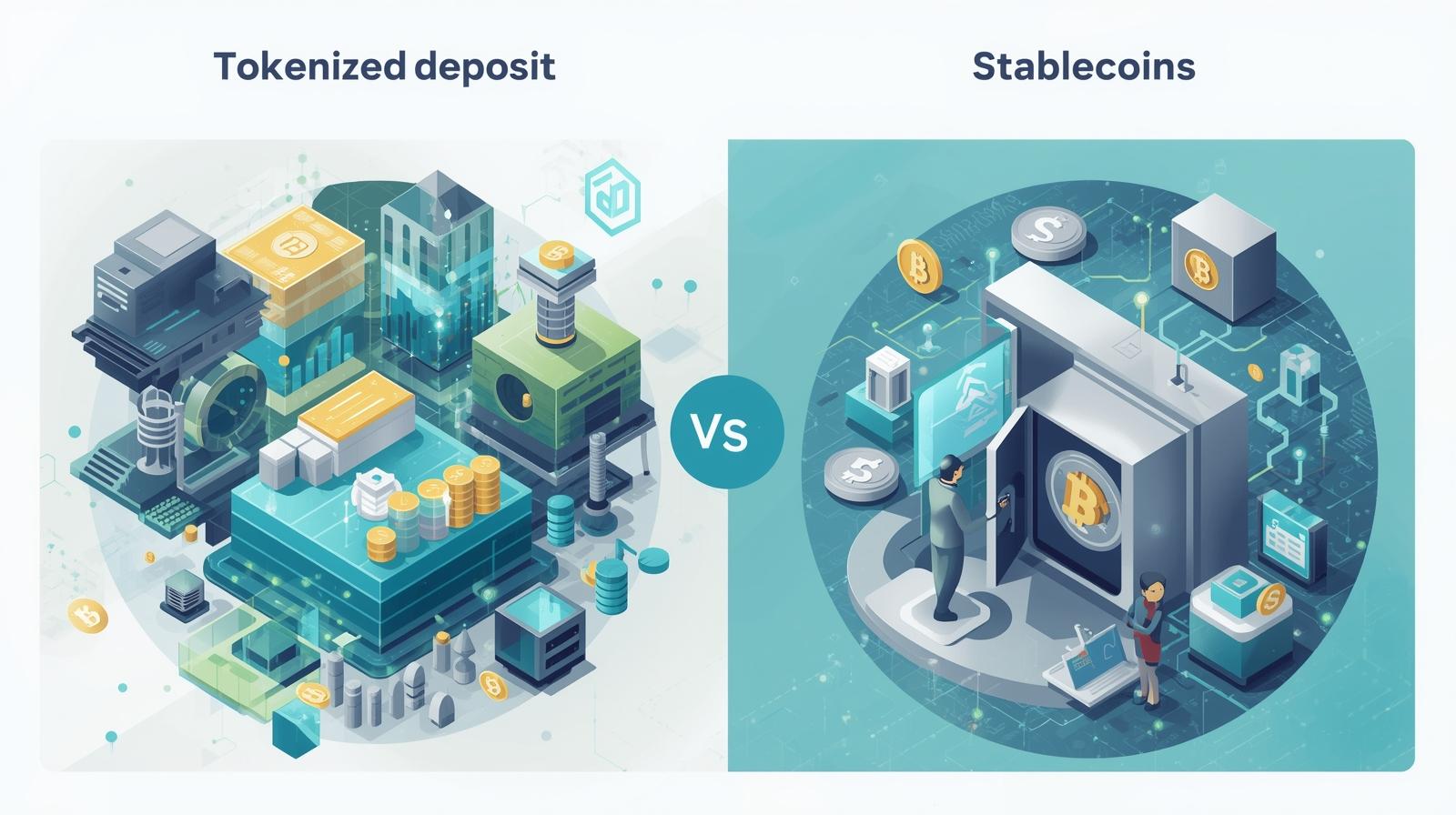
Digital money adoption is surging. Stablecoins settled over $10 trillion in transactions in 2023, surpassing Visa’s annual settlement volume. Meanwhile, banking giants are piloting tokenized deposit systems to modernize institutional finance. JPMorgan’s production-tested rollout—explained in depth in Spydra’s analysis of JPMorgan’s tokenized deposits on the Base blockchain—demonstrates how major banks are beginning to integrate tokenized deposits into real-world liquidity flows.
While these two digital money models often appear similar, their structure, regulatory frameworks, and real-world use cases are fundamentally different. This guide outlines those differences clearly and naturally, without unnecessary complexity.
Tokenized deposits are digital representations of bank deposits issued directly by regulated financial institutions. They are essentially your traditional deposits—just encoded on a blockchain. This makes them programmable, faster to settle, and interoperable with other tokenized assets, all while retaining the regulatory and safety frameworks of traditional banking.
Banks prefer this approach because it transforms existing deposits into next-generation digital instruments without altering their liability models. For a deeper breakdown of how tokenized deposits modernize banking, Spydra’s article on how deposit tokenization is reshaping banking gives a clean and practical explanation.
Stablecoins are digital tokens pegged to fiat currencies like USD but issued by private non-bank companies. They run on public blockchains such as Ethereum, Solana, and Tron, making them highly accessible and globally liquid.
They’re popular for:
USDT and USDC dominate the market, processing billions weekly, with stablecoins now accounting for over 11% of crypto’s total market cap.
While both represent digital money, their core differences lie in issuer type, regulatory oversight, and intended use cases.
This alone creates a major trust gap between the two.
Tokenized deposits fall neatly under existing banking regulations. Stablecoins, however, face varied rules across regions—MiCA in the EU, Payment Services Act in Singapore, and evolving frameworks in the U.S.
Tokenized deposits generally operate on permissioned blockchains (or hybrid models).
Stablecoins exist on public blockchains, enabling open participation and global access.
Stablecoin risk hinges on the issuer’s reserve quality—and history shows that poorly managed models (like TerraUSD) can collapse. Tokenized deposits avoid this entirely because the issuing bank guarantees value.
Banks increasingly view tokenized deposits as the most compliant path toward blockchain-based finance.
Tokenized deposits inherit all existing banking compliance frameworks, from KYC/AML to capital requirements.
Banks can incorporate tokenized deposits directly into:
Banks can automate treasury movements, settlements, and payments using smart contracts—something legacy systems struggle to achieve.
As markets move toward tokenized bonds, funds, and securities, banks need settlement assets operating on the same blockchain rails.
Stablecoins fill gaps traditional banking has struggled with.
Stablecoins enable near-instant international transfers, often for under $1, compared to traditional remittance fees of 6%+.
They power:
Stablecoins operate 24/7—banks don’t.
To put it simply:
They complement each other rather than compete head-on.
The answer depends entirely on the use case.
The future of finance will likely depend on a hybrid system, where both forms of digital money coexist.
Yes. Tokenized deposits remain within the regulated banking system. Stablecoins depend on issuer reserves and third-party audits.
They can. JPMorgan’s tests on Base prove it. Spydra covered this in detail in its article on JPMorgan's tokenized deposits on Base, showing how banks may eventually use hybrid-chain environments.
Not uniformly. Regulations differ across regions, making compliance more complex for institutional users.
Stablecoins currently offer faster public settlement, but tokenized deposits can match this speed on permissioned networks.
Mainly for institutional DeFi, where participants operate in permissioned environments.
They will complement—not replace—bank-issued money. Institutional finance will still rely heavily on regulated assets like tokenized deposits.
Yes. They are one of the most efficient settlement assets for tokenized markets, which is why banks are investing heavily in this area.
The debate between tokenized deposits vs stablecoins isn’t about choosing one winner—it's about understanding how each fits into the evolving digital money landscape. Tokenized deposits reshape traditional banking with compliance and efficiency, while stablecoins reshape global payments with speed and accessibility.
Financial institutions that understand the difference between tokenized deposits and stablecoins will be best positioned to navigate the tokenized future.