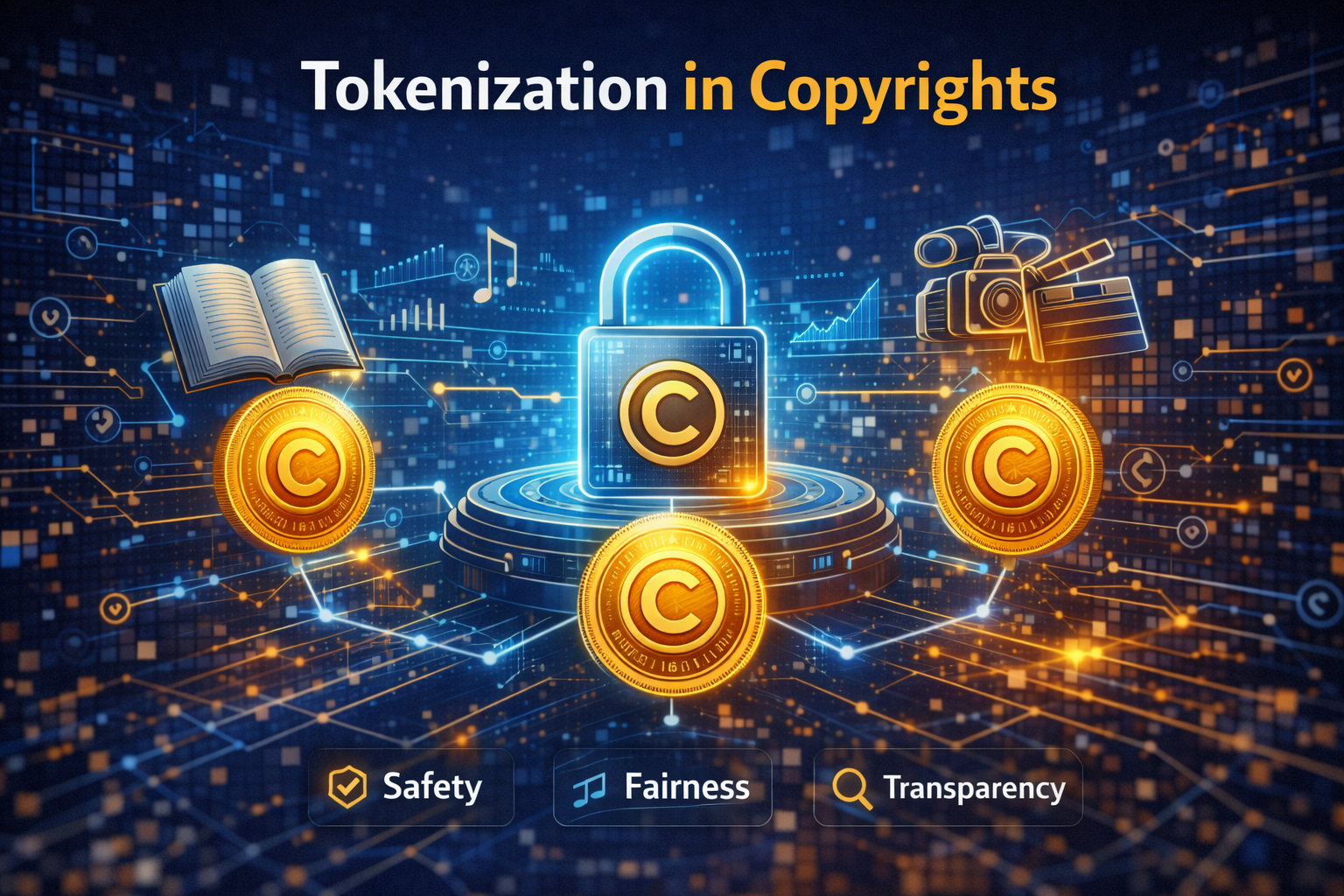
The digital economy has unlocked unprecedented opportunities for creators — but it has also exposed critical weaknesses in traditional copyright systems. Piracy, ownership disputes, royalty mismanagement, and opaque licensing structures continue to undermine creative industries. Tokenization in Copyrights is emerging as a transformative solution, leveraging blockchain infrastructure to secure intellectual property (IP) rights with transparency, automation, and immutability.
As Web3 infrastructure matures, Tokenization in Copyrights is redefining how creators register, monetize, and enforce ownership across global markets.
Tokenization in Copyrights refers to the process of representing ownership rights of creative works as blockchain-based digital tokens. These tokens can encode metadata, ownership rights, licensing conditions, and royalty structures within immutable smart contracts.
Creative assets that can be tokenized include:
Unlike traditional registration systems that rely on centralized databases, blockchain copyright protection ensures that ownership records are permanently stored on a distributed ledger.
It is important to distinguish between an NFT (Non-Fungible Token) and actual copyright ownership. While NFTs can represent proof of authenticity or access rights, copyright ownership involves legal rights such as reproduction, distribution, and public performance.
Tokenization in Copyrights goes beyond collectibles — it embeds enforceable licensing logic directly into smart contracts.
Blockchain provides a tamper-proof ledger. Once a creative work is tokenized and timestamped, the ownership record cannot be altered retroactively.
This eliminates:
Smart contracts automatically distribute royalties based on predefined terms. For example:
This reduces disputes and ensures transparent royalty allocation in real time.
Licensing agreements can be embedded within token logic. When a buyer acquires a token, licensing rights are automatically executed without manual paperwork.
Blockchain provides cryptographic timestamping, which is critical in copyright disputes. Proof-of-creation becomes mathematically verifiable rather than administratively asserted.
The immutable nature of blockchain copyright protection significantly reduces piracy and ownership fraud.
Manual royalty accounting often leads to leakages. Tokenization in Copyrights enables programmatic distribution with minimal human intervention.
Creators can divide rights into fractional tokens, enabling co-ownership and collaborative monetization models.
Traditional copyright ecosystems involve collecting societies, publishers, and distributors. Tokenization streamlines the value chain.
Blockchain networks operate without jurisdictional restrictions, allowing creators to reach global audiences directly.
Music artists can tokenize compositions and automate royalty payments across streaming platforms. This reduces dependency on centralized rights management agencies.
Film producers can tokenize distribution rights, enabling investors to hold fractional revenue shares secured via smart contracts.
Authors can tokenize digital books and embed resale royalties, creating perpetual revenue streams.
Photographers can register timestamped proofs of creation and monetize licensing transparently.
Game developers can tokenize in-game assets and intellectual property rights, creating interoperable digital economies.
While Tokenization in Copyrights offers substantial advantages, several regulatory and operational complexities remain:
Many jurisdictions have yet to define how blockchain-based IP registration interacts with national copyright offices.
Blockchain is borderless, but copyright laws remain territorial.
Smart contracts must align with statutory IP law to ensure enforceability in courts.
The absence of universal standards for intellectual property tokenization may slow adoption.
The rise of the Web3 creator economy is accelerating adoption. As AI-generated content expands, proving authorship will become increasingly critical.
Future developments may include:
Tokenization in Copyrights is positioned to become a foundational layer of digital rights management in the coming decade.
Creative industries represent trillions of dollars in global economic activity. Yet, revenue leakages, disputes, and inefficiencies persist due to outdated infrastructure.
By integrating blockchain copyright protection, smart contracts, and decentralized ownership models, Tokenization in Copyrights enables:
For creators, media companies, and IP lawyers, this shift represents both a technological and structural transformation.
Tokenization in Copyrights is not merely a blockchain trend — it is an architectural redesign of intellectual property management. By embedding ownership rights into decentralized ledgers, creators gain stronger control, faster monetization, and global enforcement capabilities.
As Web3 infrastructure evolves, Tokenization in Copyrights will play a central role in securing creative ownership in the digital age.
Organizations that adopt early will gain competitive advantage in transparency, compliance, and revenue optimization.
It is the process of representing copyright ownership rights as blockchain-based digital tokens secured through smart contracts.
No. It enhances proof of ownership but must align with national copyright laws for full legal recognition.
Blockchain creates immutable, timestamped ownership records that cannot be altered.
Yes. Smart contracts enable automatic royalty distribution based on predefined rules.
Legal recognition varies by jurisdiction. Regulatory frameworks are still evolving.