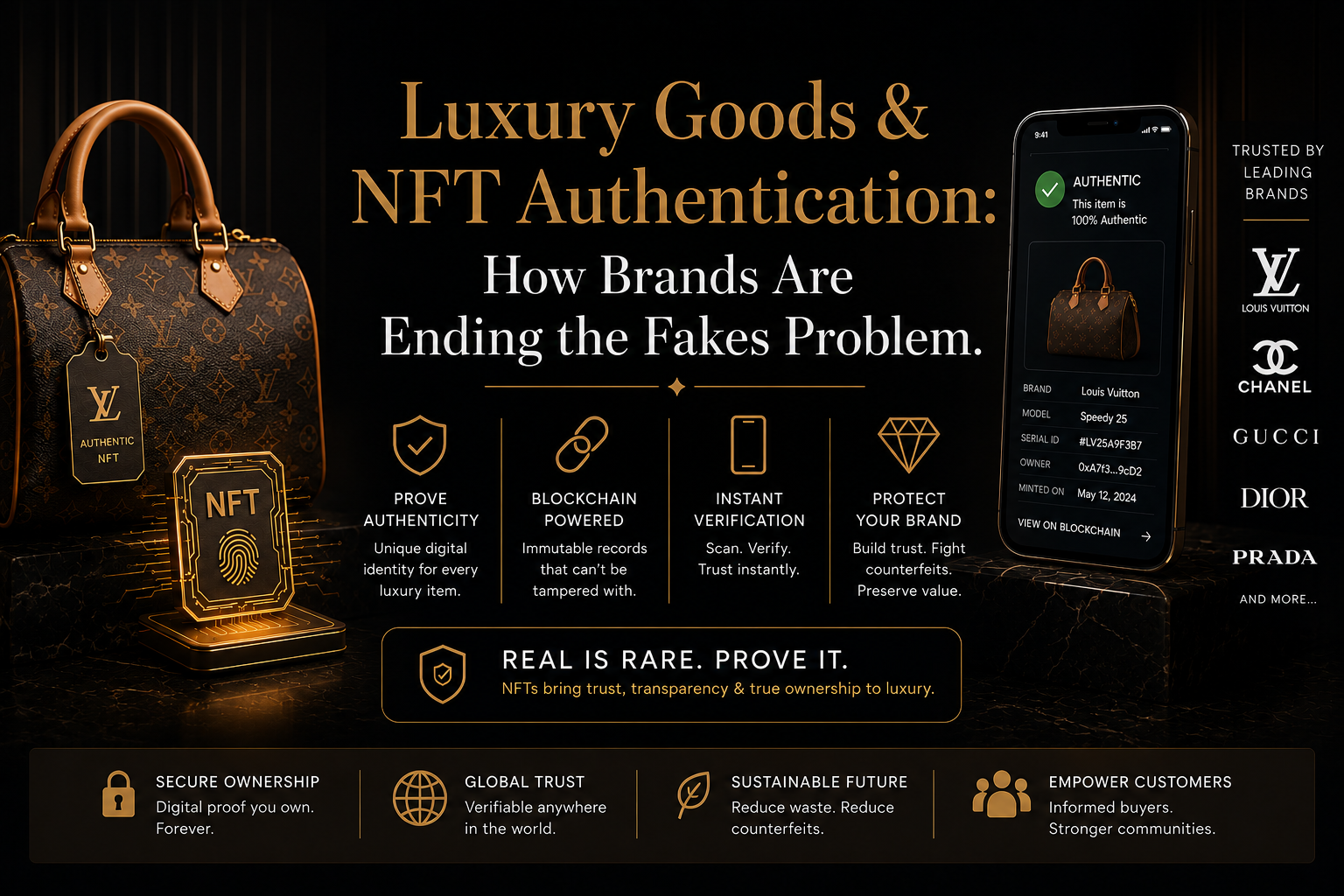
Every year, the luxury industry loses more money to counterfeits than the GDP of a small nation. And for decades, it did almost nothing that worked.
Hologram stickers. Serial numbers. RFID chips. Every solution was deployed with confidence — and defeated, often within weeks. The fakers weren't struggling to keep up. They were ahead. Then came the blockchain.
Blockchain technology has changed the equation entirely. For the first time in the history of luxury goods, brands have access to an authentication mechanism that is not just difficult to fake — it is mathematically impossible to fake. And the industry is moving fast. As we explored in our deep dive on 5 industries disrupted by asset tokenization before 2030, luxury is one of the most visible and high-stakes frontiers of this transformation.
The uncomfortable truth about anti-counterfeiting technology is that every physical solution is eventually reproducible. QR codes get cloned. RFID chips get copied. Even microscopic serial engravings have been matched by sophisticated operations with access to the same industrial lasers the brands use.
A fake handbag can be made to look identical. But a fake NFT certificate of authenticity is, by the mathematics of cryptography, impossible.
— Luxury Digital Strategy Forum, 2024
The token itself is a unique cryptographic record stored on a blockchain — typically Ethereum, or increasingly on purpose-built enterprise chains. For a deep understanding of how enterprise-grade private blockchains underpin this, see our guide on the future of private blockchain and Hyperledger Fabric.
The shift from experimentation to infrastructure is well underway. The blockchain use cases across supply chain and retail — from fintech transformation to jewelry traceability—share the same underlying infrastructure logic powering luxury NFT authentication.
Perhaps the most strategically significant development is the Aura Blockchain Consortium—a rare instance of direct competitors collaborating on shared infrastructure. By 2024, Aura had issued over 40 million digital product passports. The privacy and security architecture of permissioned blockchains like Hyperledger Fabric makes exactly this kind of consortium model possible—where sensitive brand data stays private while the authentication record remains publicly verifiable.
The EU's Digital Product Passport regulation will require product categories to carry digital passports containing sustainability, origin, and authentication data. For luxury brands already building blockchain infrastructure, compliance becomes a competitive advantage rather than a burden.
The most sophisticated brands have realized that a blockchain-linked physical product is something categorically new: a permanent, data-rich relationship with every owner, forever. This mirrors the broader commercial opportunity in how blockchain is transforming fintech—where verifiable, on-chain records unlock revenue models that were structurally impossible in a paper-based world.
The authenticated resale market for luxury goods is projected to reach $70 billion by 2030. Brands have historically captured zero revenue from secondary sales. With NFT-linked products, brands can build royalty structures into smart contracts — converting a previously invisible market into recurring revenue.
An NFT passport creates a verified record of every owner. With consumer consent, brands gain visibility into the full product lifecycle — and the opportunity to engage with secondary buyers who were previously invisible.
The NFT linked to a physical luxury item can unlock digital experiences: brand archives, exclusive events, early product releases, digital twins in virtual environments. This connects directly to the broader evolution of tokenized loyalty programs as the next evolution in retail customer engagement — where blockchain-backed rewards replace points with real, tradeable digital assets.
The cryptographic uniqueness of an NFT is guaranteed. The link between the NFT and the physical item is only as strong as the mechanism connecting them. The security architecture within permissioned blockchains like Hyperledger Fabric ensures that even if the physical link is attacked, the on-chain record itself cannot be tampered with.
Authentication tokens must reference rich product metadata—material provenance, high-resolution imagery, and certification documents. The answer is decentralized file storage. As detailed in our guide on IPFS and decentralized storage for tokenized assets, pinning metadata to IPFS ensures it is permanently accessible, tamper-proof, and not dependent on any single server—critical for a certificate that must remain valid decades into the future.
Brands investing in seamless UX—one-tap NFC verification via a native brand app, no wallet required — are seeing higher adoption than those requiring crypto-native onboarding. Consumer literacy remains uneven, particularly in secondary market channels.
A Breitling passport on Arianee and an LVMH passport on Aura currently operate in separate ecosystems. Cross-chain interoperability standards are an active area of protocol development, with the Aura Consortium actively recruiting additional members.
By 2031, industry analysts expect NFT-linked digital product passports to be standard across all major luxury groups. AI-powered valuation tools are accelerating this further. As explored in our analysis of AI-powered asset tokenization and real-time valuation, combining on-chain provenance with AI-driven appraisal creates a dynamic authentication layer — one where a luxury item's authenticity and fair market value are both verifiable in real time.
How Spydra Powers Luxury Authentication
Spydra's low-code tokenization platform on Hyperledger Fabric gives luxury brands and retailers the infrastructure to issue NFT-linked digital product passports — without deep blockchain engineering.
NFT authentication creates a unique digital certificate for a luxury item on a blockchain. This certificate serves as proof of authenticity, ownership, and provenance, helping brands and consumers combat counterfeit products.
Luxury brands assign a blockchain-based digital identity to each product. Customers can verify authenticity by scanning a QR code, NFC chip, or digital product passport linked to the item's blockchain record.
Yes. Verified ownership history and authenticated provenance can increase buyer confidence in secondary markets, potentially improving the resale value of luxury watches, handbags, jewelry, and collectibles.
A digital product passport is a blockchain-backed record that stores information about a product's origin, manufacturing details, ownership transfers, repair history, and sustainability credentials.
Counterfeit luxury goods cost brands billions of dollars annually. Blockchain authentication helps reduce fraud, improve supply chain transparency, strengthen brand trust, and enhance customer engagement.
NFT-backed authentication allows resale platforms to instantly verify the authenticity and ownership history of products, reducing disputes and counterfeit listings.
High-value items such as designer handbags, luxury watches, fine jewelry, limited-edition sneakers, collectibles, and premium fashion accessories are among the most common use cases.
Unlike paper certificates, blockchain records cannot be easily altered, duplicated, or lost. This provides a more secure and transparent method of proving authenticity and ownership.
Consumers can scan a QR code or NFC tag attached to the product. The linked blockchain record displays verified product information, ownership history, and authenticity details.
NFTs are expected to power digital product passports, authenticated resale ecosystems, customer loyalty programs, exclusive brand experiences, and transparent ownership tracking across the luxury industry.
Yes. Blockchain-based product passports can track sourcing, manufacturing, repairs, and recycling information, helping brands demonstrate sustainability and regulatory compliance.
Brands can integrate blockchain platforms such as Spydra into their supply chains to create digital identities, issue NFT certificates, manage ownership transfers, and support authenticated resale markets.