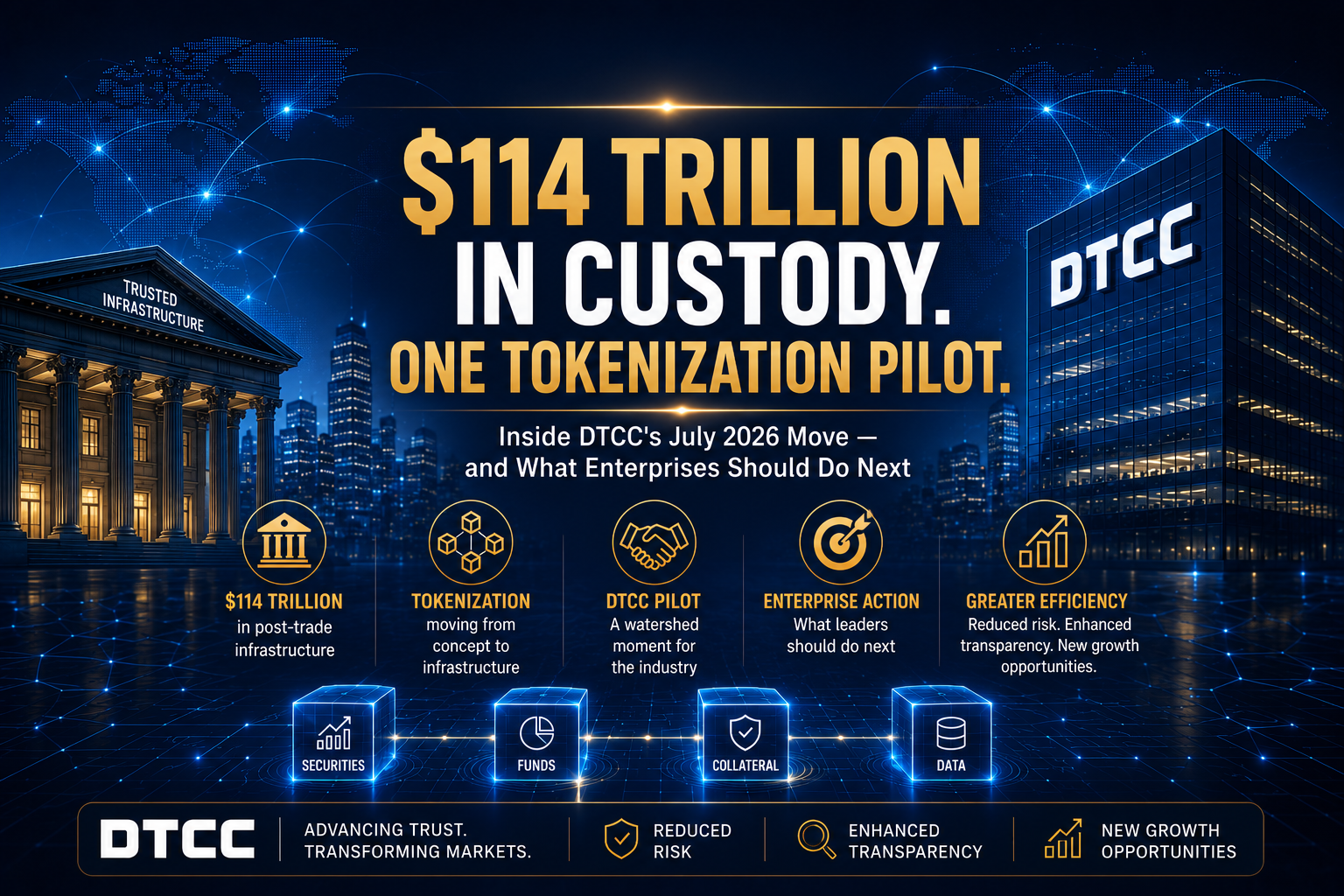
In July 2026, the Depository Trust & Clearing Corporation (DTCC) — the institution that custodies over $114 trillion in U.S. securities — began limited production trades of tokenized Russell 1000 equities, major ETFs, and U.S. Treasuries. More than 50 firms, including BlackRock, Goldman Sachs, JPMorgan, Circle, and Ondo Finance, are part of the working group behind the initiative, with a full commercial launch scheduled for October 2026.
This is not a crypto-native experiment. It is the operator of America's core settlement infrastructure moving tokenization from pilot to production. For CIOs, CTOs, and enterprise architects across banking, insurance, and capital markets, the pilot is a signal that permissioned, compliant blockchain infrastructure has moved from innovation-lab territory to boardroom priority — and that the window to prepare is now, not after the October launch.
Key Takeaways
DTCC's tokenization service, developed by its subsidiary the Depository Trust Company (DTC), lets DTC-custodied assets — Russell 1000 constituents, major index ETFs, and U.S. Treasury bills, bonds, and notes — exist as blockchain-based tokens that carry the same legal ownership rights as their traditional-form counterparts. The service received a defined, three-year authorization from the SEC in December 2025, and July 2026 marks the start of limited production trades under that authorization, ahead of a full commercial rollout in October 2026.
Unlike many earlier real-world asset (RWA) tokenization efforts, DTC's model does not create synthetic exposure to an asset held elsewhere. The token represents legal ownership within an already-regulated depository — the same custody and entitlement structure institutions already trust, expressed on a blockchain-based ledger. That distinction matters enormously for enterprise risk and compliance teams evaluating tokenized securities for the first time.
DTCC is not a startup testing a narrative — its subsidiaries processed U.S. $4.7 quadrillion in securities transactions in 2025 and provide custody for securities from more than 150 countries. When infrastructure at this scale moves toward tokenization, it forces every enterprise touching capital markets, custody, or asset servicing to answer the same question: is our own technology stack ready to interoperate with tokenized rails?
The pilot's working group is itself instructive. It places BlackRock and Goldman Sachs — firms that compete aggressively in public markets — alongside crypto-native infrastructure providers like Circle and Ondo Finance, whose tokenized Treasury products already carry billions in assets under management outside the traditional clearinghouse system. DTCC's move brings both worlds onto a single settlement rail rather than letting them evolve in parallel, which is precisely the interoperability problem enterprise blockchain buyers have struggled with for years.
The July pilot is deliberately testing tokenization's toughest use case first: the most liquid, most actively traded instruments in U.S. capital markets, rather than the illiquid private assets most earlier pilots targeted. Russell 1000 equities, major ETFs, and Treasuries will show whether tokenized settlement can hold up under real market conditions and volume — not just in a sandbox.
This follows closely on two other 2026 regulatory milestones: the New York Stock Exchange announced its own tokenized securities platform in January 2026 and received SEC approval for rule change SR-NYSE-2026-17 in April 2026, clearing the way for 24/7 trading of U.S. listed equities with near-instant settlement and stablecoin-based funding. Nasdaq received similar SEC approval in March 2026 to enable tokenized trading of Russell 1000 stocks and major index ETFs on the same order books as traditional shares, with identical investor rights. Three of the largest names in U.S. market infrastructure moving in the same direction within a single year is a stronger adoption signal than any single vendor announcement.
The lesson for enterprise leaders outside capital markets is not to wait for their own industry's DTCC moment. Financial market infrastructure tends to lead; other sectors — insurance, supply chain finance, manufacturing, real estate — follow within 18 to 36 months once compliant patterns are proven. Spydra's own Financial Assets tokenization solution and enterprise clients such as ICICI Bank, IDFC First Bank, and Bajaj Finserv reflect exactly this pattern: regulated financial institutions adopting permissioned tokenization ahead of the broader market.
Banks are already moving. JPMorgan's Kinexys platform (formerly Onyx) operates across Ethereum, its private Canton network, and Hyperledger Fabric-based systems, and the bank filed for a tokenized Treasury fund in May 2026 designed to enable continuous, 24/7 yield generation on Treasury-backed assets rather than the T+1 settlement of a traditional money-market fund. For mid-market and regional banks without JPMorgan's internal engineering bench, the more realistic path is a permissioned blockchain platform built on Hyperledger Fabric — which already underpins roughly four out of five permissioned enterprise blockchain deployments — paired with a partner that handles token issuance, workflow automation, and compliance tooling out of the box.
Insurance carriers face a parallel opportunity in tokenized policies, parametric payouts, and reinsurance-linked securities. Automating claims triggers through oracle-fed smart contracts — rather than manual adjustor review — can compress payout timelines from weeks to hours for well-defined, data-verifiable events. Spydra's parametric insurance blockchain solution is built around exactly this pattern: off-chain data feeding on-chain settlement logic without exposing sensitive policyholder data on a public ledger.
Tokenization's reach extends well past capital markets. Supply chain finance platforms use tokenized invoices and receivables to unlock working capital for suppliers who would otherwise wait 60-plus days for payment. Manufacturers are tokenizing idle equipment to access financing against underutilized assets. Textile and jewellery supply chains use blockchain-based traceability to combat counterfeiting and prove provenance from source to shelf. The common thread across every vertical is the same: a permissioned ledger that only trusted counterparties can write to, with cryptographic proof that outside auditors and regulators can verify.
The distinction matters more after DTCC's move than before it. DTC's tokenization service is built for a regulated custody environment — a model much closer to permissioned blockchain than to open, anonymous public chains. Recent industry research underscores why: a BeInCrypto and RWA.xyz study published this month found that of roughly $60 billion in tokenized real-world assets across more than 7,000 products, close to $33 billion sits with zero weekly transfer activity, and 97% of tokenized RWA value remains off-limits to U.S. retail investors. Much of that stagnation traces back to assets issued on public rails without a clear regulatory or distribution framework behind them — exactly the gap permissioned infrastructure is designed to close.
Smart contracts are the enforcement layer that makes tokenization operationally useful rather than just a digital record. In practice, this means automating dividend and coupon distribution, enforcing transfer restrictions for accredited-investor-only assets, and triggering settlement the moment two counterparties' conditions are met. Spydra's Custom Chaincode and Workflows modules let enterprises encode these rules without hand-writing Solidity or hiring a dedicated blockchain engineering team for every use case.
Real-world asset (RWA) tokenization converts rights to a physical or financial asset — equity, debt, real estate, commodities, receivables — into a digital token on a blockchain. The token doesn't replace the legal claim; it represents it, recorded in a form that can be transferred, fractionalized, and settled programmatically. The market has moved well past pilot status: tokenized credit instruments (private credit, on-chain lending, corporate bonds, and structured debt) now exceed $31 billion outstanding, according to BeInCrypto and RWA.xyz data, held across nearly 185,000 addresses. Figure Technologies' tokenized home-equity line of credit (HELOC) product alone reached roughly $20.1 billion by early July 2026 — more than every tokenized U.S. Treasury combined. Tokenized credit has quietly become the largest non-stablecoin tokenized asset category, ahead of the Treasuries that first proved the model out.
Hyperledger Fabric remains the dominant permissioned framework for enterprise deployments — powering an estimated 80% of permissioned enterprise blockchains, by industry analyst estimates — precisely because it supports private channels, pluggable consensus, and fine-grained access control that public chains weren't designed for. Spydra's Token Engine and Listeners sit on top of Fabric to give enterprises issuance, monitoring, and event-driven automation without needing an in-house Fabric engineering team.
DTC's authorization came through a defined, three-year SEC No-Action Letter — a reminder that even the most credible institutional pilots operate inside explicit regulatory guardrails, not around them. Enterprises evaluating tokenization should expect a similar posture: engage regulators early, scope pilots to well-defined asset classes, and build compliance enforcement into the technology layer itself rather than treating it as a downstream audit function.
The right partner brings more than a blockchain SDK. Look for demonstrated enterprise clients in regulated industries, a permissioned architecture built for compliance from the ground up, and certifications that procurement and risk teams will actually recognize — ISO 27001, ISO 9001, SOC 2, GDPR alignment, and CMMI Level 3 process maturity are reasonable baseline requirements for any vendor handling institutional or financial data on-chain.
The gap between the July pilot and the October 2026 commercial launch is roughly three months — not much runway for an enterprise starting infrastructure evaluation from zero. Coinbase and EY's 2026 institutional survey found that 67% of institutions now prioritize asset tokenization over the next three to five years, up from earlier years' more tentative interest. Enterprises that begin scoping their own tokenization use case now, rather than after October, will be positioned to move alongside the market rather than react to it. Spydra's solutions consultancy team works with enterprises specifically on this early-stage scoping and pilot design.
Citi Institute's June 2026 'Tokenization 2030' report projects the global tokenized asset market growing from roughly $17-25 billion today to $5.5 trillion by 2030 in its base case, with a bull scenario reaching $8.2 trillion — a compounding shift, not a one-time event. U.S. Treasuries currently represent over half of tracked tokenized value and remain the segment closest to production-grade maturity, but tokenized credit has already overtaken Treasuries in outstanding value, and equities are the newest frontier following the DTCC, NYSE, and Nasdaq approvals. The direction across every data source points the same way: tokenization is moving from adjacent experiment to core capital-markets infrastructure.
DTCC's July 2026 tokenization pilot is the clearest signal yet that enterprise blockchain adoption has moved from proof-of-concept to production infrastructure. Businesses that treat this as a capital-markets-only story will be caught flat-footed when the pattern repeats in their own industry within the next 18 to 36 months. The enterprises that prepare now — assessing use cases, choosing compliant permissioned infrastructure, and running contained pilots — will be positioned ahead of the next wave rather than scrambling to catch up to it. Schedule a blockchain consultation with Spydra to assess where tokenization fits your enterprise roadmap.
Ready to Explore Enterprise Tokenization?
For asset classes with slow settlement, manual reconciliation, or illiquidity, yes — the ROI case rests on measurable reductions in settlement time, reconciliation cost, and counterparty risk, not on blockchain as a standalone goal.
Cost varies widely by scope, but a contained pilot on an existing permissioned platform is typically far less expensive than building custom infrastructure from scratch, since issuance, workflow, and compliance tooling can be configured rather than engineered.
It sets a template — regulated custody plus tokenized settlement — that other custodians, exchanges, and banks are likely to follow, raising the bar for what counterparties will expect from institutional infrastructure.
Banking, insurance, real estate, supply chain finance, manufacturing, pharma, and jewelry/gemstones all have live, in-production tokenization use cases today.
A scoped pilot on an existing permissioned platform can go live in weeks to a few months; enterprise-wide rollout typically follows a phased, multi-quarter roadmap.
Permissioned frameworks such as Hyperledger Fabric are generally preferred for regulated, institutional use cases requiring private channels and fine-grained access control.
Hyperledger Fabric suits use cases needing permissioned access and data privacy between known counterparties; Ethereum and similar public chains suit use cases prioritizing broad public liquidity and composability.
They typically cover use-case assessment, token and workflow design, compliance mapping, pilot delivery, and integration with existing core systems.
By defining the legal structure behind the token, choosing a permissioned or public issuance model, and building the compliance and workflow logic that governs transfers before launching a pilot.
Prioritize demonstrated enterprise clients in regulated sectors, a permissioned-first architecture, and recognized certifications such as ISO 27001, SOC 2, and GDPR alignment.