Executive Summary
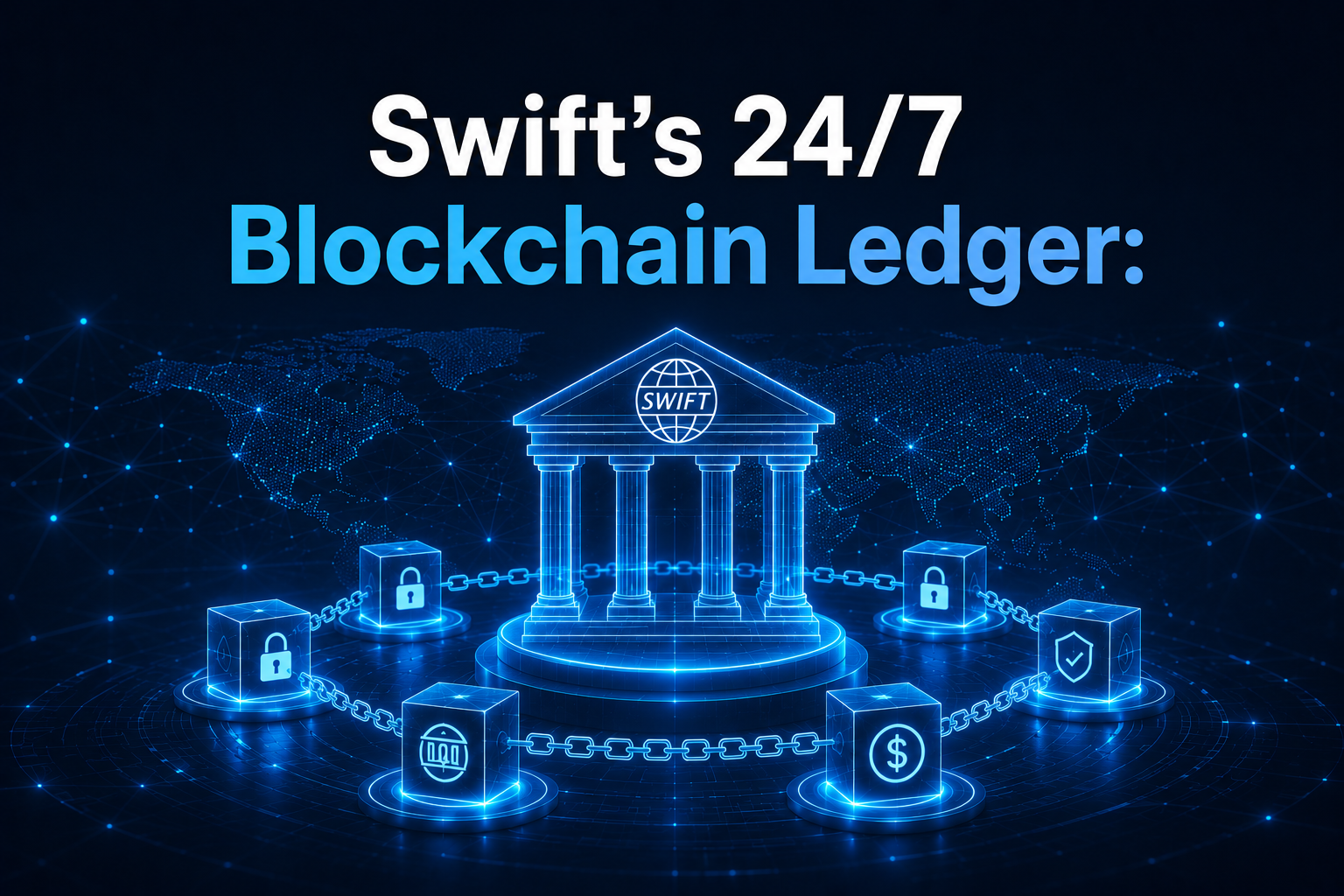
On July 9, 2026, Swift — the bank-owned messaging network connecting more than 11,500 financial institutions worldwide — confirmed its new blockchain-based shared ledger is ready for initial use by 17 banks across six continents, including HSBC, UBS, Citi, Wells Fargo, BNP Paribas, and BNY. The ledger lets banks move tokenized deposits for corporate customers overnight and on weekends, with final settlement still running through Swift's existing payment rails.
This is a materially different signal than a crypto-native stablecoin project: it is the incumbent global payments messaging utility, owned and governed by its member banks, extending always-on availability to regulated digital money. For CIOs, treasurers, and enterprise architects at banks and large corporates, it marks the point where tokenized infrastructure stops being an alternative to correspondent banking and starts becoming an extension of it.
Key Takeaways
Swift first announced the development of a shared blockchain ledger platform in October 2025, positioning it to let banks settle transactions involving stablecoins and tokenized assets across multiple blockchains—working alongside existing payment rails rather than replacing them. On July 9, 2026, Swift confirmed the ledger is ready for initial use, with 17 banks across six continents preparing to test live transactions. Swift's chief business officer, Thierry Chilosi, described the move as extending the trust and stability of established finance into the frontier of digital money.
The design is deliberately conservative in one respect: funds can move for customers overnight and on weekends using tokenized deposits, but final settlement still occurs through Swift's existing payment infrastructure. That structure is the core of the story—this is 24/7 availability layered onto regulated rails, not a replacement of them.
Swift's network already moves money between more than 11,500 financial institutions and reportedly delivers 75% of payments to beneficiary banks within 10 minutes. The gap it hasn't closed until now is time: weekends, holidays, and overnight windows where corporate treasury teams have simply had to wait. Tokenized deposits close that gap without asking banks to trust an unfamiliar rail—the ledger sits on top of infrastructure banks already use daily. For enterprises managing multi-currency treasury operations through Spydra's Financial Assets solutions, the practical impact is fewer idle-cash windows and less working capital trapped in transit over a weekend.
A tokenized deposit is a digital representation of commercial bank money — not a stablecoin issued by a third party, and not a cryptocurrency. The issuing bank still holds the underlying deposit; the token is simply a blockchain-native instruction that can move continuously, including outside normal banking hours. Swift's ledger acts as the shared layer connecting each bank's own tokenized-deposit ledger to every other participating bank's, so a payment initiated at 11 p.m. on a Saturday from a bank in Singapore can reach a beneficiary bank in London before Monday's market open, with final settlement completing once traditional rails reopen.
The roster spans six continents, and the group has been shaping the ledger's design since Swift's October 2025 announcement — a working-group model that mirrors how DTCC structured its own tokenized-securities pilot earlier this year.
Stablecoin issuers already offer transfers that can settle outside banking hours, and several corporates have used them for exactly that reason. But banks have consistently pointed to regulatory, compliance, and risk-control gaps as reasons to prefer tokenized deposits on bank-led infrastructure instead. A tokenized deposit carries the same regulatory status as the bank account behind it; a stablecoin's backing, redemption rights, and issuer solvency sit outside that framework. For enterprises with compliance and audit obligations, that distinction is often decisive.
Cross-border payments have long been slow, manual, and loaded with FX spread and settlement risk, particularly through correspondent banking chains that route a single payment through several intermediary banks. Swift's tokenized-deposit ledger doesn't eliminate correspondent banking, but it compresses the time cost of the weekends and holidays that traditionally freeze that chain entirely. For enterprises running 24/7 global operations—manufacturing, logistics, e-commerce—that compression translates directly into working-capital efficiency.
The same 24/7, always-on principle extends well past bank-to-bank payments. Supply chain finance platforms built on tokenized receivables and supply chain finance infrastructure already move working capital faster than traditional invoice cycles; layering continuous settlement underneath that model compounds the benefit further. Central banks exploring their own digital currencies face a parallel design question, which is precisely what Spydra's CBDC solution is built to address—modernizing banking infrastructure without displacing existing monetary and regulatory frameworks.
Swift explicitly designed the ledger to support regulated digital money and tokenized assets across multiple blockchains, working alongside current payment rails rather than replacing them. That is a permissioned-first posture, not a public-chain one—participant banks are known, vetted, and bound by existing regulatory obligations. It's the same architectural logic underpinning Hyperledger Fabric-based enterprise deployments: known participants, private channels, and programmable rules enforced at the ledger layer rather than relied upon after the fact.
Once deposits are tokenized, treasury operations that previously required manual intervention—batch payment releases, FX conversion triggers, intercompany settlement—become candidates for automation. Spydra's Workflows and Custom Chaincode modules let enterprise treasury teams encode these rules directly, so a weekend payment release can trigger automatically once predefined conditions are met, without waiting for a Monday-morning manual review.
The lesson here mirrors the pattern seen across 2026's other major tokenization milestones: incumbents, not challengers, are setting the pace. Swift is owned by its member banks; DTCC is Wall Street's own clearinghouse. When infrastructure this deeply embedded moves toward tokenization, it signals that the technology has cleared the bar for institutional trust — and that waiting for a competitor to move first is no longer a viable strategy.
Hyperledger Fabric continues to power an estimated 80% of permissioned enterprise blockchain deployments, precisely because it supports private channels and fine-grained access control that a bank-led, permissioned ledger like Swift's requires. Spydra's Token Engine and Listeners give enterprises the issuance and real-time event monitoring layer needed to plug into shared ledgers like Swift's without building that integration from scratch.
Swift's approach—regulated digital money, bank-issued, settling on existing rails—is designed to sit inside current banking regulations rather than push against them. That's a deliberate contrast to stablecoin models still working through jurisdiction-by-jurisdiction regulatory clarity. Enterprises evaluating tokenized-deposit readiness should expect their own regulators to treat bank-issued tokenized deposits as an extension of existing deposit and payments regulation, rather than a novel asset class requiring new rules from scratch.
Banks and large enterprises evaluating a tokenization partner for this shift should look for proven permissioned-ledger deployments in regulated industries, interoperability with existing core banking and treasury systems, and certifications procurement teams will recognize — ISO 27001, ISO 9001, SOC 2, GDPR alignment, and CMMI Level 3 process maturity are reasonable baseline expectations for any vendor touching institutional payment data.
Swift's ledger is live for 17 banks today, and its member-bank governance model means adoption is likely to widen faster than a purely commercial vendor rollout would. Enterprises with treasury operations spanning multiple currencies and time zones should treat this the way they'd treat any core infrastructure shift from a utility they already depend on: evaluate readiness now, rather than after competitors have already captured the working-capital efficiency gains. Spydra's solutions consultancy team works with banks and enterprises specifically on this kind of early infrastructure readiness assessment.
Swift's move sits alongside a broader 2026 pattern: DTCC tokenizing equities and Treasuries, the U.S. and U.K. coordinating a cross-border tokenization rulebook, and multiple central banks piloting CBDC infrastructure. Each is converging on the same underlying shift — regulated money and securities becoming always-on, programmable, and interoperable across institutions, without abandoning the compliance frameworks that took decades to build. The direction is consistent: 24/7 availability is becoming the baseline expectation for institutional finance, not a competitive differentiator.
Swift's 24/7 blockchain ledger is a milestone precisely because of who's behind it: not a crypto-native challenger, but the bank-owned utility that over 11,500 financial institutions already depend on. For enterprise banking and treasury leaders, the message is straightforward—always-on, tokenized infrastructure is no longer a future consideration; it is live, bank-led, and being tested by some of the largest names in global finance right now. Schedule a blockchain consultation with Spydra to assess how tokenized-deposit and treasury infrastructure fits your enterprise roadmap.
Ready to Explore Enterprise Tokenization?
For enterprises with multi-currency, multi-timezone treasury flows, yes—the ROI case rests on recovering weekend and overnight settlement delay, not on blockchain as a standalone goal.
Digital representations of commercial bank money, issued by the bank itself, that can move continuously across a shared ledger while final settlement still ties back to existing regulated payment rails.
Swift's ledger moves bank-issued tokenized deposits under existing banking regulation, while stablecoins are issued by third parties operating under a separate, still-evolving regulatory framework.
HSBC, UBS, Citi, Wells Fargo, BNP Paribas, and BNY are among the 17 banks across six continents preparing to test live transactions.
A scoped pilot integrating with existing treasury management systems can go live in weeks to a few months, with wider rollout following a phased, multi-quarter roadmap.
Permissioned frameworks such as Hyperledger Fabric are generally preferred for regulated, institutional use cases requiring private channels and fine-grained access control.
No—Swift's ledger works alongside existing payment rails, adding always-on availability rather than replacing correspondent banking relationships.
They typically cover use-case assessment, tokenized-deposit and workflow design, compliance mapping, pilot delivery, and integration with existing core banking systems.
By mapping which treasury flows lose the most value to weekend and overnight delay, then piloting tokenized-deposit integration with a contained set of currency corridors.
Prioritize demonstrated deployments in regulated financial services, a permissioned-first architecture, and recognized certifications such as ISO 27001, SOC 2, and GDPR alignment.