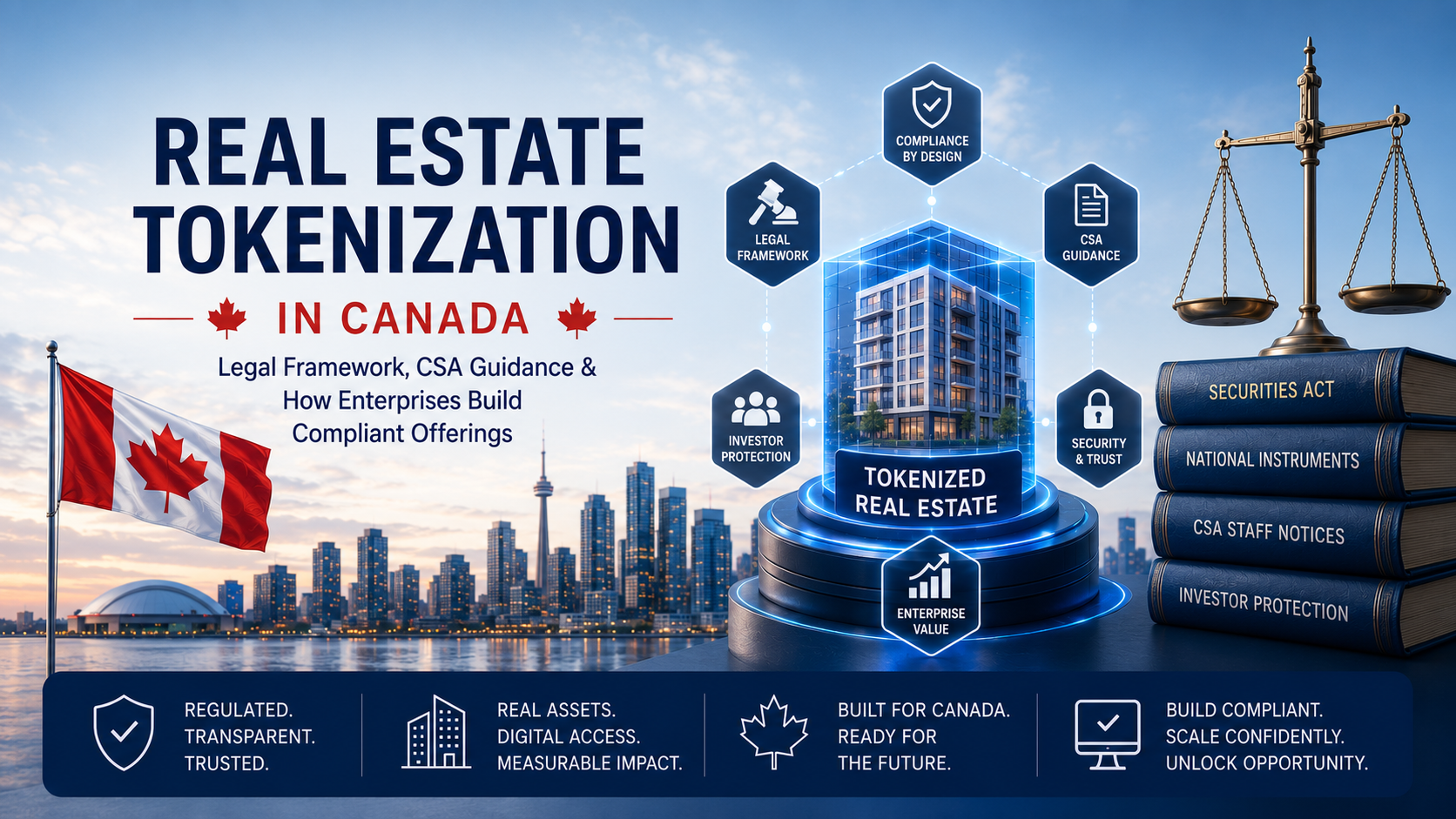
Real estate tokenization in Canada is being asked a more specific question in 2026 than it was a year ago. It is no longer "Can this property be put on a blockchain?" but "What legal structure, compliance program, and technology stack will hold up once the Canadian Securities Administrators, provincial land registries, and OSFI start paying closer attention to tokenized real estate?" That shift matters, because it is regulators, not technologists, who are now setting the pace for real estate tokenization in Canada.
In 2026 the Bank of Canada, RBC Capital Markets, TD Bank Group, and Export Development Canada completed a pilot that produced the country's first tokenized bond, settled using a wholesale digital central bank currency. Weeks later, the CSA opened Project Tokenization, a Collaboratory initiative that convened fintechs, financial institutions, and legal professionals in Calgary and Toronto to work through how tokenized financial products, including tokenized real estate and other real-world asset (RWA) tokenization models, intersect with existing securities law. Real estate tokenization in Canada has been part of that conversation from the start, because it combines high asset value, provincial land title rules, fractional ownership, and securities law in a single digital asset structure.
This guide walks through what real estate tokenization in Canada actually represents in legal terms, how the CSA and OSFI are currently treating tokenized property structures, the ownership models issuers are using for Canadian real estate tokenization, and why the underlying blockchain infrastructure needs to be built for compliance from day one rather than retrofitted later. Along the way, we cover the semantic building blocks of the space—fractional ownership, digital securities, permissioned blockchain networks, and smart contract compliance—so property owners, developers, and investors evaluating real estate tokenization in Canada have a single, current reference.
A token has no independent legal status. Its value comes entirely from the rights attached to it and the structure that creates those rights. In Canada, provincial land title systems remain the sole authoritative record of legal ownership of real property, and no blockchain record—however sophisticated the digital asset—replaces that registry. This is the starting point for any discussion of real estate tokenization in Canada.
Real estate tokenization in Canada is therefore built around a special-purpose entity—typically a corporation, limited partnership, or trust—that holds legal title to the property. Investors acquire tokens representing shares, partnership units, or trust units in that entity, not a direct claim on the land itself. The property continues to be administered through the applicable provincial framework, while the blockchain layer handles investor onboarding, transfer approvals, distributions, and recordkeeping for the tokenized property interest. Ineffect, Canadian real estate tokenization layers digital ownership and fractional ownership mechanics on top of a conventional real estate holding structure, rather than replacing it.
Key Takeaway
A token is an administrative wrapper around an existing legal interest, not a new form of Canadian property ownership. Investor rights live in the governing agreements—subscription documents, shareholder or partnership agreements, and trust deeds—not in the smart contract.
The choice between a corporation, limited partnership, or trust drives governance, taxation, financing, and transfer restrictions for any real estate tokenization in a Canadian program. It should be settled before any blockchain architecture, token standard, or smart contract logic is designed.
Whichever wrapper is used, the governing documents need to spell out economic entitlements, voting rights, investor eligibility, approved-transfer procedures, and how blockchain records reconcile with the entity's official register if a discrepancy ever arises. Getting this right is what separates a durable real estate tokenization inCanada offering from a purely technical experiment.
The Canadian Securities Administrators continue to apply existing securities law principles to real estate tokenization in Canada rather than writing a separate tokenization statute. Under CSA Staff Notice 46-308, a token will generally be treated as a security where it involves an investment of money in a common enterprise with an expectation of profit from the efforts of others—the label attached to the token does not change that analysis. In practice, most tokens representing fractional interests in real estate will be securities, which means prospectus requirements, available exemptions such as the accredited investor or offering memorandum exemption, and dealer or adviser registration obligations all remain in play for any tokenized real estate offering.
Project Tokenization, run through the CSA Collaboratory, is the clearest signal yet of where policy on real estate tokenization in Canada is heading. Workshops held in Calgary in April 2026 and Toronto in June 2026 brought together fintechs, issuers, custodians, and legal professionals to work through friction points between tokenized products and current securities rules, with further phases expected to include discussion papers and live testing of tokenized instruments. Separately, federally regulated financial institutions are now operating under updated prudential guidance aligned with Basel Committee standards, which caps exposure to higher-risk crypto-assets at 5% of Net Tier 1 capital—a detail that thatmatters for any lender asked to finance a Canadian real estate tokenization structure.
None of this replaces the fundamentals: transfer restrictions, suitability requirements, know-your-product obligations, and ongoing disclosure continue to apply to real estate tokenization in Canada exactly as they would to a traditional offering.
For real property, the provincial land title registry remains the controlling record. For interests in the holding entity, the issuer's own share, unit, or partnership register is authoritative. Blockchain activity is a supporting layer in any real estate tokenization in Canada program—it should make onboarding, compliance checks, and distributions more efficient, but the legal documentation needs to state explicitly how on-chain activity reconciles with those official records and what happens if the two ever diverge: an incorrect transfer, a lost access credential, or a change in investor information.
Tax treatment follows the structure, not the token. An interest in a corporation, a limited partnership, a trust, or a debt instrument secured by real estate each carries different consequences for income distributions and capital gains under a real estate tokenization in Canada program. Cross-border investor participation adds withholding tax, foreign-investor eligibility, and multi-jurisdiction reporting questions that should be modeled before the offering launches, not after the first distribution.
Smart contracts can enforce eligibility checks, transfer restrictions, and distribution logic, but only if they are built to reflect the legal terms rather than simplified into "anyone can transfer at any time” code. This is where the choice of blockchain infrastructure has real consequences for real estate tokenization in Canada.
A permissioned network such as Hyperledger Fabric gives issuers direct control over who can transact, which is difficult to replicate cleanly on a fully public chain built for anonymous participation. Spydra's asset tokenization platform is built on Hyperledger Fabric for exactly this reason and maps the operational needs of real estate tokenization in Canada onto specific capabilities:
● Token Engine handles the fractionalization and issuance of tokens representing shares, LP units, or trust units in the holding entity, with fungible and non-fungible token models available depending on how the real estate tokenization in Canada structure is designed.
● Workflows automate the business rules behind distributions, payouts, and pay-ins, so returns on tokenized property are calculated and released on the schedule set out in the governing agreements rather than through manual processing.
● Oracles bring off-chain data—rental income, occupancy rates, comparable sales, and valuation updates—onto the ledger, keeping investor-facing NAV figures for the tokenized real estate aligned with the underlying asset's actual performance.
● Listeners flag critical on-chain events in real time, supporting the audit trail and reconciliation processes that tie blockchain records back to the entity's official registers.
Where Spydra Fits
For issuers structuring a corporation, limited partnership, or trust to hold a Canadian property, Spydra's real estate tokenization platform provides the permissioned blockchain infrastructure to enforce those legal terms at the token level, with certifications—ISO 27001, ISO 9001, SOC 2, GDPR, and CMMI Level 3—that institutional counterparties and lenders typically ask to see before signing off on a real estate tokenization in Canada structure.
● Define the commercial objective first—raising capital, expanding the investor base, or modernizing administration are different problems with different structures for real estate tokenization in Canada.
● Select the ownership vehicle (corporation, LP, or trust) before designing any technology.
● Determine whether the offering is a private placement to a limited group or part of a broader tokenized property platform, since the two paths carry different registration and marketplace obligations.
● Build governance documents that address transfers, valuation methodology, reporting frequency, and reconciliation between blockchain and legal records.
● Engage real estate counsel, securities counsel, tax advisors, and the technology provider together, from the outset, rather than sequentially.
● Confirm the tokenization platform can enforce investor eligibility and transfer restrictions at the infrastructure level rather than relying on manual compliance checks layered on top.
Tokenization does not manufacture a market on its own. Real estate has historically been illiquid because of transaction size, valuation complexity, and limited transferability, and a digital wrapper does not remove those characteristics from real estate tokenization in Canada. Meaningful secondary trading still depends on investor demand, regulatory clarity, and custody infrastructure—issuers should treat tokenized real estate as a tool for better administration and broader access, not a guaranteed liquidity event.
Real estate tokenization in Canada is the process of representing an economic or equity interest in a property—held through a corporation, limited partnership, or trust—as a digital token on a blockchain, while legal title remains with the provincial land registry system.
No. Provincial land title registries remain the authoritative record of legal title. A token used in real estate tokenization in Canada typically represents an interest in a corporation, limited partnership, or trust that holds the property, not a direct claim to the corporation itself.
In most cases, yes. The Canadian Securities Administrators apply a substance-over-form test, so a token that gives investors an expectation of profit from the efforts of others will generally be treated as a security regardless of how it is labeled.
Through Project Tokenization and the CSA Collaboratory, the CSA has run stakeholder workshops in 2026 to examine how tokenized financial products, including real estate tokenization in Canada, intersect with existing securities laws, with further guidance expected as the initiative matures.
No. Tokenization can streamline administration and transfers, but meaningful secondary trading still depends on investor demand, regulatory clarity, custody infrastructure, and the characteristics of the underlying asset.
A permissioned network lets issuers enforce investor eligibility, transfer restrictions, and jurisdictional rules directly at the infrastructure layer, which aligns more naturally with the compliance obligations that apply to real estate tokenization in Canada than a fully public chain.
Real estate tokenization in Canada is a legal and commercial structuring exercise that happens to be supported by blockchain technology, not the other way around. The strongest real estate tokenization in Canada offerings start with a clearly defined ownership structure and enforceable investor rights, stay ahead of CSA guidance as Project Tokenization develops through 2026, and run on infrastructure built to enforce compliance rather than bolt it on afterward.
Spydra works with enterprises across financial assets, real estate, and other regulated asset classes to build permissioned, Hyperledger Fabric-based tokenization programs with the compliance controls institutional stakeholders expect from real estate tokenization in Canada. To see how Token Engine, Workflows, and Oracles apply to a specific property or portfolio,
Book a demo with Spydra's team or explore the full real estate tokenization solution.