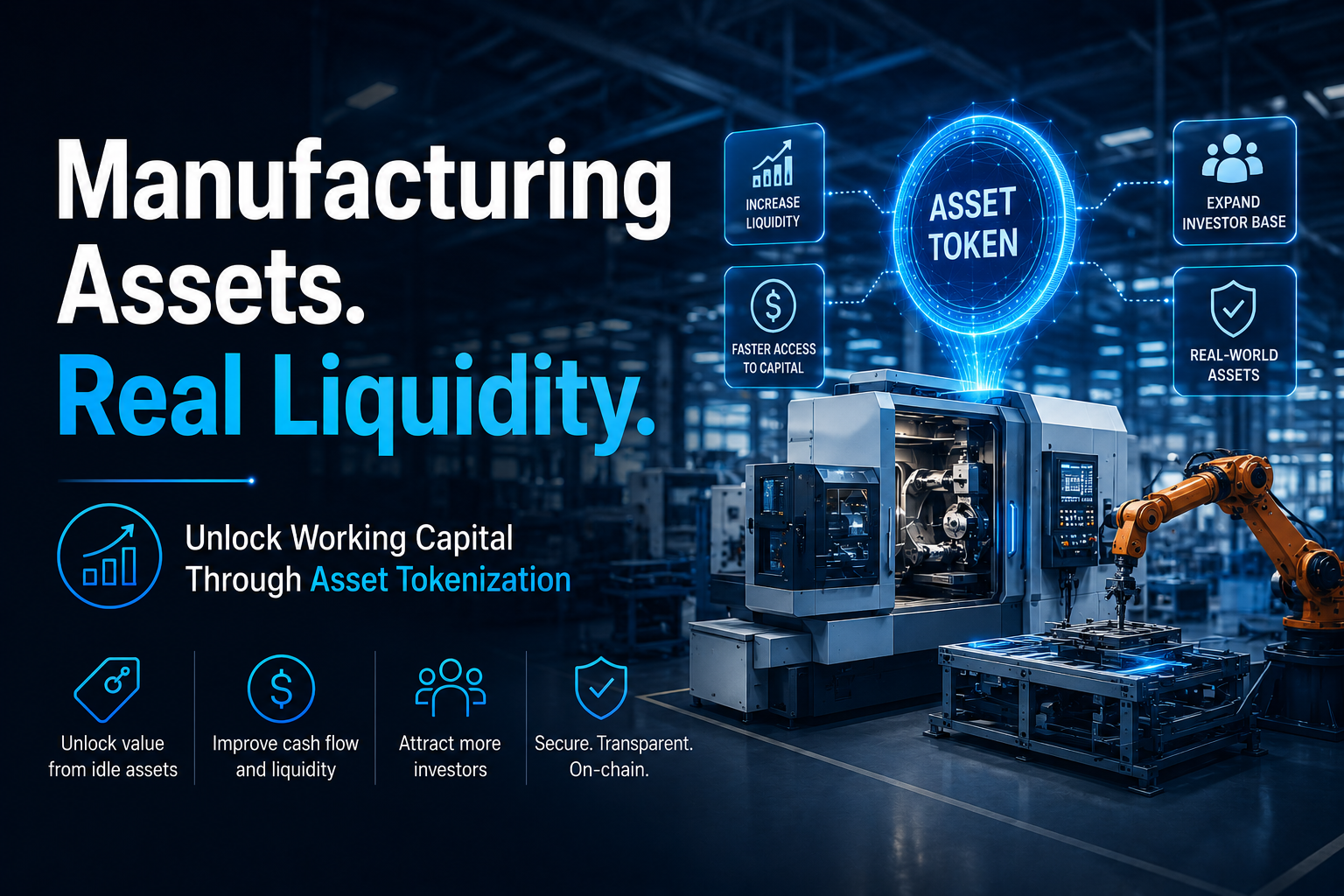
For most manufacturers, the factory floor tells two stories simultaneously. The first is the familiar one: machinery humming, production lines moving, output accumulating. The second is quieter and far more expensive — rows of CNC machines sitting idle between production runs, forklifts parked for entire shifts, injection moulding equipment depreciating on the balance sheet without generating a single rupee of return. This second story represents a massive, mostly invisible working capital problem that
asset tokenization is now uniquely positioned to solve.
Global manufacturing capacity utilization typically hovers between 75% and 85%, meaning that at any given moment, as much as 25% of a manufacturer's installed equipment base generates zero revenue. For a mid-sized manufacturer with Rs. 50 crore in machinery, that translates to Rs. 10–12 crore in dormant capital — capital that could otherwise fund raw material procurement, expansion, or R&D. Asset tokenization on permissioned blockchain networks like Hyperledger Fabric offers manufacturers a direct path from idle asset to active liquidity, without traditional bank dependency, lengthy approval cycles, or the risk of losing control over their equipment.
"The asset tokenization market is projected to grow from USD 2.06 trillion in 2024 to USD 41.94 trillion by 2032 at a CAGR of 45.83% — and manufacturing equipment is emerging as one of its fastest-growing underlying asset classes." — SNS Insider
Most manufacturers understand depreciation as an accounting concept. Fewer internalize it as a cash flow crisis. When a piece of equipment sits unused, it simultaneously loses book value, incurs maintenance costs, consumes floor space, and provides no return on the capital that purchased it. In fact, industry analysis consistently shows that underutilized machinery is one of the leading drivers of poor working capital ratios in asset-heavy sectors.
The problem compounds further when manufacturers need short-term liquidity. Conventional lenders demand lengthy appraisals, credit histories, and collateral structures that rarely reflect the true operational value of specialized equipment. By the time approvals come through — often weeks or months later — the working capital gap has widened. This is precisely the structural inefficiency that asset tokenization addresses head-on.
Asset tokenization is the process of converting a physical asset — in this case, manufacturing equipment — into a digital token on a blockchain network. Each token represents a provable, legally-backed fractional ownership stake or collateral claim against the underlying asset. Token holders can buy, sell, or pledge these tokens, creating a liquid market for what was previously an entirely illiquid asset class.
On Hyperledger Fabric — the enterprise-grade permissioned blockchain on which Spydra's platform is built — this process is executed with full privacy controls, role-based access, and an immutable audit trail. Unlike public blockchains, Hyperledger Fabric allows manufacturers to share asset data selectively: investors see what they need to; competitors and unauthorized parties see nothing. This architecture makes it particularly suited to industrial equipment tokenization, where proprietary production data and asset specifications are sensitive.
Spydra's asset tokenization platform abstracts this technical complexity through a low-code interface, allowing operations and finance teams to tokenize equipment assets without deep blockchain expertise. The process — from asset onboarding to token issuance — that previously required months of custom development can now be completed in days.
The journey from idle equipment to unlocked working capital on Spydra's platform follows a clear, compliance-ready sequence:
Manufacturers using Spydra's asset tokenization platform on Hyperledger Fabric report dramatically faster capital raise cycles compared to traditional equipment financing — with the added benefit of retaining operational control of the tokenized asset throughout.
The table below illustrates the key differences between conventional equipment financing and asset tokenization through Spydra's Hyperledger Fabric platform:
The operational advantage is clear: asset tokenization does not require manufacturers to relinquish equipment control or rely on a single institutional lender. Instead, it opens working capital from a distributed pool of investors while keeping the equipment on the production floor and under the manufacturer's management.
Not all idle equipment is equally tokenizable. The assets that attract the most investor interest share certain characteristics: high residual value, broad applicability across industries, verifiable utilization data, and low technological obsolescence risk. In the manufacturing context, the strongest candidates include:
Spydra's platform supports custom chaincode for each asset class, allowing manufacturers to embed industry-specific parameters — OEE (Overall Equipment Effectiveness) scores, MTBF (Mean Time Between Failures) data, and certification status — directly into the token's metadata, making valuations transparent and auditable for investors. Explore how Spydra's GraphQL data layer makes this on-chain data instantly queryable for reporting and due diligence.
Enterprise manufacturers evaluating blockchain-based tokenization rightly ask: why Hyperledger Fabric, and not a public blockchain? The answer lies in three core enterprise requirements that Hyperledger Fabric uniquely satisfies.
First, privacy. Manufacturing assets carry sensitive information — production capacity, supplier relationships, proprietary process data. Hyperledger Fabric's channel architecture allows the tokenization platform to share asset data with authorized investors without exposing it to competitors or the public network. This is a fundamental architectural advantage over Ethereum or other public chains where all transaction data is globally visible.
Second, performance. Hyperledger Fabric supports thousands of transactions per second with deterministic finality, making it suitable for the high-frequency reporting and settlement operations that accompany active equipment token markets. See how Spydra uses this in supply chain finance scenarios — the same infrastructure applies directly to equipment asset markets.
Third, compliance. Permissioned blockchains enable manufacturers to implement KYC/AML checks, investor accreditation verification, and jurisdiction-specific regulatory controls at the network level. Spydra integrates these compliance layers natively, ensuring that equipment tokenization programs meet Indian and international regulatory standards — a point explored in depth in Spydra's guide to security and privacy in Hyperledger Fabric.
The shift from theoretical to practical is where asset tokenization's value becomes tangible for manufacturing CFOs. When Spydra's tokenization platform is deployed for equipment tokenization, manufacturers typically experience outcomes across three dimensions:
Working Capital Improvement: Capital previously locked in idle equipment becomes accessible without new debt on the balance sheet. For a manufacturer with Rs. 20 crore in underutilized machinery, tokenizing even 30–40% of that asset base can generate Rs. 6–8 crore in liquidity — funds available for raw material procurement, workforce expansion, or technology upgrades. Understand the full scope of benefits of asset tokenization for enterprises of all sizes.
Balance Sheet Optimization: Tokenized equipment can be structured as off-balance-sheet instruments depending on the token's legal structure, improving key financial ratios that lenders and investors track. Explore how asset tokenization integrates with ERP systems to automate this reporting.
Investor Relationship Diversification: Rather than depending on a single bank relationship, manufacturers build a broader capital base — including leasing companies, family offices, and strategic investors — who benefit from the equipment's output through revenue-sharing smart contracts. This mirrors the liquidity model Spydra has applied in real estate tokenization, now extended to industrial assets.
Spydra offers manufacturers a structured onboarding path that minimizes technical complexity and maximizes speed-to-liquidity. The platform's no-code interface handles token creation, investor management, smart contract configuration, and on-chain reporting — all built on Hyperledger Fabric's enterprise-grade infrastructure.
The process begins with an asset audit — identifying which equipment qualifies for tokenization based on value, utilization rate, and investor appeal. Spydra's team then configures the tokenization structure, including fractional ownership parameters, investor rights, and automated distribution schedules. Post-issuance, Spydra's GraphQL-powered data layer and Listener infrastructure ensure manufacturers maintain real-time visibility into token activity without changing existing operational workflows.
With the tokenized real-world asset (RWA) market already surpassing USD 24 billion in 2025 and projected to reach USD 2 trillion by 2030, the manufacturers who tokenize their equipment assets today are not merely solving a working capital problem — they are building the financial infrastructure of the next decade of industrial operations.
Idle equipment is not a manufacturing problem; it is a financial architecture problem. The machinery sitting unused between production runs carries real value — value that traditional financing structures have historically failed to mobilize efficiently. Asset tokenization on Hyperledger Fabric, delivered through Spydra's enterprise platform, changes this equation entirely.
By converting equipment into investable digital tokens, manufacturers access working capital faster, on better terms, without surrendering operational control. The technology is proven, the infrastructure is enterprise-ready, and the market demand from institutional investors for tokenized industrial assets is growing rapidly. The question for manufacturing CFOs and operations leaders is not whether to tokenize — it is which assets to start with. Explore how others have navigated enterprise tokenization challenges and what Spydra's platform delivers in practice.
Ready to unlock the working capital sitting idle in your factory? Explore Spydra's asset tokenization platform and discover how Hyperledger Fabric can transform your equipment into a dynamic financial asset.
Asset tokenization is the process of converting ownership or economic rights of physical manufacturing assets—such as machinery, production lines, or industrial equipment—into digital tokens recorded on a blockchain. These tokens can represent full or fractional ownership, making it easier to raise capital while retaining operational use of the asset.
Instead of selling underutilized equipment or using traditional loans, manufacturers can tokenize the asset and offer digital tokens to qualified investors. This allows businesses to access liquidity while continuing to use the equipment in their operations.
A wide range of industrial assets can be tokenized, including:
Key benefits include:
Not necessarily. The ownership structure depends on how the tokenization is designed. Manufacturers can tokenize only a portion of the asset's value while retaining operational control and continued use of the equipment.
Traditional financing often requires lengthy approval processes, strong credit history, and collateral. Asset tokenization focuses on the value of the equipment itself, enables fractional investment, reduces intermediaries, and can significantly speed up fundraising.
Yes. Blockchain technology provides immutable transaction records, transparent ownership tracking, and cryptographic security. When combined with regulatory compliance and smart contracts, it offers a highly secure framework for managing tokenized assets.
Yes. One of the biggest advantages of tokenization is fractional ownership. Investors can purchase smaller portions of high-value industrial assets, making manufacturing investments more accessible while improving liquidity for asset owners.
Smart contracts automate processes such as token issuance, investor onboarding, compliance checks, dividend or revenue distribution, and ownership transfers. This reduces administrative costs and minimizes manual intervention.
It can be. Compliance depends on the jurisdiction and the type of token being issued. Modern tokenization platforms support KYC, AML, investor accreditation, transfer restrictions, and other compliance requirements to help businesses meet regulatory obligations.
Enterprise blockchain networks such as Hyperledger Fabric are popular for manufacturing because they provide permissioned access, high performance, privacy, scalability, and enterprise-grade security for tokenized assets.
Spydra provides an enterprise-grade asset tokenization platform that enables manufacturers to tokenize machinery and industrial assets, automate compliance, manage digital securities, and launch tokenized investment opportunities on enterprise blockchain infrastructure with minimal development effort.