India's maritime ambitions are extraordinary. More than 90% of the country's trade by volume moves through its ports. Nine Indian ports now rank in the world's top 100. The cargo handling capacity of Indian ports reached 2,818 million tonnes per annum (MTPA) as of March 2026 — double what it was a decade ago.
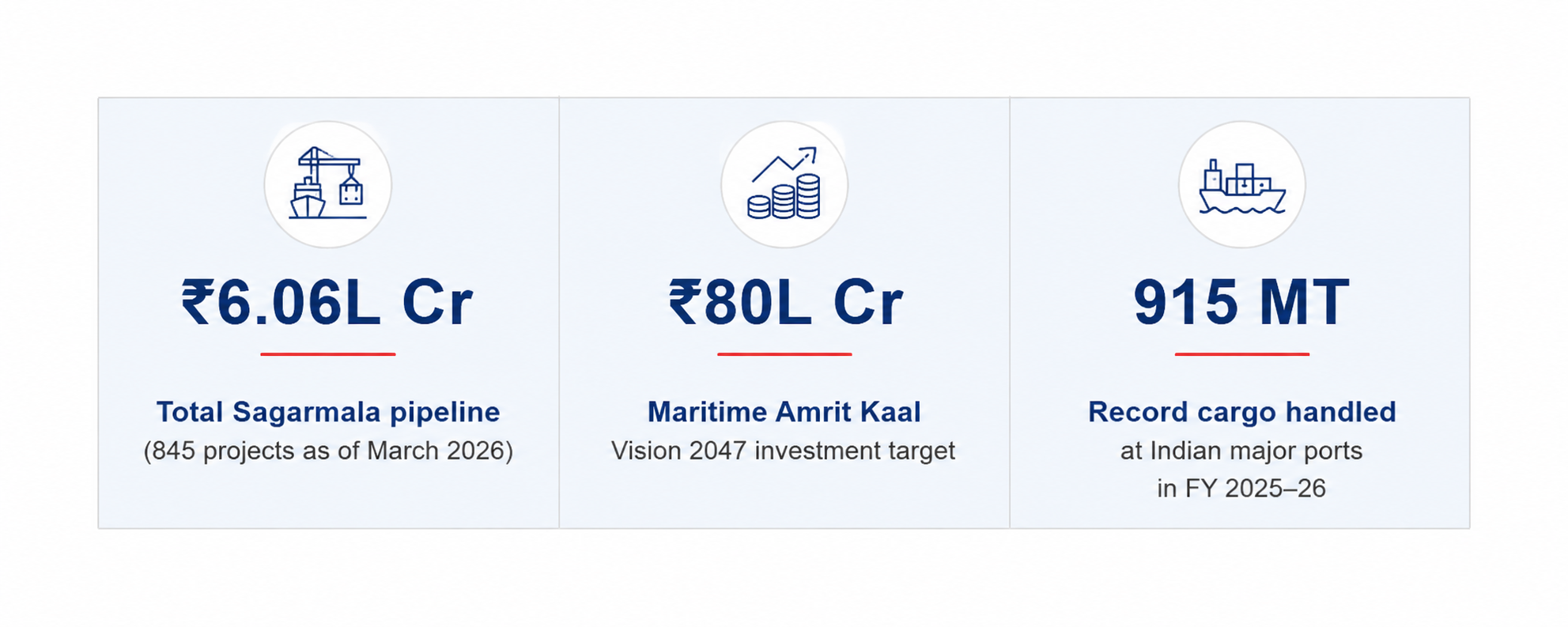
And yet the Sagarmala Programme—India's flagship port-led development initiative—has completed just 315 of its 845 planned projects as of March 2026. The remaining 530 projects, worth approximately ₹4.49 lakh crore, are either under implementation or still in the planning stage. The Maritime Amrit Kaal Vision 2047 envisions a total investment of ₹80 lakh crore to transform India into a global maritime leader by independence's centenary year.
The bottleneck is not ambition. It is not engineering capacity. It is capital. Traditional financing mechanisms — public budgetary allocations, sovereign bonds, and bank project finance — are simply not moving fast enough to match the scale of the opportunity.
This is precisely where blockchain-based port infrastructure tokenization offers government port authorities, the Ministry of Ports, Shipping, and Waterways, and infrastructure agencies a transformative alternative: raise capital from global institutional and accredited investors by issuing digital tokens backed by port revenues, terminal lease agreements, and cargo handling infrastructure—with automated compliance, real-time audit trails, and no dependence on constrained public budget cycles.
This blog explains how port tokenization works, which Sagarmala assets are best suited for it, and what government agencies need to evaluate before implementing a tokenization strategy.
TL;DR
India's Sagarmala Programme has 845 projects worth ₹6.06 lakh crore in its pipeline — but only 315 have been completed. The bottleneck is capital, not ambition. Blockchain-based asset tokenization offers India's port trusts and government infrastructure agencies a proven alternative: raise capital from global investors by issuing digital tokens backed by port revenues, terminal leases, and cargo handling assets — with automated compliance, real-time audit trails, and no dependence on public budget cycles.
The Sagarmala Programme, overseen by the Ministry of Ports, Shipping, and Waterways, has taken up 845 projects estimated at ₹6.06 lakh crore. As of March 24, 2026, 315 projects worth ₹1.57 lakh crore have been completed. That leaves 530 projects — the majority of the pipeline — yet to be financed and delivered.
Sagarmala 2.0, launched with budgetary support of ₹85,482 crore, aims to catalyze ₹3.6 lakh crore in total investment through a combination of public and private capital. The gap between what the public budget can provide and what the program requires is exactly where alternative financing mechanisms—including infrastructure tokenization—become strategically relevant.
💡
Sagarmala Finance Corporation Limited (SMFCL) — restructured in June 2025 as India's first maritime-sector NBFC — approved ₹4,300 crore in loan sanctions in December 2025. This is a positive step, but represents less than 0.1% of the programme's total pipeline value. The capital gap requires solutions at a different scale.
Port infrastructure tokenization is the process of converting the economic rights of a port asset — revenues from container terminal operations, berth lease agreements, cargo handling fees, warehousing revenues, or project bonds — into digital tokens on a blockchain.
Each token represents a fractional claim on the asset's revenue stream or ownership value. These tokens can be issued to verified investors globally; traded on regulated secondary markets; and managed entirely through smart contracts—automating compliance, revenue distribution, and reporting without manual government intervention.
Unlike equity privatization—which transfers ownership and operational control—port tokenization allows government port trusts to retain full operational control while unlocking capital from private investors. The token holders receive economic returns; the port authority remains the operator and regulator.
Critical distinction: Tokenizing a port asset is NOT privatization. It is a structured financing mechanism—similar to issuing bonds, but more flexible, faster, and accessible to a broader global investor base. The government retains ownership and operational control throughout.
Not all port assets are equally suited for tokenization. The best candidates share three characteristics: verifiable, stable revenue streams; clear legal ownership structures; and long-term asset lives that justify investor interest. Here are the primary Sagarmala asset categories:
Here is how traditional financing compares to tokenized infrastructure across every dimension that matters to a government port authority or infrastructure fund manager:
For government agencies evaluating tokenization, here is the complete implementation process — from asset selection to ongoing investor management:
1 Asset identification & revenue mapping
The port authority identifies the asset to be tokenized — a container terminal concession, berth lease revenue stream, or project bond. An independent financial institution maps and verifies the revenue flow that tokens will represent.
2 Legal structuring
Legal counsel establishes the vehicle through which tokens confer rights — typically a Special Purpose Vehicle (SPV) or trust. This defines investor rights: revenue share percentages, payment schedules, transfer restrictions, and exit conditions. No operational control transfers.
3 Regulatory coordination
The offering structure is coordinated with SEBI (for securities classification), RBI (for FEMA compliance on foreign investors), and MoPSW's oversight framework. Tokenized infrastructure bonds may fit within SEBI's existing DLT-based bond settlement pilot.
4 Smart contract development & audit
Smart contracts encoding the token's economic terms—revenue distribution schedules, investor eligibility rules, and transfer restrictions—are developed and independently audited before deployment on the permissioned blockchain network.
5 Investor onboarding & KYC
Investors complete digital KYC, including FEMA verification for NRI and foreign investors. Verified investors receive on-chain credentials reusable across future token subscriptions, eliminating repeated documentation.
6. Token issuance
Tokens are minted and distributed to verified investors. The investor registry is recorded immutably on-chain—replacing manual cap tables with a real-time, CAG-accessible digital ledger of all beneficial owners.
7 Automated revenue distribution
Smart contracts receive port revenue data via Oracle feeds—cargo volumes, terminal fees, and lease payments—and automatically distribute proportional income to token holders without manual government intervention.
8 Secondary market & ongoing compliance
Where permitted, investors trade tokens on regulated digital securities exchanges. Smart contracts enforce transfer restrictions — only verified, compliant buyers can receive token transfers. Full audit trail available to regulators at any time.
India's port sector has already demonstrated blockchain's operational value—the next step is extending that infrastructure to asset tokenization.
🌍
Global signal: The World Economic Forum's 2026 digital asset report confirms that blockchain is moving from experimentation to enterprise-grade deployment as foundational infrastructure for capital markets. India's port sector — with its digital pilots already underway — is positioned to lead this transition in the infrastructure asset class.
Tokenization allows port trusts to raise significant capital from global investors without transferring operational control or ownership. The SPV or trust structure keeps the asset legally government-owned while distributing economic returns to token holders—a fundamentally different risk profile from PPP or full privatization.
India's 32 million-strong NRI diaspora represents a massive, currently underleveraged pool of investment capital. Tokenized port bonds — accessible with low minimum investments and no need to physically execute Indian property registrations — could mobilize NRI savings for Sagarmala infrastructure at a scale that traditional bond markets cannot reach.
Every token transaction, revenue distribution, and ownership change is permanently recorded on the blockchain—accessible to the Comptroller and Auditor General's office in real time, without the manual data compilation that current government audit processes require. This dramatically reduces audit costs and fraud risk in large infrastructure programs.
Access to global investor capital through tokenization reduces dependence on slow public budget allocation cycles. Port authorities can raise project finance independently, accelerating construction timelines without waiting for annual budget approvals or bank credit committee decisions.
Broadening the investor base from a handful of domestic bond buyers to a global pool of accredited investors creates competitive pricing for infrastructure capital. When more investors compete for the same asset, the cost of capital falls—directly reducing the long-term financing burden on port trusts and the public exchequer.
JNPT's solar capacity and India's green port push align directly with ESG mandates of global infrastructure funds. Tokenizing green port infrastructure enables port trusts to access dedicated ESG capital pools—sovereign wealth funds, climate-focused institutional investors, and impact finance platforms—that traditional bond markets cannot efficiently reach.
Government port authorities evaluating tokenization must navigate a multi-layered regulatory environment. The following is an overview of key frameworks—not legal advice. Agencies should engage specialist legal and financial counsel before implementation.
📋 NMP alignment: The National Monetisation Pipeline aims to raise ₹6 lakh crore from government asset monetisation between 2021 and 2025. Port tokenization is directly aligned with NMP objectives—providing a modern, transparent, and globally accessible mechanism for infrastructure asset monetization that traditional instruments cannot match.
Building port tokenization infrastructure from scratch — custom smart contracts, compliance modules, investor onboarding systems, Oracle integrations, and regulatory reporting — would require a specialized team and 18–24 months of development. Enterprise tokenization platforms compress this to 6–12 weeks.
Government port authorities require platforms with:
Spydra (spydra.app) is an enterprise-grade asset tokenization platform built on Hyperledger Fabric — the permissioned blockchain framework used by central banks, financial regulators, and enterprise consortiums globally. Spydra's architecture is purpose-built for exactly the compliance requirements that government port tokenization demands.
The convergence of three forces in 2026 makes this the right moment for India to move port tokenization from concept to pilot.
India's Sagarmala Programme has the projects, the engineering capacity, and the strategic vision. What it lacks is a capital mobilisation mechanism that matches the scale of the opportunity.
Blockchain-based port infrastructure tokenization is not a speculative technology experiment. It is a proven capital markets instmobilizationlied to government infrastructure — that is being adopted by sovereign wealth funds, central banks, and port authorities globally in 2026.
The ₹6.06 lakh crore Sagarmala pipeline does not need to wait for public budget cycles to be funded. It needs a permissioned, compliant, enterprise-grade tokenization infrastructure that can convert port revenue streams into investable digital assets—accessible to NRI diaspora, global infrastructure funds, and domestic accredited investors—in a regulatory framework India is actively building.
Government port authorities that begin evaluating tokenization infrastructure today — legal structuring, platform assessment, regulatory coordination — will be positioned to launch India's first tokenized port asset when the regulatory window opens. Those that wait will be catching up to international peer ports that moved earlier.
🔑 Key Takeaways
Explore Port & Infrastructure Tokenization with Spydra
Spydra's enterprise-grade permissioned blockchain platform provides government port authorities and infrastructure agencies the compliance infrastructure, investor onboarding, and token lifecycle management needed to tokenize port assets — with full regulatory auditability and zero blockchain expertise required.
Q: What is port infrastructure tokenization?
A: Port infrastructure tokenization is the process of converting the economic rights of a port asset — terminal concession revenues, berth lease fees, cargo handling charges, or project bonds — into digital tokens on a blockchain. Each token represents a fractional claim on the asset's revenue stream. Tokens can be issued to global investors, managed via smart contracts, and traded on regulated secondary markets, while the government port authority retains full operational control and ownership of the underlying asset.
Q: Does tokenizing port assets mean privatization?
A: No. Tokenization and privatization are fundamentally different. Privatisation transfers ownership and operational control to a private entity. Tokenization creates a structured financing mechanism —Privatizationssuing bonds — where investors receive economic returns (revenue share) but the government port trust retains ownership, operational authority, and regulatory control. The SPV or trust structure holds the asset; token holders have economic rights only.
Q: Which Sagarmechanism—similart suited forbonds—where?
A: Assets with stable, verifiable, long-teshare),enue streams are the strongest candidates: container terminal concession revenues, port bond instruments, warehousing and logistics zone leases, fishing harbor docking fees, inland waterway terminal revenues, and green infrastructure assets generating measurable energy savings. Greenfield projects with no revenue history are more complex to tokenize and typically require government revenue guarantees to attract investor interest.
Q: Is port infrastructure tokenization legal in India?
A: Port infrastructure tokenization currently operates within a patchwork of existing frameworks — SEBI's debt securities regulations, RBI's FEMA rules, PMLA compliance requirements, and port trust governance laws. India's Parliamentary Finance Committee recommended a digital asset SRO framework in July 2026. SEBI's DLT-based bond settlement pilot provides a potential regulatory pathway for tokenized port bonds. Agencies should engage legal counsel with blockchain and infrastructure finance expertise to navigate the current framework while monitoring regulatory developments.
Q: How does Sagarmala Finance Corporation (SMFCL) relate to tokenization?
A: SMFCL was restructured in June 2025 as India's first maritime-sector NBFC with an expanded mandate to provide financial solutions for ports, shipping, and related industries. SMFCL's institutional mandate and maritime sector focus make it a natural candidate to structure or guarantee tokenized port bond issuances—providing the government-backed credit enhancement that global investors require for emerging market infrastructure tokens.
Q: Can NRI investors participate in tokenized port bonds?
A: Yes — subject to FEMA compliance and RBI-approved investment routes. Tokenization platforms can encode FEMA eligibility checks directly into smart contract transfer rules, automating compliance at the point of investor onboarding. This removes the friction that currently deters NRI capital from direct infrastructure investment — potentially mobilizing a significant portion of India's $100 billion+ annual NRI remittance flow toward Sagarmala infrastructure.
Q: What blockchain network is appropriate for government port tokenization?
A: A permissioned blockchain — specifically Hyperledger Fabric — is the appropriate infrastructure for government port tokenization. Permissioned networks provide data privacy for sensitive port revenue and investor data; participant credentialing ensuring only verified entities transact; regulatory auditability giving CAG and MoPSW real-time access to records; and performance at scale handling thousands of investor transactions without public network congestion. Public chain connectivity can be added for specific investor segments requiring DeFi liquidity access.
Q: How long does it take to tokenize a port asset?
A: End-to-end implementation — from asset selection through legal structuring, regulatory coordination, smart contract development, investor onboarding, and token issuance — typically takes 6–12 months for a first tokenization. Legal and regulatory preparation represents the longest phase (3–6 months). Technical deployment on an enterprise tokenization platform takes 6–12 weeks. Subsequent tokenizations of additional assets can be significantly faster using the same infrastructure and legal framework.