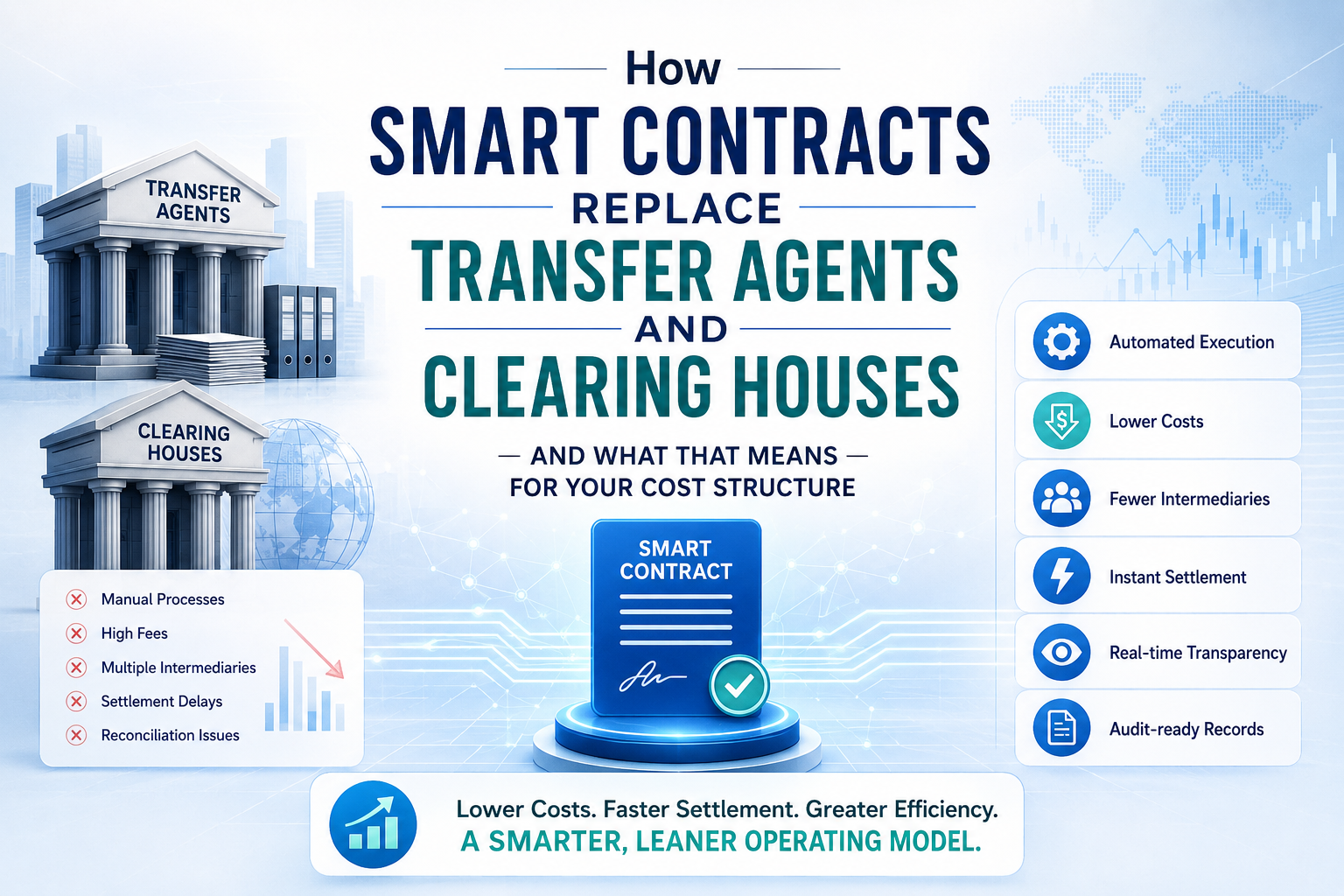
Every publicly traded share, corporate bond, or private security an investor holds today passes through a chain of intermediaries before ownership is finally recorded. Transfer agents maintain the shareholder register. Registrars validate issuance records. Custodians hold assets on behalf of clients. Clearing corporations' net trades and guarantee settlement. Depositories immobilize certificates. Reconciliation teams spend their days making sure all of these separate ledgers agree with one another.
This infrastructure exists to solve a real problem: trust between parties who don't know each other. But the cost of solving that problem with layers of intermediaries is high. Settlement still commonly takes one to two business days. Corporate actions — dividends, splits, redemptions — are processed manually across multiple systems. Reconciliation between broker, custodian, and clearinghouse records consumes enormous back-office labor. And every additional intermediary in the chain adds a point of counterparty risk.
Smart contracts for securities settlement offer a fundamentally different model. Instead of multiple parties each keeping their own record and reconciling against each other after the fact, ownership, compliance rules, and settlement logic live directly on a shared, programmable ledger. This article breaks down which transfer agent and clearing house functions smart contracts can realistically automate today, which regulated functions still require licensed intermediaries, and what the shift means for an enterprise's cost structure, implementation roadmap, and risk profile.
Traditional securities markets rely on a chain of intermediaries—issuer, transfer agent, broker, clearing house, custodian, depository, and investor—each keeping a separate record of the same transaction and reconciling it after the fact.
An issuer sells securities to raise capital. A transfer agent maintains the official register of who owns what. A broker executes trades on behalf of investors. A clearing house sits between buyers and sellers, netting trades and guaranteeing that both sides deliver. A custodian holds the underlying asset for institutional clients. A depository—such as the Depository Trust Company in the U.S.—immobilizes physical certificates and enables electronic book-entry transfer. The investor, at the end of the chain, typically sees only a brokerage statement.
The lifecycle of a single security touches every one of these parties multiple times: issuance, subscription, allocation, settlement, ownership transfer, dividend distribution, corporate actions, and eventual redemption or sale. At each stage, a separate ledger is updated—the transfer agent's register, the broker's books, the clearing house's netting system, and the custodian's records—and none of these ledgers are authoritative on their own. Reconciliation exists precisely because no single source of truth exists across the chain.
A transfer agent maintains the official shareholder register, records ownership changes, processes dividends and corporate actions, and performs compliance checks — work that remains largely manual and paper-driven in many markets.
A transfer agent is the entity of record for who owns a security. Its core responsibilities include maintaining the shareholder register, recording transfers when securities change hands, processing dividend and interest payments, administering corporate actions such as stock splits or mergers, running KYC and accreditation checks on new holders, generating regulatory reports, and preserving an auditable history of ownership.
In many markets, large parts of this work are still handled through batch processing, spreadsheets, and manual verification, especially for private securities, restricted stock, and smaller issuers that don't justify the cost of fully automated systems. That manual layer is exactly where errors, delays, and costs accumulate.
A clearinghouse validates and nets trades, manages counterparty risk through margin requirements, and guarantees settlement between buyer and seller—a role that became essential once markets grew too large for bilateral trust.
Clearing houses emerged to solve a specific problem: when Party A and Party B trade a security, how does each know the other will actually deliver? A clearing house interposes itself as the buyer to every seller and the seller to every buyer, matching and validating trades, netting offsetting positions to reduce the number of settlements needed, collecting margin to cover potential default risk, and guaranteeing that a trade settles even if one counterparty fails.
This central counterparty model dramatically reduced systemic risk in legacy markets built on bilateral, paper-based trading. But it also introduced its own layer of fees, delay, and reconciliation—the clearing house's records must still be reconciled against the custodian's, the broker's, and the transfer agent's.
Settlement fees, transfer agent charges, custodian costs, reconciliation labor, and delayed-settlement liquidity costs compound across every trade — and a single private securities issuance can pass through five or more fee-charging intermediaries.
Every intermediary in the chain charges for its role, and those charges accumulate. Transfer agents charge per-holder record-keeping and corporate action processing fees. Registrars charge for issuance and maintenance. Custodians charge asset-based safekeeping fees. Clearing houses charge per-trade clearing and margin financing costs. On top of direct fees, enterprises absorb reconciliation labor—teams whose entire job is comparing one ledger against another and chasing down discrepancies—plus audit costs to verify that all of these separate records are consistent and the opportunity cost of capital tied up during multi-day settlement cycles.
Consider a mid-sized private securities issuance: the issuer pays a transfer agent to maintain the register, a registrar for issuance processing, a custodian to hold assets for institutional investors, a clearing arrangement for secondary trading, and an internal or outsourced reconciliation function to keep all of it in sync. Each layer adds basis points of cost and days of delay—cost that ultimately gets passed to the issuer, the investor, or both.
Smart contracts can encode ownership registries, compliance rules, transfer restrictions, and payment logic directly into the token itself, automating functions that previously required a human intermediary to check and execute manually.
A smart contract is executable code deployed on a blockchain that automatically carries out predefined logic once its conditions are met. Applied to securities, that logic can cover a wide range of functions previously performed by transfer agents and administrators: maintaining the cap table as the single on-chain ownership registry, enforcing transfer restrictions and investor whitelisting at the point of transaction rather than after the fact, automatically calculating and distributing dividends or interest payments to every token holder, enforcing lock-up periods programmatically, executing shareholder voting and tabulating results on-chain, and processing redemptions or token burns according to predefined rules.
The practical shift is that compliance and record-keeping move from being a downstream check performed after a trade to being a precondition embedded in the trade itself. If an investor is not KYC-verified or not eligible under jurisdictional rules, the smart contract simply will not execute the transfer — there is no separate compliance team reviewing the transaction after the fact.
Token standards built for regulated securities — such as ERC-3643 — embed identity verification, ownership records, and corporate action logic directly on-chain, turning the blockchain itself into the authoritative shareholder register.
Modern security token standards go further than a simple balance ledger. ERC-3643, for example, ties an on-chain identity module to every wallet, so eligibility and transfer restrictions are enforced automatically without requiring a custodian or transfer agent to manually check each transaction. Combined with smart contract logic, this creates a shareholder registry that updates itself in real time, maintains an immutable audit trail by default, calculates and distributes corporate actions programmatically, and generates compliance reports as a byproduct of normal operation rather than a separate exercise.
Because every transfer, distribution, and ownership change is recorded on the same ledger, the blockchain becomes the single source of truth that transfer agents and registrars previously had to maintain and reconcile across parallel systems.
Smart contracts enable atomic, delivery-versus-payment settlement where a trade and its payment execute simultaneously and irreversibly—collapsing the traditional trade-to-settlement chain and reducing the counterparty risk clearing houses exist to manage.
In traditional markets, settlement flows through several steps in sequence: a trade is executed, routed to a broker, passed to a clearinghouse for netting and guarantee, forwarded to a custodian, and finally settled—a process that commonly takes one to two business days (T+1 or T+2) and depends on every party in the chain performing its role correctly.
On a blockchain, the sequence collapses. A trade is submitted to a smart contract, which can execute atomic settlement: the transfer of the security and the corresponding payment occur as a single, indivisible transaction. Either both legs complete or neither is—there is no window in which one party has delivered and the other has not. This is the mechanism behind delivery-versus-payment (DvP) on-chain and enables T+0, same-day, or even near-instant settlement, with real-time ownership updates and materially reduced counterparty risk.
That said, smart contracts do not eliminate every function a clearing house performs. In many jurisdictions, a regulated central counterparty is still legally required for certain instrument classes, and clearing houses continue to play a role in cross-market netting, systemic risk management, and default guarantee funds that a smart contract alone cannot replicate without a regulated entity standing behind it. Enterprises building this kind of infrastructure typically start on a permissioned Hyperledger Fabric network for regulatory control, then extend to public chain rails once liquidity and investor-reach needs grow.
Comparing traditional market infrastructure against smart contract infrastructure across settlement time, intermediaries, reconciliation, and cost highlights where the greatest efficiency gains occur.
Traditional Market Infrastructure vs. Smart Contract Infrastructure
Beyond lower fees, programmable securities infrastructure delivers faster settlement, continuous compliance, real-time auditability, and access to global investor pools that legacy infrastructure struggles to reach efficiently.
Cost reduction is the most immediately visible benefit, but it is not the only one. Faster settlement improves liquidity and frees up capital that would otherwise sit idle during a multi-day settlement window. Real-time ownership records give issuers and regulators an accurate picture of who holds a security at any moment, rather than a snapshot reconstructed after the fact. Continuous, embedded compliance replaces periodic manual checks, reducing the risk of a non-eligible investor slipping through. Automated reporting turns what was a separate compliance exercise into a natural output of the system.
Enterprises also gain improved auditability, since every transaction and corporate action is permanently recorded; programmable assets that can encode complex terms like tiered distributions or conditional transfers directly into the security itself; and broader investor access, since fractional, tokenized securities can reach a wider and more geographically distributed investor base than instruments bound to legacy settlement rails.
Major financial institutions and market infrastructure providers — including DTCC, SIX Digital Exchange, JPMorgan, Swift, and the European Investment Bank — have moved tokenized securities and blockchain-based settlement from pilot projects into recurring market activity.
Institutional adoption of tokenized securities has accelerated. The European Investment Bank has issued multiple tranches of digital bonds on public blockchain rails, with major banks acting as dealers on sovereign-grade tokenized debt. Hong Kong has issued multiple rounds of tokenized government bonds and has signaled that tokenized bond issuance will become a regular feature of its market infrastructure rather than a series of isolated pilots. Swift has run interoperability trials demonstrating that tokenized assets can move across different blockchain networks using existing Swift messaging rails, addressing a key barrier to institutional adoption. The DTCC, SIX Digital Exchange, and JPMorgan have each advanced their own initiatives exploring tokenized settlement, digital custody, and blockchain-based clearing infrastructure.
This momentum reflects a broader trend: financial institutions are increasingly treating blockchain not as a niche payments technology but as programmable infrastructure for the securities lifecycle itself — issuance, settlement, custody, and corporate actions running on a shared, rules-based ledger.
Enterprises adopting smart-contract-based securities infrastructure typically move through a structured path — from identifying eligible asset classes to piloting a single issuance before scaling across product lines.
Regulatory recognition, legal enforceability, custody models, and integration with legacy systems remain the primary obstacles enterprises must address before scaling smart-contract-based securities infrastructure.
The technology is only part of the equation. Regulatory recognition of tokenized securities varies significantly by jurisdiction, and legal enforceability of on-chain ownership must align with existing securities law. Identity verification and privacy requirements have to be balanced carefully, particularly on public networks where transaction data may be more widely visible. Custody models for digital assets are still maturing, and enterprises need clarity on who is legally responsible for asset safekeeping.
Cross-chain interoperability, smart contract security and audit practices, governance of upgrades to deployed contracts, and integration with legacy core banking and record-keeping systems all require deliberate planning. Jurisdiction-specific securities laws add a further layer of complexity for issuers operating across multiple markets, since a compliance framework that works in one jurisdiction may not transfer directly to another.
Financial institutions increasingly view blockchain not as a payments technology but as programmable infrastructure for the entire securities lifecycle—reducing operational complexity while improving compliance and scalability.
The shift underway is less about replacing individual intermediaries and more about rethinking how securities infrastructure is built. Instead of separate systems for registration, compliance, settlement, and reporting that must be reconciled against each other, programmable infrastructure embeds those functions directly into the asset. That reduces operational complexity, strengthens compliance by enforcing it continuously rather than periodically, and gives enterprises a scalable foundation for issuing and managing digital securities as volumes grow.
Smart contracts can automate a substantial share of the operational work traditionally performed by transfer agents and clearinghouses—maintaining the shareholder registry, enforcing compliance at the point of transaction, executing corporate actions, and enabling atomic, near-instant settlement. The result is a meaningfully lower cost structure, faster settlement cycles, and stronger auditability than legacy, multi-intermediary infrastructure can offer.
That said, regulated intermediaries have not disappeared, and depending on jurisdiction and asset class, licensed transfer agents, custodians, or central counterparties may still be legally required. What blockchain changes is how much of the operational burden those regulated entities need to carry by embedding business rules directly into the security itself rather than layering manual checks on top of it.
For enterprises evaluating this shift, the opportunity is to build compliant, permissioned, and scalable tokenized securities infrastructure using smart contracts, automated compliance workflows, and support for both private and public blockchain networks. Spydra's asset tokenization platform is built for exactly this purpose — helping financial institutions and asset managers modernize securities issuance and settlement without abandoning the regulatory rigor the market requires.
READY TO MODERNIZE YOUR SECURITIES INFRASTRUCTURE?
• Spydra's Asset Tokenization Platform helps financial institutions issue and manage compliant, permissioned, and scalable tokenized securities.
• Automate compliance workflows, reduce settlement costs, and deploy on both private and public blockchain networks.
• Learn more at spydra.app/tokenization
A smart contract is self-executing code on a blockchain that automatically carries out predefined actions — such as transferring ownership or releasing payment—once its conditions are met, without requiring a manual intermediary step.
Smart contracts can automate many transfer agent functions, including maintaining the ownership registry, processing transfers, and distributing dividends. Depending on jurisdiction, a regulated transfer agent may still be legally required for certain securities.
Blockchain-based atomic settlement reduces the need for netting and counterparty guarantees that clearing houses traditionally provide. However, regulated central counterparties may still be required for certain instrument classes and cross-market risk management.
Atomic settlement is a blockchain-based process where the transfer of a security and its corresponding payment occur as a single, indivisible transaction—either both complete or neither does.
T+0 settlement means a trade settles on the same day it is executed, rather than one or two business days later as is standard in most traditional markets today.
By automating registry maintenance, compliance checks, and corporate action processing, smart contracts reduce the manual labor and layered intermediary fees that drive up costs in traditional securities infrastructure.
Legal enforceability depends on jurisdiction and how local securities law treats on-chain records. Many jurisdictions are actively developing frameworks to recognize tokenized ownership, but recognition is not yet universal.
Corporate action logic — such as dividend calculation and distribution, interest payments, or redemption terms — can be coded directly into the smart contract so it executes automatically against the current token holder registry.
Key risks include smart contract security vulnerabilities, regulatory uncertainty, custody and key management challenges, and the need for robust governance around any changes to deployed contract logic.
Capital markets, private equity, real estate, corporate debt, and fund management are among the sectors seeing the most active adoption of tokenized securities infrastructure.
Yes. Permissioned blockchains such as Hyperledger Fabric are widely used for regulated securities because they allow enterprises to control network participation, enforce privacy, and maintain compliance while still gaining the efficiency benefits of a shared ledger.
Spydra provides a low-code asset tokenization platform with built-in compliance workflows, smart contract automation, and support for both permissioned and public blockchain networks, enabling enterprises to issue and manage tokenized securities end to end.