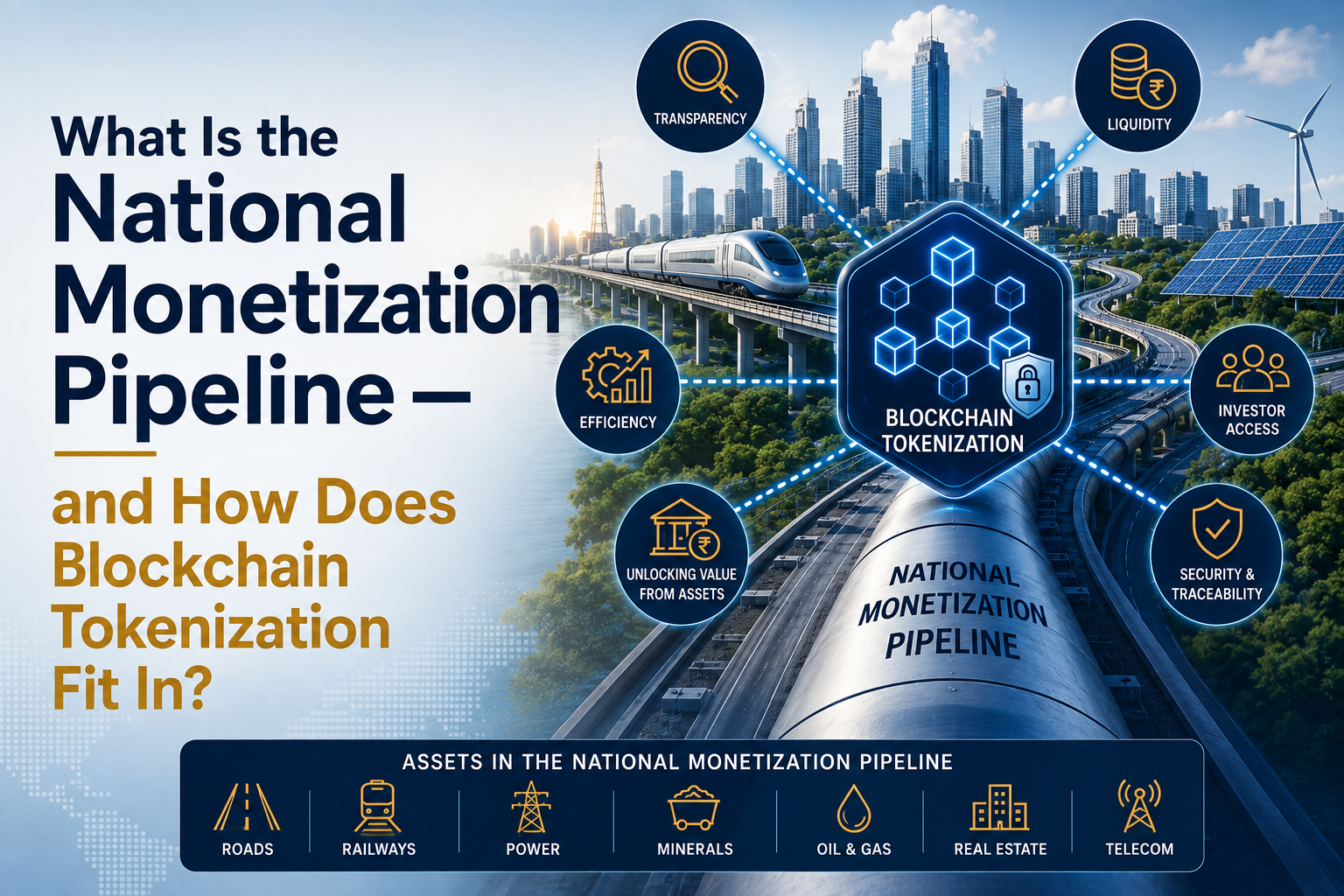
Introduction: Why India Needs to Unlock Value From What It Has Already Built
India has spent decades building infrastructure. Highways, railways, ports, power grids, airports, and urban systems represent trillions of rupees of public investment. Yet the government's capacity to fund new infrastructure continues to face fiscal constraints, competing budget priorities, and the sheer scale of what remains to be built.
The answer is not always to build more. Sometimes it is to extract greater value from what already exists—and reinvest those proceeds into the next generation of assets.
This is the logic behind the National Monetization Pipeline (NMP): a structured program to generate capital from operating brownfield infrastructure by bringing in private-sector partners without transferring ownership of the underlying assets.
The central question this blog addresses is where, when, and under what circumstanceswhere, and cons could could blockchain-based asset tokenization serve as an enabling technology layer for the kinds of structured finance instruments that NMP and its successor programs require?
The answer is not simple. Tokenization is not a replacement for NMP's legal and financial architecture. It is a potential operational layer — one that could improve how rights, cash flows, compliance, investor reporting, and secondary transfers are represented and managed. Whether and how it fits depends entirely on regulatory clarity, legal structuring, and market adoption that are still developing in India.
⚡ TL;DR
India's National Monetisation Pipeline (NMP) — now in its second phase targeting ₹16.72 lakh crore across 12 sectors by FY2030 — is the government's primary mechanism for unlocking capital from existing public infrastructure without selling it. Blockchain tokenization is not part of NMP's current official implementation. However, it represents a potential digital infrastructure layer that could make certain monetization structures more transparent, programmable, and accessible to a broader investor base—if deployed on top of the appropriate legal, financial, and regulatory frameworks.
Section 1: What Is the National Monetization Pipeline (NMP)?
The National Monetization Pipeline is a structured program developed by NITI Aayog, in consultation with infrastructure line ministries, to monetize brownfield core infrastructure assets of the Central Government. It was announced under Union Budget 2021-22 and formally launched in August 2021 by Finance Minister Nirmala Sitharaman.
The program's core philosophy is asset recycling: government invests public capital to build infrastructure, then engages private sector partners to operate and manage those assets under long-term arrangements, generating revenue that the government reinvests into new infrastructure projects.
What Monetization Is—and What It Is Not
Monetization is NOT the same as selling a public asset. The government retains ownership of the underlying infrastructure.
Monetization involves leasing, concession-granting, or structuring investment rights over the asset's future cash flows for a defined period.
Private sector partners pay upfront or periodic fees for the right to operate the asset, collect user fees, or receive defined revenue streams—with the asset reverting to the government at the end of the concession period.
The proceeds flow to the Consolidated Fund of India, PSUs, Port Authorities, or State Consolidated Funds—depending on the implementing agency—for reinvestment in new capital projects.
📌
In short, NMP converts the operational value of existing government infrastructure into investable financial flows—without transferring asset ownership. Private partners bring operational efficiency and capital; the government retains the asset and reinvests the proceeds.
NMP 1.0 (FY2022–25) achieved approximately ₹5.3 lakh crore—around 89% of its ₹6 lakh crore target — across sectors including roads, coal, mining, and power. Building on this, the Government of India and NITI Aayog launched NMP 2.0 on February 24, 2026, with a significantly more ambitious target of ₹16.72 lakh crore across 12 sectors over FY2026–30. NITI Aayog projects that NMP 2.0 could boost India's GDP by ₹40 lakh crore over 5 to 10 years.
Section 2: What Assets Are Covered Under the National Monetization Pipeline?
NMP 2.0, launched February 24, 2026, covers 12 sectors of brownfield core infrastructure assets owned by central government ministries and public sector entities. The following table shows the sector-wise breakdown of the ₹16.72 lakh crore aggregate monetization target for FY2026–30, as announced by NITI Aayog:
Sector
NMP 2.0 Target (FY26–30)
Share of Total
Highways, MMLPs & Ropeways
₹4,42,000 crore
26%
Power (Transmission & Generation)
₹2,76,500 crore
17%
Railways
₹2,62,300 crore
16%
Ports, Shipping & Waterways
₹2,63,700 crore
16%
Coal
₹2,16,000 crore
13%
Mining
₹1,00,000 crore
6%
Urban Infrastructure
₹52,000 crore
3%
Civil Aviation
₹27,500 crore
2%
Telecom
Included
<1%
Warehousing & Storage
₹10,000 crore
1%
Petroleum & Natural Gas
₹16,300 crore
1%
Tourism
Included
<1%
Source: NITI Aayog / Ministry of Finance NMP 2.0 release, February 24, 2026. Note: These are aggregate monetization targets, not all assets will necessarily be suitable for or subject to tokenization. Eligibility for any specific monetization instrument—including blockchain-based structures—depends on the applicable legal framework, regulatory approvals, and asset-specific structuring.
Section 3: How Does Infrastructure Asset Monetization Work?
Infrastructure asset monetization works by separating the economic value of an asset from its physical ownership. The government retains ownership; private partners access the right to operate the asset and collect revenue for a defined period.
Common Monetization Structures Under NMP
Toll-Operate-Transfer (TOT): The government grants a private entity the right to collect toll revenues from an existing highway for a defined concession period — typically 15–30 years — in exchange for an upfront lump-sum payment. At the end of the period, the asset reverts to NHAI.
Infrastructure Investment Trusts (InvITs): Pool cash-flow-generating infrastructure assets into a trust structure regulated by SEBI. Units of the InvIT are listed and traded on Indian stock exchanges, allowing institutional and retail investors to participate in infrastructure revenue streams with defined income distributions.
Long-term Lease Arrangements: Government entities grant operational rights over an asset—an airport, a port berth, or a railway station—to a private operator for a long lease period, with defined revenue-sharing or concession fee arrangements.
Concession and User-Fee Models: The government grants a concession to operate a public utility—a power transmission line, a gas pipeline—allowing the concession holder to collect user fees while bearing operational and maintenance obligations.
Securitization of Cash Flows: Future revenue streams from an infrastructure asset are packaged and sold to investors as securities. This is distinct from an asset sale—only the right to future revenues is transferred.
The key distinction across all models: investors acquire rights to future cash flows or operational revenues — not ownership of the physical asset itself. Legal enforceability of those rights depends entirely on the underlying contract, concession agreement, regulatory approval, and applicable law.
🔑
Key concept: Owning an infrastructure investment right is not the same as owning the infrastructure. Investors in NMP-related instruments hold contractually defined economic interests. Blockchain tokenization, if applied, would represent those economic interests digitally — not the physical asset itself.
Section 4: Why Traditional Asset Monetisation Can Be Complex
Despite NMP's policy ambition, the execution of infrastructure asset monetization faces structural complexity that affects transparency, investor confidence, and operational efficiency. NMP 1.0's mixed-sector performance illustrates these challenges concretely—railways, aviation, and telecom underperformed, while roads and coal exceeded targets.
Fragmented data infrastructure: Revenue data from infrastructure assets—toll collections, energy output, port throughput—is often held in disparate government systems that are not standardized, real-time, or easily verifiable by investors.
Multiple stakeholder complexity: A single concession agreement involves the asset owner (a central ministry or PSU), the concessionaire (private operator), NHAI/AAI/POSCO/relevant regulator, lenders, and investors—each with different information requirements and reporting expectations.
Manual reconciliation: Verifying that revenue distributions match contractual entitlements requires manual reconciliation across multiple systems. Errors and delays are common, especially for assets with variable revenue profiles.
Limited secondary market liquidity: Most NMP-related instruments—TOT bonds, InvIT units, and concession-backed securities—trade in thin markets with limited price discovery. This limits the investor base and raises the cost of capital for the government.
Investor reporting friction: Quarterly and annual reporting to InvIT unit holders, concession bond investors, and regulatory bodies involves significant manual data collection and verification—adding administrative overhead and creating opportunities for inaccuracy.
Transfer restrictions and compliance: Changing investor ownership in a concession-backed security requires navigating regulatory approvals, SEBI compliance, FEMA rules for foreign investors, and anti-money laundering obligations — a process that can take weeks.
Monitoring cash flows: Ensuring that toll receipts, port revenues, or power transmission fees are accurately captured and channelled to the correct distribution structure requires robust monitoring mechanisms that current systems do not always provide.
These challenges are not unique to India. They are structural features of large-scale infrastructure finance globally — and they represent the operational context in which blockchain tokenization is being evaluated as a potential improvement layer.
Section 5: What Is Blockchain Asset Tokenization?
Blockchain asset tokenization is the process of creating a digital token on a blockchain network that represents a legally defined right or economic interest in a real-world asset. The token is not the asset itself — it is a digital record of a contractually defined claim, enforced by the underlying legal structure.
In the context of infrastructure finance, tokenization would typically represent the following:
A fractional economic interest in an InvIT unit or concession-backed instrument
A defined revenue-share right linked to infrastructure cash flows
A digital representation of a bond or note backed by infrastructure revenues
NOT ownership of the physical infrastructure asset
The Tokenization Process — Step by Step
1. Asset / Legal interest identification
The underlying infrastructure asset and its legally defined monetization structure—TOT concession, InvIT unit, or revenue-share agreement—are identified and verified.
2 Legal & financial structuring
Legal counsel establishes the vehicle (SPV, trust, or securities framework) through which the token will represent investor rights. This step defines what the token legally means — no tokenization proceeds without this.
3 The legal rights are mapped to a token specification—supply, income entitlements, transfer restrictions, and governance parameters—on the chosen blockchain network.
4. Compliance layer KYC/AML, investor accreditation, FEMA eligibility (for foreign investors), and applicable SEBI regulations are configured and verified before any investor receives tokens.
5 Token issuance
Tokens are minted and distributed to verified investors. The investor register is recorded on the blockchain—replacing or supplementing manual cap tables.
6 Automated distributions
Oracle-connected smart contracts receive verified revenue data—toll collections, energy fees, and port receipts—and automatically distribute proportional income to token holders.
7 Transfer and compliance enforcement
Token transfers are enforced by smart contracts — only eligible, verified buyers can receive a transfer. Transfer restrictions are automated, not manually policed.
8 settlement and reporting
All transactions, distributions, and compliance events are permanently recorded on the blockchain, providing real-time reporting to investors and regulators without manual compilation.
Section 6: How Could Blockchain Tokenization Fit Into NMP?
It is important to state clearly: the Government of India has not officially adopted blockchain tokenization as part of the National Monetization Pipeline's implementation framework. The applications described below are potential or emerging models — not current government policy or NMP implementation mechanisms.
With that important caveat, there are ten areas where blockchain tokenization could serve as an enabling digital infrastructure layer for NMP-compatible financial instruments:
Converting fractional economic interests in InvIT units, concession revenue rights, or infrastructure bonds into digital tokens—making those interests programmable, transferable, and auditable on a shared ledger. Tokenizing economic interests:
Where SEBI frameworks permit, existing listed infrastructure securities (InvIT units, infrastructure bonds) could be represented on a blockchain for more efficient settlement and transfer. Tokenizing eligible infrastructure securities:
Creating on-chain digital records of the cash-flow entitlements defined in TOT or PPP concession agreements — connecting Oracle-verified revenue data directly to automated distribution smart contracts. Digitizing concession cash-flow rights:
Where legally structured, enabling smaller-ticket investment in infrastructure revenue streams through tokenized fractionalization—subject to SEBI, RBI, and applicable securities regulations. Compliant fractional investment structures:
Smart contracts connected to verified revenue oracle feeds automate quarterly income distributions to token holders—eliminating manual calculation, payment instructions, and reconciliation. Automating distributions:
On-chain records provide investors with real-time access to asset performance data, distribution history, and compliance events—replacing manual quarterly report packages. Improving investor reporting:
Smart contracts encode SEBI-mandated lock-ups, FEMA eligibility checks, and accredited investor requirements directly into token transfer rules — automatically enforcing compliance at every transaction. Programmable transfer restrictions:
Every token issuance, transfer, distribution, and compliance event is permanently recorded—providing CAG, SEBI, and RBI with real-time audit access without requiring manual data requests. Auditable transaction history:
Verified toll collection data, energy meter readings, or port throughput figures — connected to on-chain smart contracts — provide tamper-resistant revenue verification for investor reporting and distribution. Oracle-connected revenue verification:
Regulated digital securities exchanges where eligible investors can trade tokenized infrastructure instruments — improving secondary market liquidity for an asset class that currently trades in thin, fragmented markets. Secondary market infrastructure:
⚠️
Important: Tokenization would sit on top of an appropriate legal and financial structure — not replace it. A token is only as legally meaningful as the underlying contract, regulatory approval, and jurisdictional framework that defines what it represents. Technology does not substitute for legal enforceability.
Section 7: NMP + Tokenization — A Hypothetical Example
[HYPOTHETICAL EXAMPLE — For illustrative purposes only. This does not describe any existing government programme, official NMP implementation, or Spydra product deployment.]
Consider a national highway monetized under a toll-operate-transfer model. NHAI grants a 25-year concession to a private operator to collect toll revenues from an existing 4-lane corridor. The operator pays NHAI an upfront concession fee and commits to maintenance obligations.
Under a hypothetical tokenized structure, the economic interest in the concession — specifically, a defined percentage of the toll revenue stream during the concession period — could be structured as follows:
Category
Details
Physical Infrastructure
National highway corridor — owned by NHAI, operated under
TOT concession
SPV holds SEBI-approved revenue participation rights for
concession period. Investors hold SPV units.
Tokenization Framework
SPV units represented as digital tokens on permissioned
Hyperledger Fabric network
KYC / AML
Investors complete digital KYC; FEMA eligibility verified;
on-chain credentials issued
Smart Contract
Receives Oracle-verified toll revenue data quarterly;
auto-distributes proportional income to token holders
Eligible Investors
Verified accredited investors (domestic + eligible
NRI/foreign, per SEBI/RBI framework)
Automated Distributions
Smart contract distributes quarterly income within
24 hours of Oracle data confirmation
Transparent Reporting
Real-time dashboard; exportable audit trail for SEBI,
CAG, and investor review
What blockchain DOES in this scenario: Records token ownership immutably, automates income distribution via smart contract, enforces transfer restrictions programmatically, provides a real-time audit trail, and enables potential secondary market trading of eligible investors.
What blockchain does NOT do: Create the legal right (the SPV structure and concession agreement do that); guarantee revenue (toll income depends on traffic and operator performance); replace SEBI or NHAI regulatory approvals; or make the investment risk-free.
Section 8: Traditional Infrastructure Monetization vs. Tokenized Infrastructure Framework
The following comparison illustrates potential differences between traditional monetization models and a blockchain-enabled framework. Note: actual benefits depend on implementation quality, regulatory environment, legal structure, and market adoption — not the technology alone.
Factor
Traditional Monetisation Model
Blockchain-Enabled Model
Record keeping
Manual registers, fragmented across ministries
Shared immutable ledger with role-based access
Investor onboarding
Paper-based, repeated per transaction
Digital KYC/AML, one-time on-chain credential
Compliance
Manual checks, periodic reviews
Programmable rules in smart contracts
Transfer restrictions
Contractually defined, manually enforced
Encoded in smart contract, auto-enforced
Distribution
Manual calculation, bank transfers
Automated smart contract payouts on trigger
Settlement
T+2 to T+30 depending on instrument
Near real-time on-chain settlement
Auditability
Periodic CAG reports, manual compilation
Real-time regulator-accessible audit trail
Reporting
Quarterly/annual, manually prepared
Continuous on-chain transparency
Reconciliation
Multi-party, error-prone
Single source of truth reduces reconciliation need
Secondary transfers
Thin markets, complex paperwork
Regulated digital exchange, programmable eligibility
Programmability
Static contract terms
Dynamic smart contract execution
Transparency
Selective, delayed disclosures
Permissioned real-time access for all authorised parties
Section 9: Potential Benefits of Tokenization for Infrastructure Finance
The following benefits are potential outcomes of well-implemented, legally structured blockchain tokenization — not guaranteed results. Benefits that are purely technological are distinguished from those requiring regulatory or legal adoption.
Technology-Enabled Benefits
Automated distributions: Smart contracts eliminate manual calculation, payment instruction, and bank transfer workflows for income distributions.
Programmable compliance: Transfer restrictions, eligibility checks, and reporting obligations encoded in smart contracts execute automatically—reducing manual compliance overhead.
Real-time audit trail: Every transaction is permanently recorded—accessible to regulators without manual data requests or compilation delays.
Reduced reconciliation: A shared ledger reduces multi-party reconciliation by providing a single authoritative record of ownership and distributions.
Oracle-verified data integrity: Toll revenue, energy output, and port throughput data are connected via verified Oracle feeds to smart contracts—reducing dependence on self-reported figures.
Benefits Requiring Regulatory and Legal Adoption
Fractionalization at lower ticket sizes: Subject to SEBI regulations on investor eligibility and minimum investment thresholds.
Secondary market liquidity: Requires regulated digital securities exchanges and SEBI-approved trading frameworks for tokenized instruments.
NRI and foreign investor access: Requires RBI-approved investment routes and FEMA-compliant token structures—technology enables but does not replace regulatory approval.
Cross-border settlement: Potential for near-instant cross-border settlement—contingent on bilateral regulatory recognition and FEMA compliance.
Section 10: Challenges and Risks Enterprises Should Evaluate
A balanced assessment of blockchain tokenization for NMP-type structures must acknowledge the following challenges—some structural, some regulatory, and some technology-specific.
India does not yet have a comprehensive framework specifically governing tokenized infrastructure securities. SEBI's digital securities pilots and the Parliamentary Finance Committee's July 2026 digital asset recommendations are moving in the right direction, but definitive frameworks are still developing. Regulatory uncertainty:
A token's legal meaning depends entirely on the underlying contract and jurisdiction. In a dispute, Indian courts would look to the SPV agreement, concession contract, and securities law—not the blockchain record. On-chain records must align precisely with off-chain legal documents. Legal enforceability:
Whether tokenized infrastructure interests constitute securities under the Securities Contracts (Regulation) Act depends on structuring and SEBI guidance. Incorrect classification creates significant regulatory and criminal risk. Securities regulation compliance:
Errors in smart contract code can result in incorrect distributions, unauthorized transfers, or locked funds. Independent audits are non-negotiable—not a best practice. Smart contract risk:
Smart contracts are only as reliable as the data they receive. Manipulated or erroneous oracle data—such as falsified toll collection figures—directly corrupts automated distributions. Oracle and data integrity:
Institutional investors require regulated digital asset custody compatible with their own compliance frameworks. The Indian digital asset custody ecosystem is still maturing. Custody:
Any divergence between what the smart contract does and what the legal agreement specifies creates risk. Both must be drafted and reviewed together, not separately. Off-chain and on-chain legal alignment:
Investor data collected for KYC must comply with India's Digital Personal Data Protection Act 2023 and applicable information security standards. Privacy and DPDP compliance:
Who has authority to upgrade smart contracts, pause the system, or override automated distributions in the event of a revenue dispute? Governance frameworks must be defined before deployment. Governance:
Token issuance does not guarantee secondary market liquidity. A thin or illiquid secondary market can leave investors unable to exit, creating investor confidence risk. Liquidity risk:
Section 11: What Would a Tokenized Infrastructure Architecture Look Like?
For enterprises and government agencies evaluating blockchain tokenization for NMP-aligned instruments, the following architecture describes how each layer functions:
Factor
Traditional Monetisation Model
Blockchain-Enabled Model
Record keeping
Manual registers, fragmented across ministries
Shared immutable ledger with role-based access
Investor onboarding
Paper-based, repeated per transaction
Digital KYC/AML, one-time on-chain credential
Compliance
Manual checks, periodic reviews
Programmable rules in smart contracts
Transfer restrictions
Contractually defined, manually enforced
Encoded in smart contract, auto-enforced
Distribution
Manual calculation, bank transfers
Automated smart contract payouts on trigger
Settlement
T+2 to T+30 depending on instrument
Near real-time on-chain settlement
Auditability
Periodic CAG reports, manual compilation
Real-time regulator-accessible audit trail
Reporting
Quarterly/annual, manually prepared
Continuous on-chain transparency
Reconciliation
Multi-party, error-prone
Single source of truth reduces reconciliation need
Secondary transfers
Thin markets, complex paperwork
Regulated digital exchange, programmable eligibility
Programmability
Static contract terms
Dynamic smart contract execution
Transparency
Selective, delayed disclosures
Permissioned real-time access for all authorised parties
Section 12: Could Tokenization Make Infrastructure Investment More Accessible?
One of the most discussed potential benefits of tokenization is making infrastructure investment accessible to a broader investor base—through fractionalization, digital onboarding, and programmable compliance.
This potential is real but contingent on regulatory decisions that have not yet been made in India. Key distinctions:
Fractionalization is technically possible: A ₹100 crore InvIT-equivalent interest could theoretically be divided into 10 lakh tokens at ₹1,000 each. Whether small-ticket investors are legally eligible to hold such instruments depends on SEBI's investor classification rules and minimum investment thresholds—currently ₹10,000 per unit for listed InvITs under SEBI regulations.
Digital onboarding reduces friction: Wallet-less, email-based investor onboarding — such as that provided by Spydra's platform — removes the technical barriers that currently deter retail and mid-market investors from digital asset markets.
Programmable compliance could enable global access: FEMA-compliant transfer restrictions encoded in smart contracts could allow eligible NRI and foreign investors to participate in tokenized infrastructure instruments without the manual compliance burden that currently limits cross-border infrastructure investment.
Secondary market liquidity is not guaranteed: Token issuance does not automatically create a liquid secondary market. Infrastructure assets have long holding periods, and investor demand for secondary market tokens depends on yield profiles, market confidence, and regulatory recognition of the trading venue.
💡
The democratization of infrastructure investment through tokenization is a long-term possibility, not a near-term certainty. It requires coordinated regulatory action from SEBI, RBI, and potentially the Ministry of Finance — in addition to technically sound platform deployment.
Section 13: NMP, RWA Tokenization, and the Future of Infrastructure Finance
India's NMP 2.0 exists within a global wave of Real World Asset (RWA) tokenization that is reshaping infrastructure finance. The convergence of several forces in 2026 makes the intersection of NMP and blockchain tokenization worth serious enterprise attention.
Global institutional momentum: BlackRock, JPMorgan, and Franklin Templeton have moved tokenized real-world asset products—Treasuries, credit, and real estate—to production in 2026. The infrastructure asset class is the logical next frontier.
Regulatory building blocks in India: SEBI's DLT-based corporate bond settlement pilot, RBI's CBDC infrastructure, and the Parliamentary Finance Committee's July 2026 SRO recommendation create the regulatory foundation for tokenized infrastructure instruments.
InvIT maturation: India's listed InvIT market—IRB InvIT, India Grid Trust, and Powergrid InvIT—has demonstrated investor appetite for infrastructure yield products. Tokenized InvIT interests or InvIT-adjacent structures could extend that market to a broader digital-first investor base.
Green infrastructure capital needs: India's clean energy transition requires massive private capital for solar, wind, and grid infrastructure. Tokenized green infrastructure bonds—targeting ESG-focused sovereign wealth funds and impact investors—could unlock a global capital pool currently underutilized for India's energy transition.
NMP 2.0's scale requires innovation: ₹16.72 lakh crore in five years is an ambitious target. Traditional instruments — PPP concessions, InvIT listings, TOT bonds—will carry most of the load. But as India's digital asset regulatory framework matures, tokenized structures could become a complementary channel for attracting capital from investor segments that traditional instruments cannot efficiently reach.
These are forward-looking possibilities, not policy commitments. Enterprise decision-makers should monitor SEBI, RBI, and NITI Aayog regulatory developments and begin building internal capability — legal, technical, and operational — to deploy when the regulatory window opens.
🔑 Key Takeaways
NMP 2.0, launched February 24, 2026, targets ₹16.72 lakh crore in infrastructure asset monetisation across 12 sectors by FY2030 — building on NMP 1.0's ~89% achievement of its ₹6 lakh crore target.
Asset monetisation is not asset sale. The government retains ownership; private partners receive defined economic rights — cash flows, operational revenues — for a concession period.
Blockchain tokenization could serve as a digital infrastructure layer for NMP-compatible financial instruments — improving transparency, automating distributions, and enabling programmable compliance.
The Government of India has NOT officially adopted blockchain tokenization as part of NMP's implementation. The applications described in this article are potential or emerging models.
A token is only legally meaningful when backed by an appropriate legal structure — SPV, trust, concession agreement, or SEBI-regulated securities framework. Technology does not create legal rights.
Key challenges — regulatory uncertainty, legal enforceability, smart contract risk, custody, and off-chain/on-chain alignment — must be addressed before any tokenized NMP instrument reaches investors.
India's regulatory building blocks — SEBI DLT bond pilot, RBI CBDC, Parliamentary Finance Committee recommendations — suggest the framework for tokenized infrastructure instruments is developing.
Enterprises should begin building internal capability — legal, compliance, and technical — now, so they are positioned to deploy when regulatory clarity arrives.
Conclusion: Tokenization as Infrastructure, Not a Replacement
India's National Monetization Pipeline is one of the most ambitious public-sector asset recycling programmes globally. NMP 2.0's ₹16.72 lakh crore target across 12 sectors represents a structural commitment to capital efficiency in infrastructure finance—and the program's FY2022–25 track record demonstrates that the model works.
Blockchain tokenization should not be viewed as a replacement for NMP's existing legal, financial, and regulatory architecture. InvITs, TOT concessions, PPP models, and infrastructure bond instruments will remain the primary vehicles for NMP implementation for the foreseeable future.
Where tokenization adds value is as an operational layer: improving how legally defined rights, cash flows, compliance requirements, investor transfers, and audit trails are represented, managed, and reported — on top of the existing structure, not instead of it.
As India's digital asset regulatory framework matures through SEBI, RBI, and the Parliamentary Finance Committee's recommendations, the conditions for compliant tokenized infrastructure instruments are gradually being established. Enterprises and government agencies that begin preparing now — building legal expertise, evaluating enterprise tokenization platforms like Spydra, and monitoring regulatory developments — will be positioned to deploy when the opportunity window opens.
Frequently Asked Questions
Q: What is the National Monetization Pipeline?
A: The National Monetization Pipeline (NMP) is a Government of India program developed by NITI Aayog to monetize brownfield core infrastructure assets of the Central Government without selling them. NMP 1.0 (FY2022–25) achieved approximately ₹5.3 lakh crore (~89% of target). NMP 2.0, launched February 24, 2026, targets ₹16.72 lakh crore across 12 sectors by FY2030.
Q: What is the purpose of NMP in India?
A: NMP's purpose is to unlock capital from existing government infrastructure through private-sector participation, and reinvest those proceeds into building new infrastructure. It is a mechanism for capital recycling — converting the operational value of built assets into funding for the next generation of projects — without requiring asset sales or additional public borrowing.
Q: Which assets are covered under NMP?
A: NMP 2.0 covers 12 sectors: highways (including MMLPs and ropeways) at ₹4.42 lakh crore (26%), power at ₹2.77 lakh crore (17%), railways at ₹2.62 lakh crore (16%), ports at ₹2.64 lakh crore (16%), coal at ₹2.16 lakh crore (13%), mining at ₹1 lakh crore (6%), urban infrastructure, civil aviation, telecom, warehousing, petroleum and natural gas, and tourism.
Q: Is NMP the same as selling government assets?
A: No. NMP is not asset privatization or divestment. The government retains ownership of the underlying infrastructure. Private partners receive defined economic rights — the right to collect toll revenues, operate an airport, or receive concession fee flows — for a defined period under contractual arrangements. At the end of the concession period, the asset reverts to government control.
Q: What is infrastructure asset monetization?
A: Infrastructure asset monetization is the process of generating capital from existing government-owned infrastructure by bringing in private-sector partners to operate assets, collect user fees, or provide upfront payments — in exchange for defined economic rights over a concession period. The government retains asset ownership and reinvests the proceeds in new infrastructure.
Q: What is blockchain asset tokenization?
A: Blockchain asset tokenization is the process of creating a digital token on a blockchain network that represents a legally defined economic interest or right in a real-world asset. The token is not the asset itself — it is a digital record of a contractual claim. Legal enforceability depends on the underlying structure, applicable law, and regulatory approval — not the token technology alone.
Q: Can National Monetization Pipeline assets be tokenized?
A: No NMP asset has been officially tokenized as of August 2026, and blockchain tokenization is not part of NMP's current official implementation framework. However, the economic interests derived from NMP-compatible structures—InvIT units, concession revenue rights, and infrastructure bonds—could potentially be represented as digital tokens if the appropriate legal structure, SEBI/RBI regulatory approval, and compliance framework are in place.
Q: How can blockchain support infrastructure asset monetization?
A: Blockchain could support infrastructure monetization as a digital operational layer by automating income distributions via smart contracts, providing real-time audit trails for regulators, encoding compliance rules (KYC, FEMA, transfer restrictions) programmatically, improving investor reporting through on-chain data, and enabling secondary market infrastructure for eligible tokenized instruments. These are potential capabilities contingent on regulatory adoption.
Q: Does tokenization transfer legal ownership of an infrastructure asset?
A: No. Tokenization does not transfer legal ownership of any infrastructure asset. Tokens represent digitally defined economic interests — such as revenue share rights or unit interests in a trust structure — that are created by the underlying legal and financial structure. The Government of India would retain ownership of any NMP asset regardless of tokenization.
Q: What are the benefits of tokenizing infrastructure assets?
A: Potential benefits include automated income distributions via smart contracts; programmable compliance eliminating manual regulatory checks; real-time audit trails for CAG and SEBI; fractional investment structures (subject to SEBI regulations); improved secondary market liquidity for eligible instruments; and global investor access including NRI diaspora capital. Benefits requiring regulatory adoption should not be assumed until the framework is in place.
Q: What are the risks of infrastructure asset tokenization?
A: Key risks include regulatory uncertainty about tokenized infrastructure securities classification; legal enforceability of on-chain records in Indian courts; smart contract code errors causing incorrect distributions; Oracle data manipulation affecting automated payments; custody infrastructure immaturity; off-chain/on-chain legal misalignment; and illiquid secondary markets. Each requires explicit mitigation before any investor-facing deployment.
Q: How can enterprises build a compliant asset tokenization platform?
A: Enterprises should engage legal counsel with blockchain and securities law expertise to define the instrument structure; coordinate with SEBI and RBI for regulatory positioning; select an enterprise-grade tokenization platform with built-in KYC/AML, permissioned blockchain, Oracle connectivity, and token lifecycle management; commission independent smart contract audits; and ensure all on-chain rules align precisely with the underlying legal documentation. Platforms like Spydra (spydra.app/asset-tokenization-platform) provide the technical infrastructure layer for this process.
Written by
Manish Tewari
Manish, a blockchain entrepreneur and Web3 strategist with 17+ years of experience, simplifies complex topics and shares practical insights on asset tokenization, digital assets, enterprise blockchain adoption, and the evolving Web3 ecosystem. His work focuses on helping organizations unlock real-world value through secure and compliant blockchain infrastructure.
Get started with Spydra
Spydra is a next-generation API driven Decentralization-as-a-Service platform to enable business and developers to leverage the full potential of Blockchain and the Decentralized Web Infrastructure.