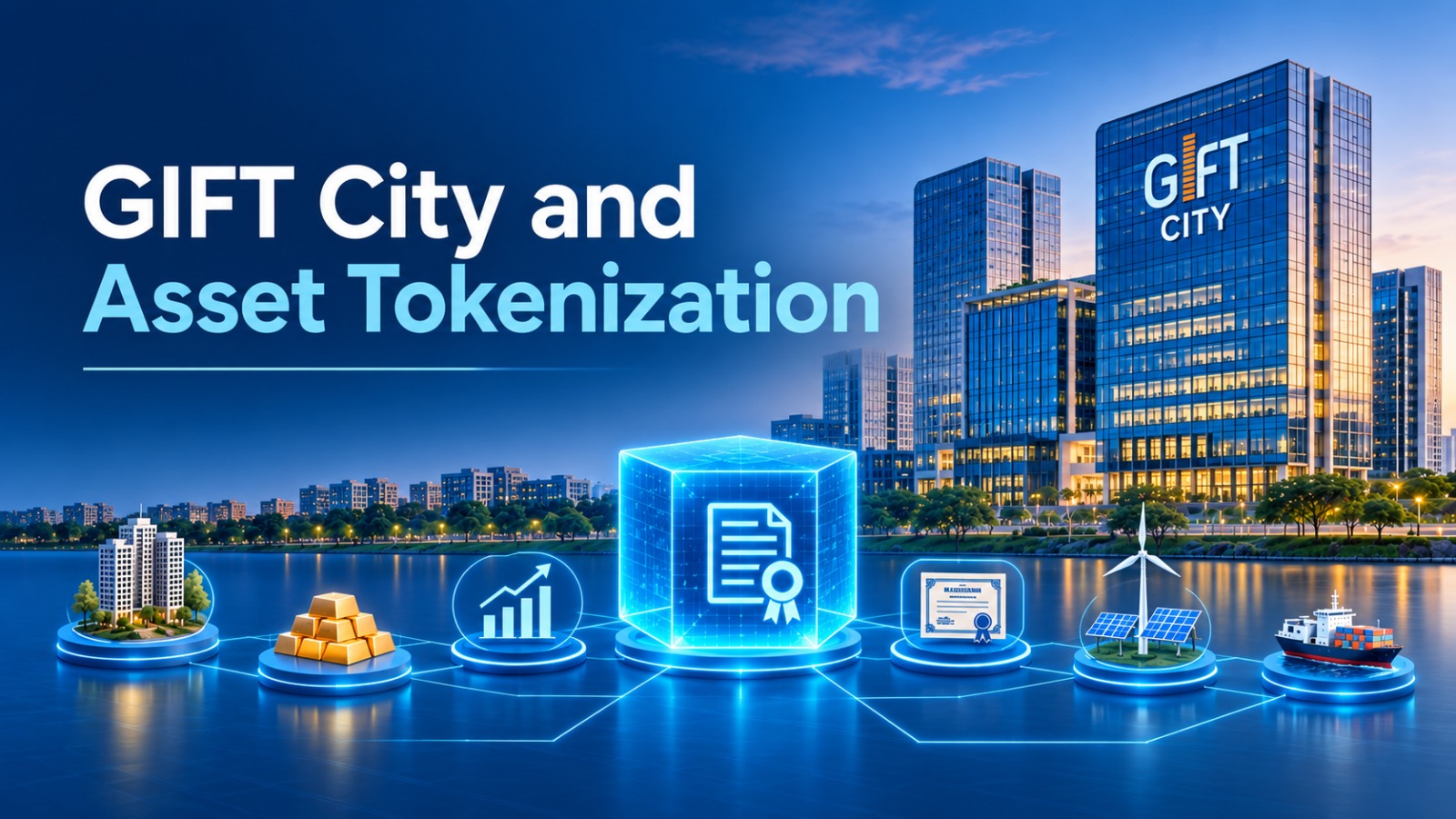
GIFT City tokenization is possible only within the boundaries IFSCA has actually set. As of 5 November 2026, GIFT City does not have a final, notified framework for issuing tokenized real-world assets. What exists is a mix of established IFSC regulations for financial products, a technology-services category that covers tokenization tooling, a 2026 sandbox for limited-scope testing, and a February 2025 consultation paper on tokenizing real-world assets. For Indian enterprises, an IFSC can be a viable route to structure tokenized financial assets for domestic and international investors, but only when the underlying instrument, the issuing entity and the activity each fit an existing IFSCA permission, or are tested through the sandbox.
This guide covers what GIFT City is, what the current regulatory position allows, which assets are candidates, and how an issuance project would run in practice. It does not repeat the coverage of India's proposed tokenization bill or Maharashtra's DELTA Act, which are compared briefly below.
GIFT City (Gujarat International Finance Tec-City) hosts India's first International Financial Services Centre (IFSC), set up under the Special Economic Zones Act, 2005. The International Financial Services Centres Authority (IFSCA), created under the IFSCA Act, 2019, is the unified regulator for financial products, services and institutions in the IFSC.
Three features make it different from India's domestic market:
For enterprises, this is why an IFSC structure is worth evaluating for tokenized assets: it offers a regulated jurisdiction built around cross-border capital flows. It is not an automatic route to tokenization, and every flow between an IFSC entity and a person resident in India remains a FEMA event.
IFSCA is the primary regulator for IFSC activity. SEBI regulates onshore securities markets and matters outside the IFSC perimeter. RBI is relevant mainly through FEMA, since Indian residents investing into IFSC entities are governed by the Overseas Investment Rules, 2022 and the Liberalised Remittance Scheme.
The position on tokenization needs to be read in categories, not as a single framework. Law firm Bhatt & Joshi Associates, in guidance current to 23 October 2026, states plainly that there is no general permission for digital-asset business in GIFT IFSC.
On the sandbox, advisers report that IFSCA has issued Limited Use Authorisations to tokenization platforms. PKM Advisory names Realdom India (Pinvest Exchange) and Terazo for fractional real estate, and a press release from Shipfinex reports a twelve-month sandbox programme for maritime assets. Treat these as company and adviser-reported precedents to verify with IFSCA, not as a template that guarantees approval.
The 2025 consultation paper scopes real-world assets such as securities, fund units, bonds, deposits, receivables, bullion, commodities and commercial real estate. Scope in a consultation is not eligibility. Each asset class below needs its own legal and regulatory analysis.
A token does not change the legal ownership or regulatory classification of the underlying asset. It is a record of rights that must be created and enforceable under the relevant law.
The workflow below is a planning framework, not a licensing checklist. Several steps depend on which IFSCA category applies, and that determination should come from counsel and, where useful, from IFSCA's informal guidance route.
Two structuring points matter. First, commentators including PKM Advisory advise separating the technology provider from the regulated issuer: a tokenization platform registered for technology services should not issue or manage assets itself. Second, IFSC entities and tokenized issuance are different activities, so a plan that blends them in one entity may not map to any single IFSCA category.
These are different approaches, not interchangeable frameworks. Only the IFSC is an operating regulatory jurisdiction today.
An institutional issuer typically needs eight layers:
Institutional issuers often prefer enterprise platforms such as Hyperledger Fabric for these workflows because it supports permissioned membership, identity-based access, channels that limit data visibility and auditable transaction records. Read more on why permissioned blockchains are winning the enterprise race.
The four examples below are hypothetical. They are not approved GIFT City transactions, and each would need a category-specific regulatory assessment.
An infrastructure company exploring tokenized project debt. Opportunity: broaden the investor base for project financing. Possible structure: debt securities issued by an IFSC special purpose entity, with a tokenized register. Technology: permissioned ledger, coupon and redemption logic, investor whitelisting. Regulatory points: securities classification, listing and depository arrangements, FEMA treatment of cash flows to and from India. See tokenizing corporate debt.
A fund manager exploring tokenized fund interests. Opportunity: faster subscription and transfer processing. Possible structure: units in an IFSC fund run by an authorised fund management entity, with the token acting as the register entry. Technology: investor onboarding, transfer restrictions, NAV and distribution events. Regulatory points: fund regime requirements, investor eligibility, transfer agent functions. See fund tokenization.
A financial institution exploring tokenized private credit. Opportunity: syndicate and service loans or receivables digitally. Possible structure: notes backed by a receivables pool, issued by an eligible IFSC entity. Technology: document anchoring, servicing data feeds, access controls for lenders. Regulatory points: classification of the notes, borrower-side FEMA rules, investor protection.
A real estate investment business exploring cross-border investment structures. Opportunity: offer international investors fractional exposure to Indian commercial property. Possible structure: an IFSC fund or SPV holding the property interest. Technology: permissioned issuance, rental distribution automation, investor registry. Regulatory points: title and registration law, FEMA rules on property-related inflows, whether the interest qualifies as a regulated product. See real estate tokenization ownership models.
Evaluate platforms against the control requirements of the regulated structure:
Spydra is an enterprise-grade, low-code blockchain platform for real-world asset tokenization, built on Hyperledger Fabric and designed for private and public blockchain use cases. It provides permissioned network architecture, smart contract-based business logic, integration with external systems, participant permissions and auditable transaction records, which are the technology building blocks of the workflow above. Spydra is technology infrastructure. It is not a legal adviser, regulator, exchange, custodian or investment intermediary, and the choice of IFSCA category, authorisations and investor eligibility stay with the issuer and its advisers. For the build-or-buy question, see build vs. buy for tokenization platforms.
GIFT City hosts India's first IFSC, regulated by IFSCA. IFSC units operate mainly in foreign currency and are treated as non-resident under FEMA, while remaining Indian entities for company and tax law.
Potentially, but only through an existing IFSCA category that fits the underlying instrument and activity, or through the sandbox. There is no general tokenization licence today.
Tokenization technology services are covered under the TechFin regulations, and IFSCA's 2025 consultation expresses intent to recognise tokens for real-world assets. A final tokenization framework had not been identified in October 2026 reviews, so issuance depends on the product framework or sandbox.
The consultation covers securities, fund units, bonds, deposits, receivables, bullion, commodities and commercial real estate. Eligibility of each is not automatic and must be assessed case by case.
Investor eligibility depends on the instrument and offering rules. Because IFSC units transact in foreign currency and are non-resident for FEMA, they are built to serve non-resident investors, subject to the applicable IFSCA requirements.
The approvals follow the underlying product and activity: for example, authorisation as a fund management entity, capital-market or listing approvals, or a sandbox Limited Use Authorisation. Confirm with IFSCA or through its informal guidance scheme.
Permissioned platforms such as Hyperledger Fabric suit regulated workflows because they offer identity-based access, controlled visibility and audit trails. The choice should reflect the regulatory category, custody model and any need for public-chain interoperability.
GIFT City deserves serious consideration for GIFT City tokenization projects aimed at domestic and international investors. It has a dedicated regulator, a foreign-currency framework, a sandbox and an active consultation on real-world asset tokenization. It does not yet have a final tokenization framework, and tokenizing an asset does not change its legal ownership or regulatory classification.
Before launch, enterprises should validate the IFSCA category, the issuing structure, investor eligibility, FEMA treatment, custody and tax position. Regulatory structuring and enterprise blockchain infrastructure have to be designed together, because transfer restrictions, onboarding and reporting live in the smart contracts and the platform.
To explore how a permissioned, low-code platform can support your structure, explore Spydra's asset tokenization capabilities or schedule a demo.