Build vs Buy Tokenization Platform: Enterprise Guide

JavaScript frameworks make development easy with extensive features and functionalities. Here are our top 10 to use in 2022.
Published on
August 17, 2026
Last updated on
August 17, 2026

Introduction: The Question Enterprises Are Asking — and Why the Framing Is Usually Wrong

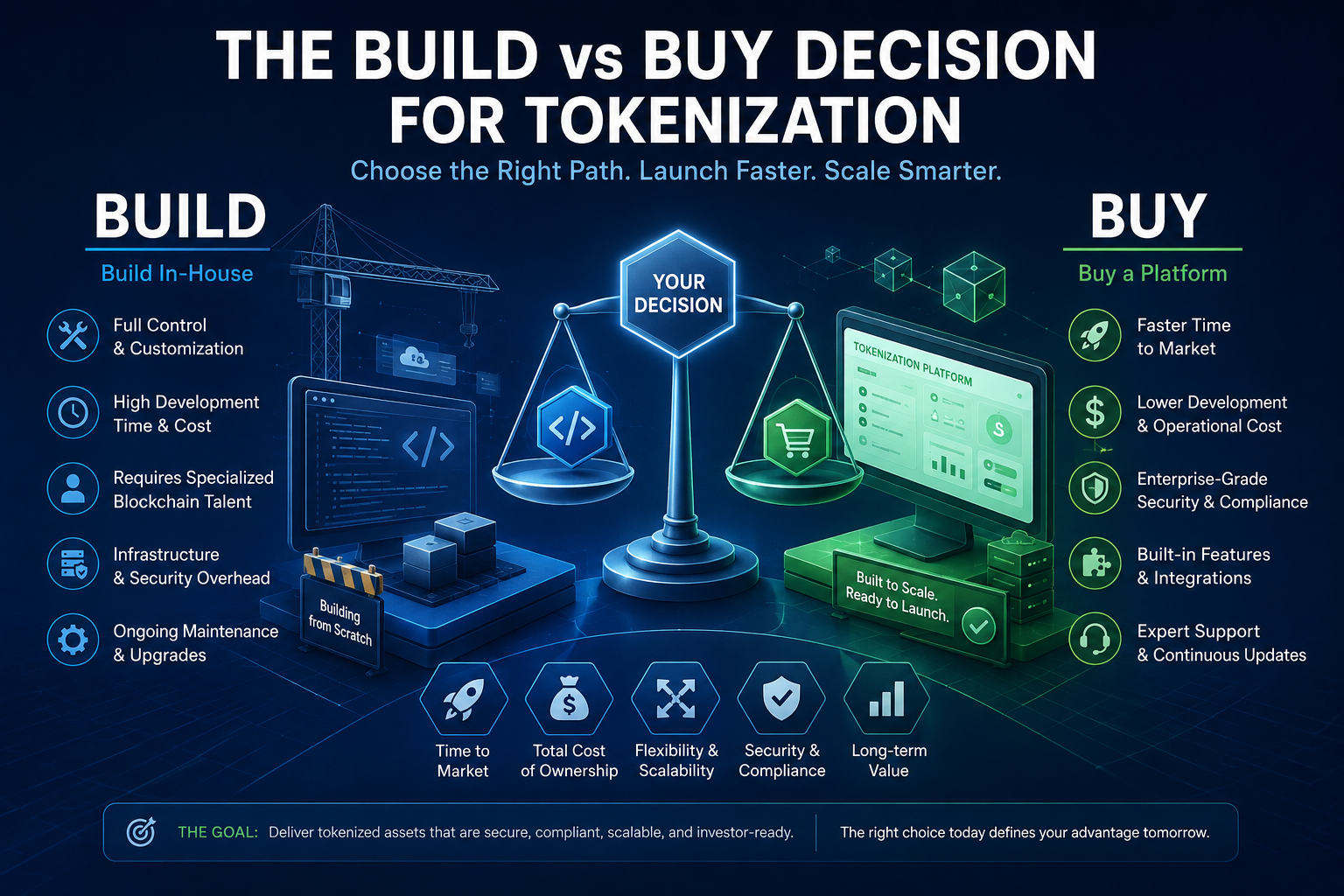
Every enterprise considering tokenization eventually faces the same decision: should we build our own blockchain infrastructure or buy an existing tokenization platform?

This framing misses a third option — and gets two of the three wrong.

The complete decision is not build vs. buy. It is build vs. buy vs. partner. And the factors that determine the right answer go far beyond which option is cheapest in year one. The variables that actually matter are time-to-market, total cost of ownership, engineering complexity, compliance architecture, security, operational scalability, and long-term maintainability.

Most enterprises that choose to build significantly underestimate what building actually means. Most enterprises that choose to buy underestimate the implementation work required to configure a platform to their specific regulatory, asset, and investor requirements. And most enterprises fail to seriously consider the partner model—where a platform provider and implementation specialist work together—which is often the most appropriate approach for complex regulated deployments.

This guide provides the framework to make the build vs. buy vs. partner decision correctly—including a TCO framework, a vendor evaluation checklist, red flags to avoid, and a practical implementation roadmap.

Section 1: Why Enterprises Are Now Asking the Build vs Buy Question

Tokenization has moved from a blockchain experiment to an enterprise implementation priority. Banks, asset managers, real estate funds, insurance companies, and corporate treasury teams are now evaluating how to tokenize:

  • Real estate — commercial, residential, and infrastructure assets
  • Securities — equity, bonds, and structured products
  • Private markets — private equity, venture capital, and hedge fund interests
  • Receivables and trade finance — invoice tokens and supply chain finance instruments
  • Fund structures — tokenized fund units with automated income distribution
  • Treasury assets — tokenized money market funds and short-duration instruments
  • Real-world assets broadly — carbon credits, commodities, and alternative investments

The initial instinct for many technology teams is to build internally. Internal builds appear to offer greater control, no vendor dependency, and infrastructure that can be precisely tailored to the organization's requirements. This instinct is understandable — and frequently wrong.

Building blockchain-based tokenization infrastructure is fundamentally different from building a conventional enterprise application. The difference is not one of scale — it is one of domain. Blockchain infrastructure, smart contract security, token standards, on-chain compliance, and KYC/AML integration require specialist expertise that most enterprise engineering teams do not possess and that is genuinely scarce in the labor market.

For context on the broader tokenization platform landscape, Spydra's comparative analysis of the top asset tokenization platforms in 2026 covers the vendor market in detail.

Section 2: What "Build" Actually Means

When an enterprise decides to build a tokenization platform, it is not building a blockchain application. It is building a tokenization operating system — a stack of interdependent infrastructure components that must work together reliably, securely, and in compliance with applicable regulations.

Blockchain Infrastructure

  • Network architecture: Choosing, deploying, and governing a permissioned blockchain network (Hyperledger Fabric, R3 Corda) or integrating with a public chain (Ethereum, Polygon)
  • Node management: Deploying, monitoring, and maintaining validator/peer nodes — including availability, performance, and upgrade management
  • Identity management: Certificate authorities, member service providers, and network credentialing for permissioned deployments
  • Wallet infrastructure: Key management, wallet provisioning, multi-signature controls, and recovery mechanisms
  • Transaction monitoring: Real-time monitoring of on-chain events for operational and compliance purposes

Token Infrastructure

  • Token standards: Selecting and implementing ERC-20, ERC-721, ERC-3643, or custom token contracts appropriate for the asset type and regulatory requirements
  • Token lifecycle management: Issuance, minting, transfers, pausing, freezing, redemption, and burn mechanisms
  • Ownership records: On-chain cap tables, investor registries, and transfer history
  • Smart contract upgrades: Managing contract versioning and upgrade patterns without disrupting live token holders

Compliance Infrastructure

  • KYC/AML integration: Connecting identity verification providers, implementing investor onboarding workflows, and maintaining ongoing compliance monitoring
  • Transfer restrictions: Encoding jurisdiction restrictions, holding limits, lock-up periods, and accreditation requirements into smart contract logic
  • Regulatory reporting: Automated generation of compliance reports for applicable regulators
  • Whitelist management: Maintaining and updating approved investor lists across all token contracts

Asset Management

  • Asset onboarding and documentation workflows
  • Valuation integration and Oracle connectivity for real-world data feeds
  • Distribution engine: Automated income calculation and payment to token holders
  • Corporate actions: Capital calls, redemptions, governance votes, and liquidation events

Integration Layer

  • Banking and payment systems for fiat on/off-ramps
  • Institutional custody providers for regulated asset holding
  • ERP and CRM connectivity for enterprise data flow
  • KYC providers, identity platforms, and sanction screening services
  • Oracle providers for verified external data feeds
  • Secondary market venues and exchange connectivity

⚠️

Building the integration layer alone — connecting a custom tokenization platform to banking systems, custody providers, KYC services, oracles, and enterprise ERP — typically requires more engineering effort than the token infrastructure itself. This is the component most frequently underestimated at project inception.

Section 3: What Enterprises Get Wrong About Building

Mistake #1: Underestimating the Engineering Surface Area

Most enterprise technology teams estimate tokenization infrastructure based on the surface area they can see — smart contracts, a token issuance interface, an investor dashboard. The surface area they cannot easily see is substantially larger: node management, certificate authority configuration, HSM integration, Oracle security, compliance automation, and multi-year upgrade management.

A production-grade tokenization platform typically requires a team of 8–15 specialists — blockchain architects, smart contract engineers, security engineers, compliance technologists, DevOps, and backend developers — working for 12–24 months before a single asset can be tokenized for live investors.

Mistake #2: Focusing on Smart Contracts Instead of the Full Operating Model

Smart contracts are one component of a tokenization platform — not the platform itself. An enterprise that has hired smart contract developers but has not addressed KYC/AML integration, Oracle connectivity, distribution automation, investor management, or secondary transfer infrastructure has not built a tokenization platform. It has built a token issuance mechanism without the operating model that makes it usable.

Mistake #3: Ignoring Compliance Architecture

Compliance cannot be added to a tokenization platform after token issuance. If transfer restrictions are not encoded in the token contract at deployment, they cannot be reliably enforced after the fact. If KYC is not integrated into the onboarding flow at launch, early investors may not meet the eligibility requirements the platform later adds.

Compliance architecture must be designed before the first line of smart contract code is written — not retrofitted after the platform is live.

Mistake #4: Underestimating Maintenance

A tokenization platform is not a project — it is a service. Once live, it requires:

  • Blockchain protocol upgrades as the underlying network evolves
  • Smart contract security patches when vulnerabilities are identified
  • KYC provider API updates as compliance requirements change
  • Regulatory adaptation as applicable laws are updated across jurisdictions
  • Infrastructure monitoring, incident response, and disaster recovery
  • Annual smart contract security audits expected by institutional investors

The engineering team required to build a tokenization platform is not demobilized at launch — it is the team required to maintain and operate it indefinitely.

Mistake #5: Assuming Internal Ownership Automatically Means Lower Cost

Internal control is not free. The cost of ownership includes the engineering team's fully loaded compensation, cloud infrastructure, security tooling, compliance technology, audit fees, and the opportunity cost of that engineering capacity not being applied to revenue-generating products.

For most enterprises, the total cost of internal ownership over three years exceeds the cost of a commercial platform — even before accounting for the revenue delayed by a longer time-to-market.

Section 4: The Hidden Costs of Building a Tokenization Platform

Direct Costs

  • Engineering salaries: Blockchain architects ($180K–$350K+/year), smart contract engineers, security engineers, and DevOps—typically 8–15 FTEs for a production platform
  • Smart contract audits: Independent security audits required before every major deployment — typically $25K–$150K per audit, depending on contract complexity
  • Compliance technology: KYC/AML providers, sanctions screening services, and regulatory reporting tools
  • Cloud infrastructure: Node hosting, HSM services, data storage, and monitoring tools
  • Legal and regulatory: Securities counsel in each target jurisdiction for instrument structuring

Indirect Costs

  • Opportunity cost: Revenue delayed by 12–24 months of platform development rather than asset deployment
  • Management overhead: Engineering leadership time spent on infrastructure rather than product strategy
  • Hiring difficulty: Experienced blockchain engineers are scarce—recruiting costs, extended timelines, and high turnover risk
  • Maintenance overhead: Ongoing team cost to maintain, upgrade, and support the platform

Risk Costs

  • Smart contract vulnerabilities: A single exploitable bug in a live token contract can result in investor losses and regulatory investigation
  • Compliance failures: A KYC or transfer restriction gap identified post-launch can require platform shutdown and regulatory remediation
  • Architecture lock-in: Early technology decisions—blockchain choice, token standard, storage model—are expensive to reverse once assets are live
  • Talent dependency: A platform that depends on two or three senior blockchain engineers is vulnerable to resignation, acquisition, or departure

TCO Framework — Strategic Formula

Total Cost of Ownership = Development + Infrastructure + Security + Compliance + Maintenance + Integration + Opportunity Cost

Note: This is a strategic decision framework, not a universal pricing formula. Actual costs vary significantly based on use case, jurisdiction, team composition, and asset complexity. Enterprises should model a 3–5 year TCO, not first-year cost alone.

Section 5: When Building Does Make Sense

Building is not universally wrong. There are scenarios where internal development is the rational strategic choice:

  • Tokenization infrastructure is itself the product: If the enterprise is building a tokenization platform as a commercial product or a regulated infrastructure service — not as a means to tokenize its own assets — proprietary infrastructure may be justified.
  • Highly specialized regulatory requirements: If applicable regulations require infrastructure architecture that no commercial platform currently supports, building may be the only option.
  • Existing mature blockchain engineering team: If the enterprise already employs 10+ experienced blockchain engineers with production tokenization experience, the incremental cost of building is lower.
  • Strategic infrastructure ownership as competitive moat: In specific market contexts, owning and controlling the tokenization infrastructure — not just the assets — creates a sustainable competitive advantage that justifies the investment.
  • Very high transaction volumes with specific throughput requirements: Where transaction volume and latency requirements exceed what commercial platforms can support, custom infrastructure may be necessary.

If none of these conditions apply, building is likely the more expensive, slower, and riskier option.

Section 6: What "Buy" Actually Means

Buying a tokenization platform does not mean purchasing a black-box SaaS application with no flexibility. Enterprise tokenization platforms range significantly in their deployment and customization models:

  • SaaS: Hosted platform with shared infrastructure — fastest to deploy, least customization, suitable for standard use cases
  • Enterprise platform: Dedicated deployment with configurable parameters — the most common enterprise model
  • Licensed infrastructure: Source code or infrastructure licensed to the enterprise for self-hosted deployment
  • White-label platform: Branded deployment of the provider's platform under the enterprise's identity
  • Platform + professional services: Platform capabilities combined with provider-delivered implementation, integration, and customization
  • Platform + integration partner: Platform capabilities combined with a third-party implementation specialist

The distinction matters because enterprises often evaluate platforms assuming they are buying a SaaS tool when the better model for their requirements is a dedicated enterprise deployment with custom integration.

Section 7: What Enterprises Actually Buy When They Choose a Tokenization Platform

An enterprise tokenization platform is not a smart contract generator. It is a pre-built, tested, and maintained stack of infrastructure components that would otherwise require years to build internally.

When evaluating platforms, enterprises are effectively purchasing the following:

  • Token Engine — configurable issuance, lifecycle management, and transfer enforcement for multiple asset classes and token standards
  • KYC/AML compliance — integrated investor identity verification, sanctions screening, and accredited investor qualification
  • Compliance controls — programmable transfer restrictions, jurisdiction rules, holding limits, and lock-up enforcement
  • Workflow automation — configurable business process automation for asset onboarding, investor onboarding, and corporate actions
  • Oracle integrations — verified external data feeds connecting real-world events (rental income, valuations) to automated smart contract execution
  • IPFS/decentralized storage — off-chain document management with on-chain integrity proofs
  • Investor management — portfolio tracking, distribution management, statement generation, and corporate action processing
  • Permissioned network — Hyperledger Fabric or equivalent permissioned blockchain infrastructure with network governance
  • Public blockchain connectivity — Ethereum, Polygon, or other public chain integration for use cases requiring broader liquidity access
  • API architecture — REST APIs for integration with existing ERP, CRM, banking, and custody systems
  • Security infrastructure — independently audited smart contracts, access control, key management, and monitoring
  • Audit and reporting — real-time on-chain audit trails accessible to regulators and compliance teams

Section 8: The Partner Model — The Middle Ground Enterprises Often Miss

The partner model combines a commercial tokenization platform with an implementation specialist — either the platform provider's professional services team or a third-party enterprise blockchain consultancy. This model is frequently the most appropriate choice for enterprises deploying in regulated environments or with complex integration requirements.

Partnering allows enterprises to:

  • Access platform capabilities without building underlying infrastructure
  • Retain strategic control over business logic, data, and investor relationships
  • Leverage specialist expertise for jurisdiction-specific legal structuring and regulatory compliance
  • Customize token behavior, workflow logic, and investor experience without building the underlying stack
  • Accelerate time-to-market while maintaining integration quality
  • Migrate from legacy systems to tokenized infrastructure with expert support

For enterprises evaluating architecture options, Spydra's blockchain solution consultancy provides enterprise architecture assessment and implementation support across the full tokenization stack.

Section 9: Build vs Buy vs Partner — Detailed Comparison

The following comparison covers thirteen decision factors across all three approaches. Note that actual outcomes depend heavily on vendor quality, implementation execution, and regulatory context—this is a directional framework, not a universal formula.

Factor Build Buy Partner
Time to market 12–24+ months Weeks to months 2–6 months
Initial engineering effort Very high — full stack build Low — configuration and integration Moderate — integration and customization
Upfront cost Very high — team, infra, audits Moderate — licensing and implementation Moderate — platform plus consulting
Long-term maintenance Full internal responsibility Platform provider handles core updates Shared between platform and partner
Customization Unlimited — but at full cost Within platform parameters High — platform plus bespoke layer
Compliance infrastructure Must be built from scratch Typically built in Configurable with expert support
Security responsibility Entirely internal Shared with platform provider Shared with platform and partner
Blockchain expertise required Deep — architecture to DevOps Low — platform abstracts complexity Moderate — integration and configuration
Scalability Depends on architecture quality Platform-managed Shared responsibility
Vendor dependency None — but talent dependency Platform provider Platform plus partner
Internal control Maximum — but maximum cost High within platform boundaries High — with external support
Integration flexibility Unlimited — at development cost REST API — platform-dependent Custom integration via partner
Best suited for Proprietary infra as core product Standard enterprise tokenization Complex or regulated deployments

Section 10: How to Calculate Build vs Buy Economics

Enterprise technology decisions should be evaluated over a 3–5 year horizon, not based on first-year cost alone. The following framework structures a TCO comparison across all three approaches.

Step 1 — Estimate Internal Build Cost

  • Team composition: Blockchain architect, 2–3 smart contract engineers, security engineer, DevOps engineer, backend engineers, compliance technology lead — 8–15 FTEs depending on scope
  • Development timeline: 12–24 months to production for a full-stack tokenization platform
  • Infrastructure: Cloud hosting, node infrastructure, HSM services, monitoring tools
  • Audits: Smart contract audits at each major deployment phase; annual security reviews
  • Compliance technology: KYC/AML provider, sanctions screening, regulatory reporting tools
  • Legal: Securities counsel in each target jurisdiction for instrument structuring

Step 2 — Estimate Opportunity Cost

  • How much revenue is delayed by 12–24 months of platform development?
  • How long before the first tokenized asset launches — and what is the value of that delay?
  • How much senior engineering capacity is consumed that could otherwise build revenue-generating products?
  • What is the cost of being a market follower rather than a first mover in your asset class?

Step 3 — Estimate Platform Cost

  • Licensing: Platform fee structure — per-asset, per-transaction, annual license, or hybrid
  • Implementation: Professional services for configuration, integration, and deployment
  • Integration: Internal engineering effort for ERP, banking, custody, and KYC connectivity
  • Support: Ongoing SLA, upgrade management, and helpdesk costs
  • Infrastructure: Platform-managed vs. enterprise-hosted deployment cost differential

Step 4—Compare 3–5 Year TCO

Most enterprises that model build vs. buy over five years—including maintenance, upgrades, compliance adaptation, and opportunity cost—find that a commercial platform has a lower total cost of ownership even when the internal build appears cheaper in year one.

The critical variable is usually not the platform license cost. It is the ongoing cost of an internal engineering team maintaining, securing, and evolving a custom tokenization platform across multiple regulatory changes and blockchain protocol upgrades.

💡

Recommendation: Model TCO over 3–5 years, not the first year alone. Include opportunity cost, maintenance, compliance adaptation, and the fully loaded cost of the internal engineering team required to maintain a custom platform. First-year cost comparisons systematically undervalue the platform option.

Section 11: How to Evaluate a Tokenization Platform

When evaluating commercial tokenization platforms, enterprise procurement teams should assess capabilities across five dimensions:

Architecture

  • Supports both permissioned blockchain (Hyperledger Fabric) and public blockchain (Polygon/Ethereum) deployment
  • REST API architecture with comprehensive documentation and webhook support
  • Modular design — components can be used independently or as an integrated stack
  • Demonstrated scalability across multiple concurrent asset classes and investor bases
  • Clear data ownership and portability — can the enterprise export its data if it changes platforms?

Token Standards and Compliance

  • Supports compliant token standards including ERC-3643 for regulated securities
  • Built-in KYC/AML integration with configurable provider connectivity
  • Programmable transfer restrictions — jurisdiction, accreditation, lock-up, and whitelist enforcement
  • Investor eligibility checks enforced at every transfer, not just at initial onboarding
  • Comprehensive audit trails accessible to regulatory bodies without manual data requests
  • Jurisdiction-configurable compliance rules for multi-market deployments

Asset Lifecycle and Operations

  • Supports multiple asset classes — real estate, bonds, funds, commodities, receivables
  • Automated income distribution with Oracle-connected smart contract triggers
  • Corporate action processing — redemptions, capital calls, governance votes
  • Investor portal with real-time portfolio tracking and statement generation
  • Oracle integration for verified external data feeds

Security

  • Independent smart contract audits — required; verify audit reports from recognized firms
  • Multi-signature controls on platform treasury and distribution wallets
  • Role-based access control for administrators, compliance teams, and investors
  • Defined disaster recovery and business continuity procedures
  • Platform security certifications and penetration testing history

Enterprise Readiness

  • Defined SLA with uptime guarantees and incident response commitments
  • Enterprise support model — named contacts, escalation paths, and response times
  • Deployment options — cloud-hosted, self-hosted, or hybrid
  • Clear upgrade strategy — how are blockchain protocol changes and smart contract updates managed?
  • Documentation quality — is the API documentation complete and maintained?

Section 12: Red Flags When Evaluating Tokenization Vendors

The following warning signs should trigger additional scrutiny in any vendor evaluation:

  • Focuses only on token creation — no discussion of compliance architecture, asset lifecycle, or investor management
  • Cannot clearly explain the deployment architecture — permissioned vs. public chain, data privacy model, node governance
  • No smart contract audit documentation available or audits conducted by unrecognized firms
  • No clear data ownership policy—the enterprise cannot export investor data or token records if it changes platforms
  • No upgrade strategy — how does the platform handle blockchain protocol upgrades or smart contract security patches without disrupting live investors?
  • "Instant tokenization" promises without discussing legal structuring, securities classification, KYC requirements, or compliance architecture
  • Limited API documentation — integration with existing enterprise systems would require significant custom development
  • No enterprise support model — no SLA, no named contacts, no escalation path
  • Weak or absent secondary market strategy — token issuance is positioned as creating automatic liquidity
  • No migration or exit strategy — no documented process for moving token records to another platform
  • Regulatory claims without specifics—"compliant with all regulations" is not a compliance architecture

Section 13: How Spydra Fits the Build vs Buy Decision

Spydra is an enterprise-grade asset tokenization platform built on Hyperledger Fabric — a permissioned, enterprise-grade blockchain framework — with optional public chain deployment for use cases requiring broader liquidity access. The platform is designed to reduce the engineering, compliance, and operational infrastructure that enterprises would otherwise need to design, build, secure, integrate, and maintain internally.

Spydra's platform addresses each component of the tokenization stack:

  • Token Engine: Configurable token issuance, lifecycle management, and transfer enforcement across multiple asset classes and token standards
  • Compliance engine: Built-in KYC/AML modules, investor whitelisting, transfer restriction enforcement, and audit trail generation
  • Workflow automation: Low-code configuration of asset onboarding, investor onboarding, income distribution, and corporate action workflows
  • Oracle integration: Verified external data feeds connecting real-world events to automated smart contract execution
  • IPFS integration: Off-chain document storage with on-chain integrity proofs for property documents and legal agreements
  • Graph Query: On-chain data querying for investor reporting, compliance monitoring, and operational analytics
  • Listeners / event monitoring: Real-time on-chain event tracking for operational and compliance teams
  • Public blockchain connectivity: Polygon and Ethereum integration for use cases where DeFi-native liquidity access is a priority alongside permissioned deployment

The value proposition is not simply faster blockchain development. It is the reduction of the infrastructure surface area the enterprise must own. Rather than building a tokenization operating system, the enterprise deploys its assets, products, and investor relationships on top of a pre-built, maintained, and audited platform. For deeper technical background on Spydra's permissioned network approach, see the Spydra Hyperledger Fabric blog post at spydra.app/blog/spydra-your-certified-hyperledger-fabric-service-provider, and for a comparison of platform options, the top tokenization platforms guide at spydra.app/blog/top-asset-tokenization-platforms.

Section 14: A Practical Decision Framework

Choose Build If...

Choose Buy If...

Choose Partner If...

  • Tokenization infrastructure is itself your core product
  • You have 10+ experienced blockchain engineers in-house
  • Unique regulatory requirements no platform addresses
  • Very high transaction volumes with specific throughput needs
  • Strategic infrastructure ownership is a competitive moat
  • Standard enterprise tokenization use case
  • Time-to-market is a strategic priority
  • No existing blockchain engineering team
  • Compliance infrastructure is a major complexity driver
  • Capital is better deployed on assets, not infrastructure
  • Complex or heavily regulated deployment
  • Need platform capabilities plus custom integration
  • Jurisdiction-specific legal structuring required
  • Want platform foundation with bespoke business logic on top
  • Migrating from legacy system to tokenized infrastructure

For enterprises that score positively on more than three of the "Build" criteria, internal development deserves serious evaluation with a detailed engineering and cost plan. For all others, buying or partnering is the more defensible strategic choice.

Section 15: The Recommended Enterprise Approach

The strongest approach for most enterprises is: start with a platform, customize where differentiation matters, retain strategic control over business logic and data.

In practice, this means a phased implementation:

1. Define the tokenization use case

What asset class? What investor type? What jurisdiction? What economic rights will the token represent?

2. Define regulatory requirements

Which securities regulations apply? What KYC/AML obligations? What transfer restrictions? Engage legal counsel before technology selection.

3. Map the asset lifecycle

From issuance through distribution, transfer, corporate actions, and redemption—document every workflow before evaluating platforms.

4. Evaluate build vs buy vs partner

Apply the TCO framework. Model 3–5 year costs including maintenance and opportunity cost.

5. Conduct vendor due diligence

Apply the evaluation checklist. Test APIs. Review audit reports. Verify data portability terms.

6. Build a pilot with one asset

Deploy a single asset on the platform before committing to a multi-asset rollout. Validate compliance, integration, and operational workflows.

7. Integrate enterprise systems

Connect the platform to existing ERP, banking, custody, and KYC infrastructure via REST API.

8. Conduct security and compliance validation

Independent review of smart contract implementation, compliance architecture, and data security.

9. Launch production

Initial investor onboarding, token issuance, and first distribution cycle.

10. Scale to additional asset classes

Leverage the platform's multi-asset architecture to extend to additional asset types and jurisdictions.

🔑 Key Takeaways

  • The correct decision framework is Build vs. Buy vs. Partner—not Build vs. Buy. Each has distinct use cases, and the partner model is frequently the most appropriate choice for regulated enterprise deployments.
  • Building a tokenization platform requires 12–24 months, 8–15 specialized engineers, and ongoing maintenance—a commitment that is rarely justified unless tokenization infrastructure itself is the enterprise's core product.
  • The TCO of building typically exceeds the cost of a commercial platform over a 3–5 year horizon, especially when opportunity cost and ongoing maintenance are included in the model.
  • Compliance architecture must be designed before smart contract development begins — it cannot be added after token issuance without significant rework.
  • When evaluating platforms, assess all five dimensions: architecture, token standards and compliance, asset lifecycle, security, and enterprise readiness. A platform strong on token issuance but weak on compliance infrastructure creates regulatory risk.
  • Red flags include: no smart contract audit reports, no data portability, 'instant tokenization' promises, and no defined upgrade strategy.
  • The strategic question is not, 'Can we build a tokenization platform? '' Should tokenization infrastructure be our core engineering competency, or should we focus resources on the assets, products, and investor experiences built on top of it?'

Conclusion: The Right Question to Ask

The build-vs.-buy question should not be framed as "Can we build a tokenization platform?" Almost any enterprise with sufficient engineering budget can build something. The right question is, "Should tokenization infrastructure be our core engineering competency—or should we focus our resources on the assets, markets, products, and customer experiences built on top of it?"

For most enterprises, the honest answer is the latter. The infrastructure required for compliant, institutional-grade tokenization — blockchain networks, smart contract security, KYC/AML compliance, Oracle integration, distribution automation, custody, and secondary market connectivity—is a specialist domain. Maintaining it is an ongoing operational commitment that competes directly with the organization's ability to invest in its primary business.

Enterprises that choose to buy or partner rather than build compress time-to-market from years to months, transfer infrastructure risk to specialist providers, and redirect engineering capacity toward the products and investor experiences that actually differentiate their business. Platforms like Spydra exist precisely to provide that foundation — so enterprises can deploy their assets and markets on top of proven infrastructure rather than rebuilding the foundation from scratch.

Frequently Asked Questions

Q: What is the build vs. buy decision for tokenization?

A: The build vs. buy decision for tokenization is the strategic choice between developing tokenization infrastructure internally, purchasing a commercial tokenization platform, or combining a platform with an implementation partner. The complete framework is Build vs Buy vs Partner. The decision involves time-to-market, total cost of ownership, compliance complexity, engineering expertise, and long-term maintainability — not first-year cost alone.

Q: Is it better to build or buy a tokenization platform?

A: For most enterprises, buying or partnering is the better strategic choice. Building requires 12–24 months, a team of 8–15 specialist engineers, compliance infrastructure, smart contract security audits, and ongoing maintenance — costs that exceed the value unless tokenization infrastructure is itself the core product. Commercial platforms compress deployment to weeks while transferring infrastructure risk to a specialist provider.

Q: How much does it cost to build a tokenization platform?

A: Building a production-grade tokenization platform typically requires 8–15 specialized engineers working for 12–24 months, plus cloud infrastructure, smart contract audits ($25K–$150K each), compliance technology, and legal counsel. Total first-year costs vary significantly by scope and jurisdiction. Critically, ongoing maintenance adds a permanent engineering cost that is frequently underestimated in initial build-vs-buy models.

Q: What are the hidden costs of building a tokenization platform?

A: Hidden costs include opportunity cost from delayed time-to-market; management overhead as senior leadership focuses on infrastructure rather than product; ongoing maintenance of a dedicated engineering team; compliance adaptation as regulations evolve; annual smart contract security audits; and architecture lock-in costs when early technology decisions need to be revised after assets are live.

Q: What should enterprises look for in a tokenization platform?

A: Evaluate platforms on five dimensions: (1) Architecture — blockchain support, API quality, scalability; (2) Compliance — built-in KYC/AML, transfer restrictions, audit trails; (3) Asset lifecycle — issuance, distributions, corporate actions; (4) Security — independent audits, key management, access control; (5) Enterprise readiness — SLA, documentation, data portability, and upgrade strategy.

Q: What is the difference between buying and partnering for tokenization?

A: Buying means deploying a commercial platform with internal implementation. Partnering means combining a commercial platform with an implementation specialist — either the platform provider's professional services team or a third-party blockchain consultancy. The partner model provides greater customization, regulatory expertise, and integration depth than self-service deployment and is often the best choice for complex or regulated enterprise use cases.

Q: How long does it take to build a tokenization platform?

A: Building a production-grade tokenization platform from scratch typically takes 12–24 months — including blockchain infrastructure, token contracts, compliance architecture, KYC/AML integration, investor management, and Oracle connectivity. A commercial tokenization platform can be configured and deployed in 4–12 weeks for standard use cases, with more complex regulated deployments taking 3–6 months.

Q: Can enterprises customize a tokenization platform?

A: Yes. Enterprise tokenization platforms provide configurable parameters, REST APIs, and low-code workflow tools that allow significant customization without requiring custom smart contract development. For highly specialized requirements — unique token structures, bespoke compliance rules, or custom integration — the partner model provides access to platform-level customization with specialist implementation support.

Q: What blockchain infrastructure is required for asset tokenization?

A: Enterprise tokenization requires a blockchain network (permissioned like Hyperledger Fabric for regulated deployments, or public chains like Polygon for broader liquidity); smart contracts for token issuance and compliance; wallet infrastructure; node management; identity and credentialing; and Oracle connectivity for real-world data. Building this infrastructure internally represents the largest component of the build option's engineering surface area.

Q: How does a tokenization platform handle KYC and AML?

A: Enterprise platforms integrate with third-party KYC/AML providers via API—performing government ID verification, liveness checks, PEP and sanctions screening at investor onboarding. Verified investor credentials are linked to blockchain wallet addresses. Smart contracts enforce KYC status at every token transfer — not just at onboarding — preventing non-compliant investors from receiving tokens regardless of how the transfer is initiated.

Q: What are the biggest risks of building tokenization infrastructure internally?

A: The biggest risks are smart contract vulnerabilities that create investor losses or regulatory exposure; compliance gaps discovered post-launch that require platform shutdown; architecture decisions that lock the enterprise into a technology approach that becomes expensive to change; talent dependency on a small number of specialist engineers; and the opportunity cost of delayed time-to-market while competitors deploy on commercial platforms.

Q: How should enterprises evaluate tokenization vendors?

A: Request and review independent smart contract audit reports from recognized firms. Test API documentation completeness. Verify data portability terms — can you export investor records and token data if you change platforms? Ask for the upgrade strategy — how are blockchain protocol changes handled for live token holders? Check the support model—named contacts, SLA commitments, and incident response procedures.

Latest posts

Subscribe to Our Newsletter

Thank you! Your submission has been received!
Oops! Something went wrong while submitting the form.
Summarise page: