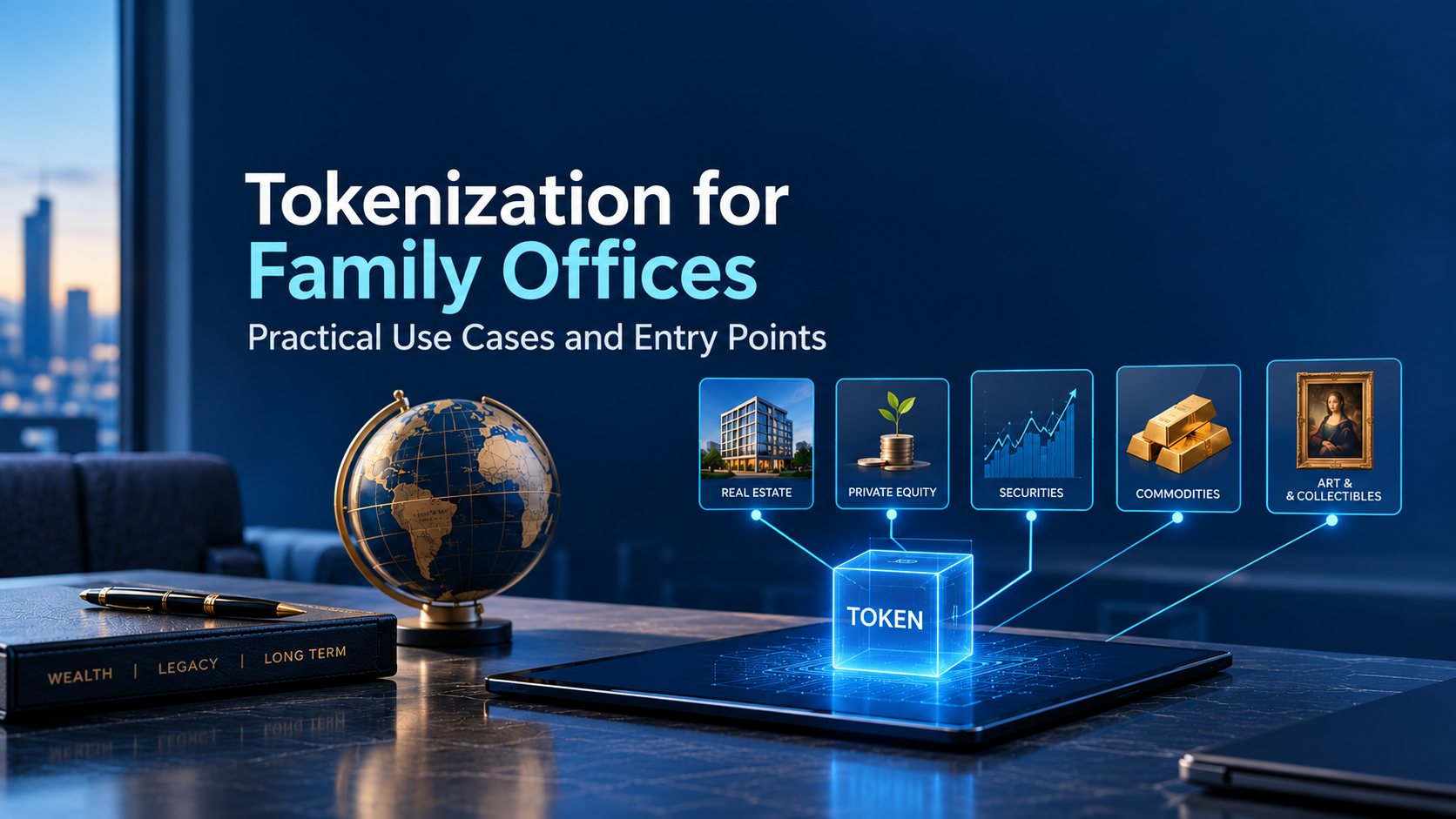
A modern family office rarely holds a simple portfolio. A single family may own a commercial building through a holding company, back several private equity funds, lend through a private credit vehicle, and keep gold in a vault and a few paintings on loan to a museum. Each holding sits in a different legal wrapper, with its own administrator, its own reporting calendar and its own paper trail.
This fragmentation is a large part of why tokenization for family offices has moved from curiosity to a standing agenda item. Family office asset tokenization means representing ownership or economic rights in a real-world asset as a digital token on a blockchain, so that records, transfers and distributions follow programmable rules. Done well, it can improve record-keeping, make fractional structures practical and give a family office a clearer view across alternative assets.
It is also easy to oversell. Interest is real but still early. JPMorgan Private Bank's 2026 Global Family Office Report, which surveyed 333 single-family offices, found that 89% held no cryptocurrency exposure, a reminder that digital assets in general remain a niche allocation for most families. Tokenization of alternative assets is a different proposition from buying crypto, because the underlying asset is a conventional one. But the caution in that survey is the right starting posture: evaluate tokenization against specific operational problems, not as a trend to join.
This guide walks through what tokenization actually is, seven practical use cases, the benefits and risks, how permissioned and public blockchains differ, and a five-step path to a first pilot.
Asset tokenization turns a record of ownership or economic entitlement into a digital token held on a distributed ledger. The token is not the asset. It is a representation of rights that exist in a legal structure: a share in a property-holding company, a unit in a fund, a participation in a loan, or a claim on vaulted gold.
That distinction matters because three things are easily confused:
A well-designed structure states explicitly how the token maps to each of these. If the legal documents do not say a token holder has a right, the token does not create it.
Smart contracts are software rules on the blockchain that enforce how the token behaves: who may hold it, when it may be transferred, and how income is distributed. A transfer to an unverified investor can be blocked automatically, and a quarterly distribution can be calculated and paid according to pre-agreed logic.
This is different from simply digitizing documents. A scanned subscription agreement in a data room is still a static file; reconciliation still happens in spreadsheets and emails. A tokenized record is a live ledger entry that updates when ownership changes.
Regulators are consistent on one point: tokenization changes the format, not the rules. In January 2026, SEC staff from three divisions issued a Statement on Tokenized Securities making clear that a security remains a security when it is represented on a blockchain, and distinguishing issuer-sponsored structures from third-party models that can add counterparty and insolvency risks. The statement is staff guidance, not a Commission rule. A senior ESMA official has made the same point in public: tokenisation does not change the nature of the asset.
For institutional use, many projects also favor permissioned blockchain infrastructure, in which only vetted participants can join the network and see data. That suits family offices, who generally need confidentiality and controlled access, a point we return to below.
The scenarios below are illustrative, not case studies. Each assumes the appropriate legal structure, securities-law analysis and custody arrangements are in place.
Traditional challenge: Commercial and residential property is large, indivisible and slow to administer. Co-investment with other families means bespoke LLC agreements, manual cap tables and cumbersome transfers.
How tokenization helps: Tokenized real estate investments represent interests in the property-holding entity as tokens, each tied to defined economic rights such as rental income and sale proceeds.
Example: A family office acquires a logistics warehouse through an SPV and offers a co-investment tranche to three allied families. Units are issued as tokens to pre-approved wallets; rental income is distributed pro rata by smart contract after the administrator confirms net income.
Business value: A cleaner ownership register, faster distributions and simpler onboarding of future co-investors.
Consideration: Title, financing covenants and local property law govern the asset. Tokens must be consistent with them, and some jurisdictions require specific registration steps for property interests.
Traditional challenge: Fund interests and direct stakes are tracked through subscription documents, side letters and administrator records. Transfers are rare, slow and subject to GP consent.
How tokenization helps: Tokenized private equity can represent fund interests or company equity with transfer restrictions encoded in the token, along with investor eligibility checks at onboarding.
Example: A multi-family office runs a feeder vehicle into a venture fund. Each investor's units are recorded as tokens, and capital-call and distribution events are logged on a shared ledger visible to the administrator and auditors.
Business value: Consistent ownership records, auditable capital activity and less manual reconciliation.
Consideration: Fund documents and GP approval rights still control transfers. Tokenizing an interest does not create a secondary market. Singapore's tokenised-fund work is instructive here: commentary on Project Guardian notes that private-market tokenisation is being piloted but real flow remains small.
Traditional challenge: Loan portfolios involve repayment schedules, interest calculations, waterfalls and covenant monitoring, much of it handled manually across parties.
How tokenization helps: Tokenized private debt can encode repayment schedules and distribution waterfalls so that investor entitlements update as borrowers pay.
Example: A family office lends to a pool of trade-finance borrowers through a special-purpose vehicle. Notes are issued as tokens, and each repayment triggers an automated allocation to senior and junior holders.
Business value: Faster, more transparent distribution and an audit trail of every payment event.
Consideration: The smart contract mirrors the loan agreement; it does not replace credit underwriting, enforcement rights or default procedures. Borrower data must stay confidential.
Traditional challenge: High-value art, vintage cars and collectibles are illiquid, costly to hold, and hard to co-own or verify.
How tokenization helps: Fractional economic interests in a vehicle that holds the object, plus a tamper-evident provenance and condition record.
Example: Several families co-own a classic car through a holding company. Tokens represent shares of that company, and the record links to authentication, insurance and storage documents.
Business value: Practical co-ownership and a durable provenance trail.
Consideration: Valuation is subjective, and physical custody, insurance and authenticity must be verified by credible third parties. A token cannot prove an object is genuine.
Traditional challenge: Physical commodities require vaulting, assay verification and redemption logistics, and paper claims can be opaque.
How tokenization helps: Digital representations are linked to specific, audited holdings under a defined custody and redemption arrangement.
Example: A family office holds an allocated gold position with a regulated custodian, and tokens record each unit of entitlement, with periodic reserve attestations.
Business value: Clearer evidence of what is held, easier transfer between approved holders and simpler reporting.
Consideration: The value rests on custodian integrity, audit quality and redemption terms. Read those terms before the technology.
Traditional challenge: Consolidated reporting across holdings typically means collecting statements from many administrators and stitching them together by hand.
How tokenization helps: When holdings across assets share a common token framework, tokenized investment portfolios can feed a single view of ownership, lifecycle events and entitlements.
Example: A CIO's team tracks real estate, credit and fund holdings on one permissioned platform with role-based dashboards for the investment team, the controller and external auditors.
Business value: Better visibility, fewer reconciliation breaks and quicker audit support.
Consideration: This benefit depends on consistent data standards and integration with existing portfolio and accounting systems. Without that, a new platform simply adds another silo.
Traditional challenge: Admitting investors across jurisdictions involves different eligibility rules, documentation and transfer restrictions.
How tokenization helps: Compliance rules can be written into token behavior, for example restricting holdings to verified investors in permitted jurisdictions.
Example: A family office in one country offers a private credit note to qualified investors in two others. Onboarding checks and jurisdictional whitelists are enforced before any token transfer.
Business value: Repeatable compliance controls and a clearer record of who may hold what.
Consideration: Encoding rules does not make an offering lawful. Local securities, tax and reporting law apply in every jurisdiction involved, and counsel must sign off on the structure.
The benefits of tokenization for family offices are best understood as potential improvements to operations, not guaranteed outcomes.
Transparency and traceability. A shared ledger records ownership changes in a verifiable sequence, which helps with audits and dispute resolution.
Operational efficiency. Automating distributions, corporate actions and register updates can reduce manual work and reconciliation errors.
Fractional structures. Smaller units can make co-investment and tiered participation easier to administer, within the limits of the legal structure.
Controlled access. Eligibility checks and role-based permissions help keep investments within approved circles, which matters for private wealth tokenization where confidentiality is central.
Portfolio administration. Consistent records support consolidated reporting and lifecycle tracking.
Potential liquidity. Tokenization can make transfers technically simpler, and regulators are building supporting infrastructure. In the US, the SEC issued a no-action letter to DTC in December 2025 for a securities tokenization pilot. But technical transferability is not liquidity. Liquidity needs willing buyers, permitted venues and legal clearance.
To be direct: tokenization does not eliminate investment risk, improve an asset's quality or guarantee a buyer. A poorly underwritten loan is still poorly underwritten when it is a token.
Neither model is universally better. The right choice depends on the use case, the investor base and the regulatory environment. Choosing the right digital asset infrastructure for family offices often means weighing both.
Enterprise permissioned frameworks such as Hyperledger Fabric are often considered for institutional use because they support known participants, private data collections and configurable access control. These features suit a family office that must protect investor identities and deal terms. Public networks offer broad reach, open composability and an existing ecosystem of settlement and trading venues, which may matter if a structure eventually needs wider distribution.
Some organizations adopt a hybrid approach: private networks for record-keeping and compliance, with controlled bridges to public environments where permitted. A platform that supports both gives a family office room to change course as regulation and market structure evolve.
If you are asking how to implement RWA tokenization in a family office, the safest answer is to start small and legal-first.
1. Identify suitable assets and structures. Look for assets that are well documented, relatively simple and already held in an SPV or fund. Good pilot candidates include a single commercial property, a modest private credit portfolio, or a commodity-backed structure with a regulated custodian. Avoid assets with unclear title or complicated financing.
2. Establish legal ownership, custody and regulatory requirements. Decide how the token maps to legal rights, who is the issuer, and who holds the underlying asset. Engage securities, tax and structuring counsel early, in every relevant jurisdiction. The SEC's January 2026 statement is a useful framework for the US analysis; Singapore's Guardian frameworks for funds and fixed income are useful references in Asia.
3. Select the blockchain infrastructure and tokenization platform. Match the network model (permissioned, public or hybrid) to confidentiality, investor and compliance needs, then evaluate platforms against the checklist below.
4. Design smart contracts, onboarding and compliance workflows. Translate the legal terms into contract logic: eligibility, transfer restrictions, distributions, corporate actions. Integrate KYC/AML checks and define who can approve what. Have contracts independently reviewed and tested.
5. Launch a controlled pilot and evaluate. Begin with a small group of known investors. Measure concrete outcomes: time to onboard, time to distribute income, reconciliation errors, audit effort and cost, compared with the traditional process. Decide on scale only after reviewing results with legal and risk teams.
Securities law and jurisdiction. Most tokenized investment interests are securities or similar regulated instruments. Rules differ by country and change quickly. The SEC and ESMA have both said tokenization does not alter the underlying classification. In Europe, the DLT Pilot Regime has seen limited uptake, and ESMA has recommended changes, so check where the framework stands before relying on it.
Custody and asset verification. Token integrity depends on the physical or legal asset behind it. Independent custody, valuation and attestation are essential.
Cybersecurity and smart contract vulnerabilities. Code errors and key-management failures can cause real losses. Audits, access controls and incident planning are required.
Investor identity and KYC/AML. Sanctions, source-of-funds and beneficial-ownership checks apply exactly as they do offline.
Valuation and liquidity. Illiquid assets remain illiquid. A token does not make an appraisal more reliable or guarantee exit.
Tax and reporting. Tokenized holdings may carry specific tax treatment and cross-border reporting duties that vary by jurisdiction.
Interoperability and governance. Systems must connect to administrators, custodians and accounting tools, and someone must own decisions about upgrades and disputes.
Tokenization does not replace legal, tax, investment or regulatory due diligence. It adds a technology layer to each of them.
When reviewing family office investment tokenization solutions, use a structured checklist:
Spydra is an enterprise-grade, low-code blockchain platform for real-world asset tokenization. It supports Hyperledger Fabric and both private and public blockchain environments, which gives teams the option to match the network to the use case. A family office or its technology partners can evaluate it as one potential option against the checklist above, alongside legal and operational due diligence. The team's asset management and real estate tokenization pages describe how these capabilities apply to specific asset types.
Whoever you choose, ask for reference architectures, security audit reports, and a clear explanation of how the platform handles compliance rules, data privacy and exit or migration.
Several developments may shape how family offices use tokenization over the next few years, though none is certain.
Market infrastructure is being built. Project Guardian, led by Singapore's MAS, has convened over 40 stakeholders across seven jurisdictions and produced frameworks for tokenized funds and fixed income. In the US, the DTC pilot and exchange proposals on tokenized securities point to mainstream market plumbing, although proposals are not approvals. In Europe, ESMA has recommended making the DLT Pilot Regime more workable.
Programmable assets may reduce administrative friction, particularly for income distributions and corporate actions. If standards converge, family offices may find it easier to connect to administrators, custodians and trading venues.
But adoption in private markets is still early and uneven, and much of the evidence is pilots rather than scaled volume. Families will likely continue to adopt selectively, where a clear operational problem exists and the legal path is settled.
Tokenization for family offices is best treated as an infrastructure decision, not a product bet. It can improve record-keeping, automate distributions and make some co-investment structures workable. It cannot create liquidity, remove legal complexity or improve the quality of an asset.
The practical path is to start with one well-understood asset, settle the legal structure first, choose infrastructure that fits your privacy and compliance needs, and measure the pilot against your current process. Families with the clearest operational pain points are best placed to benefit.
Explore how Spydra can help your organization build and manage compliant real-world asset tokenization workflows. Book a demo to discuss your tokenization requirements.
1. How can family offices tokenize assets?
Start by choosing a well-documented asset in an established legal structure, such as an SPV. Confirm the legal and regulatory treatment, arrange custody, choose a tokenization platform, design and audit the smart contracts and onboarding workflows, then run a small pilot with known investors.
2. What assets can a family office tokenize?
Common candidates include real estate, private equity and fund interests, private credit, art and collectibles, and commodities such as gold. Suitability depends on legal title, valuation clarity and the availability of custody.
3. What are the benefits of tokenization for family offices?
Potential benefits include clearer ownership records, automated distributions, easier fractional structures, controlled investor access and stronger audit trails. These are operational improvements, not guaranteed returns or liquidity.
4. Does tokenization make illiquid assets liquid?
No. It can make transfers technically simpler, but liquidity requires buyers, permitted trading venues and legal clearance. Transfer restrictions and fund documents often still apply.
5. Are tokenized assets regulated as securities?
Often yes. SEC staff stated in January 2026 that tokenized securities remain subject to federal securities laws, and European and Singapore regulators have taken a comparable "same rules, new format" approach. Always obtain local legal advice.
6. What is the best asset tokenization platform for family offices?
There is no single best option. Evaluate platforms on permissioned network support, token configurability, compliance workflows, role-based access, integrations and security. Spydra is one enterprise platform that family offices can assess against these criteria.
7. Should a family office use a permissioned or public blockchain?
It depends on confidentiality, identity management and distribution goals. Permissioned networks such as Hyperledger Fabric suit controlled participation and data privacy, while public networks offer broader reach. Some structures combine both.
8. What are the main risks of family office tokenization?
The main risks are securities-law compliance, custody and verification, smart contract and cybersecurity vulnerabilities, KYC/AML obligations, valuation limits, tax treatment and integration challenges.