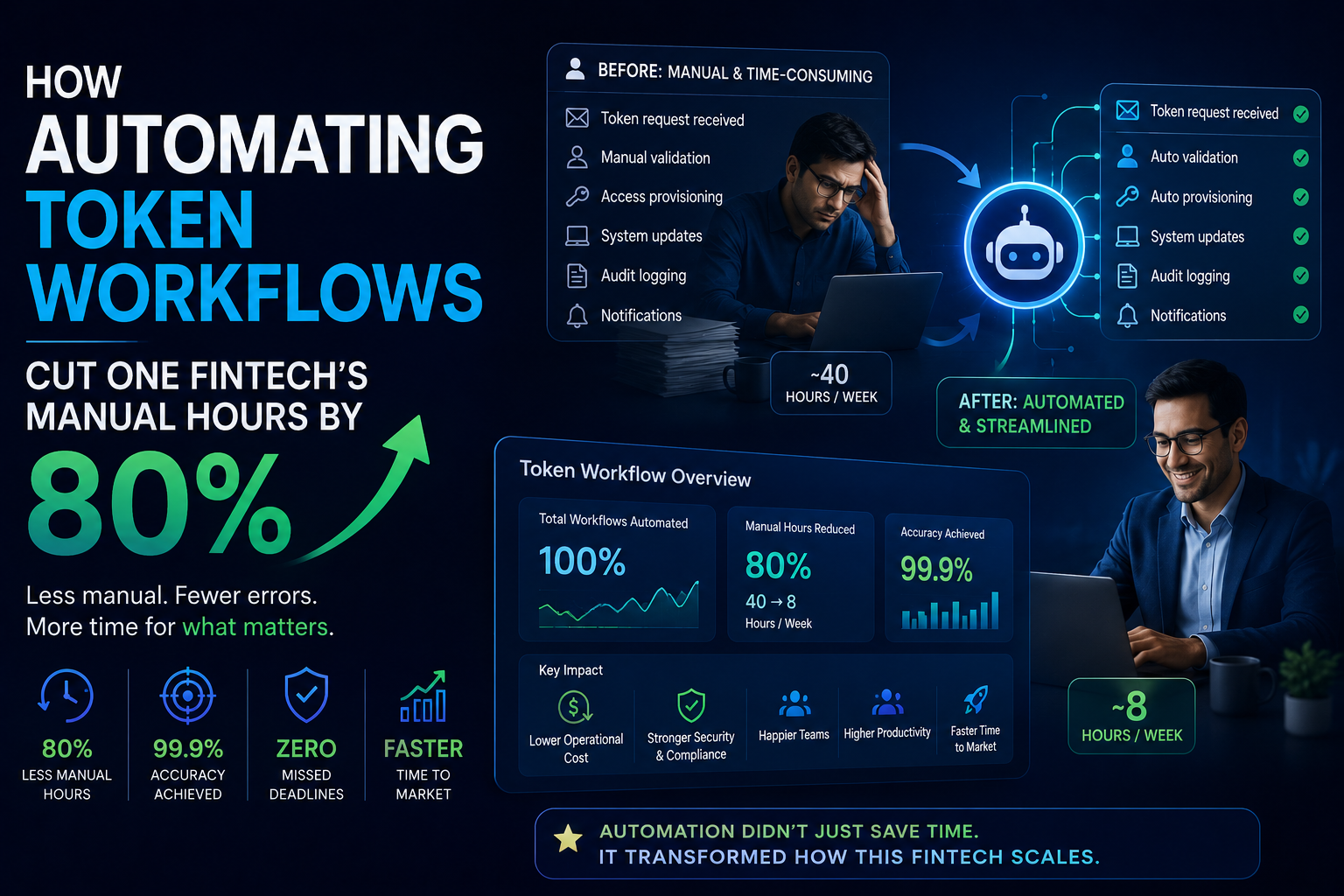
In financial services, every manual step is a liability — a place where errors accumulate, compliance gaps appear, and operational costs quietly compound. When a mid-sized fintech managing tokenized financial instruments came to Spydra, their ops team was spending over 40 hours per week on tasks that should have been automatic: manually reconciling token balances, issuing and transferring assets across ledgers, updating investor records, and running compliance checks by hand.
What happened next became one of the clearest illustrations we've seen of what blockchain workflow automation can do for a financial services operation at scale.
The fintech in question managed a portfolio of tokenized financial assets—including fractional bonds, structured notes, and fund units—across a permissioned Hyperledger Fabric network. Their core problem wasn't the blockchain infrastructure. It was everything around it.
The core tension: They had invested significantly in tokenizing their assets, but the workflows connecting token events to real business actions were still entirely manual. Tokenization without automation is like having a high-speed train network with no signal system.
Token issuance bottleneck: Every new token issuance required four approval steps across three teams, coordinated over email and spreadsheets. Average time: 3.5 days.
Manual reconciliation:- Ledger balances were reconciled manually every Monday. Discrepancies were caught days after they occurred — often after investor statements had gone out.
Compliance lag: KYC/AML checks were not integrated into the token transfer pipeline, creating a compliance review queue that averaged 48 hours per transaction.
No real-time visibility: There was no single dashboard showing token states, pending transfers, or investor positions. Data lived in disconnected systems.
These inefficiencies weren't just costing time. They were creating regulatory exposure. In an era where tokenized financial assets are attracting increasing regulatory scrutiny, a lagging audit trail is a material risk.
Over eight weeks, the Spydra implementation team worked with the fintech's engineering and operations leadership to re-architect their token operations around three core Spydra capabilities.
The company rebuilt their issuance pipeline on Spydra's Token Engine — a configurable, no-code/low-code layer for issuing, transferring, and managing digital assets on a Hyperledger Fabric network. Rather than routing approvals through email chains, the new process runs entirely on-chain with pre-defined multi-party approval logic embedded in the token's smart contract.
Token Engine capability: Configurable multi-signature token issuance with automated compliance flag triggers. When a new issuance is requested, the Token Engine automatically validates counterparty eligibility, checks available supply, initiates approval routing, and records every state change immutably on the ledger — all without human intervention at each step.
The result: token issuance time dropped from an average of 3.5 days to under 4 hours. In peak periods, the team previously processed 12–15 issuances per week with a two-person ops team working at capacity. Today, they process 60+ issuances with the same team, who are now focused on exception handling rather than routine processing.
The biggest unlock came from connecting blockchain events to downstream business actions using Spydra's Workflows module. This is no-code automation designed specifically for token lifecycle management—think Zapier, but purpose-built for on-chain events and off-chain enterprise systems.
1:- Token transfer triggers CRM update
When a token transfer is confirmed on the Fabric network, a workflow automatically updates the investor's position in the CRM and sends a confirmation notification — no manual data entry required.
2:- Compliance checks run automatically on transfer initiation
Rather than queuing for manual review, transfer requests now trigger an automated KYC/AML API call. Approved transfers proceed; flagged ones route to the compliance team with full context already assembled.
3:- Reconciliation runs on-chain continuously
Instead of Monday morning spreadsheet reconciliation, the ledger is the single source of truth. Spydra's Analytics layer surfaces real-time position data, and discrepancies trigger instant alerts via the Listeners module.
4:- Reporting is auto-generated from on-chain data
Monthly investor statements — which previously required 6–8 hours to compile manually — are now generated automatically from blockchain data using the Analytics module. The ops team reviews rather than builds.
A key part of the company's business involved token events tied to external triggers — interest rate resets, NAV calculations, and dividend distributions. Previously, these were calendar-based manual tasks. With Spydra's Oracle module, external market data is now pulled on-chain automatically, and the Listeners module monitors for the triggering conditions.
Example in practice: When an interest payment date arrives, the Oracle pulls the relevant benchmark rate, the Listener detects the event, and the Workflow triggers the token-level distribution to all eligible holders — with a full audit trail written to the ledger. What was once a 3-person, half-day task is now a zero-touch automated process.
Eight months after go-live, the numbers speak clearly. Below is a before/after comparison across the key operational metrics.
“We knew tokenization was the right direction for our product. What we didn't realize until we worked with Spydra was that the workflows around the tokens were where all our inefficiency was hiding. The automation layer is what made the whole thing work at scale.”
— Head of Operations, tokenized financial assets fintech (client identity confidential)
This case study reflects a pattern we see repeatedly across financial services organizations exploring blockchain. The initial focus is almost always on the asset side—getting the tokenization right, choosing the right chain architecture, and defining the token standards. These are important. But the operational leverage is in the workflow layer.
Automation compounds: Each automated step removes downstream manual work. A single workflow that automates token issuance also automates ledger updates, CRM sync, compliance checks, and reporting.
Compliance becomes continuous: When checks are embedded in the transfer pipeline rather than bolted on afterward, compliance becomes a default state — not a review process.
The ledger is your single source of truth: - On-chain data eliminates reconciliation by design. When the blockchain is the record, there is nothing to reconcile against.
Teams shift from execution to oversight: When routine tasks are automated, skilled ops staff focus on exceptions, strategy, and relationships — the work that actually requires human judgment.
The architecture described in this case study is directly applicable to any financial services use case involving tokenized assets, including:
The common thread: any workflow where a token event should trigger a downstream business action — and where that link is currently maintained manually — is a candidate for Spydra automation.
Spydra is built as an API-first, low-code platform. The core components—TokenToken Engine, Workflows, Listeners, and Oracle—are modular and connect to your existing tech stack via REST APIs and native integrations.
For teams already running on Hyperledger Fabric, Spydra's managed Fabric infrastructure removes the operational overhead of network management. You can also explore the financial operations case study or dive into the technical documentation to understand how the API layer works.