Private equity has always asked investors for one thing above all else: patience. Capital is locked up for seven to ten years, sometimes longer, before a fund manager returns it through an exit, a recapitalization, or a distribution. That trade-off has historically been the price of admission for the asset class's outsized returns. But the calculus is shifting. A growing number of asset managers, fund administrators, and institutional allocators are asking whether locked-up capital has to stay locked up at all.
The pressure is coming from several directions at once. Limited partners want interim liquidity without waiting out a full fund cycle. Family offices and newer institutional entrants want smaller check sizes and faster onboarding. Regulators in the U.S., EU, and Asia-Pacific have spent the last two years building clearer rules for digital securities, which removes one of the biggest excuses for standing still. And a widening set of household names in private markets, including Hamilton Lane, KKR, Apollo, and BlackRock, have already tokenized funds through infrastructure providers such as Securitize, putting institutional weight behind a model that was theoretical five years ago.
This guide breaks down what private equity tokenization actually is, why traditional PE funds are structurally illiquid, and how enterprise blockchain platforms address that illiquidity without asking managers to abandon the compliance controls that private markets depend on.
What Is Private Equity Tokenization?
Quick definition
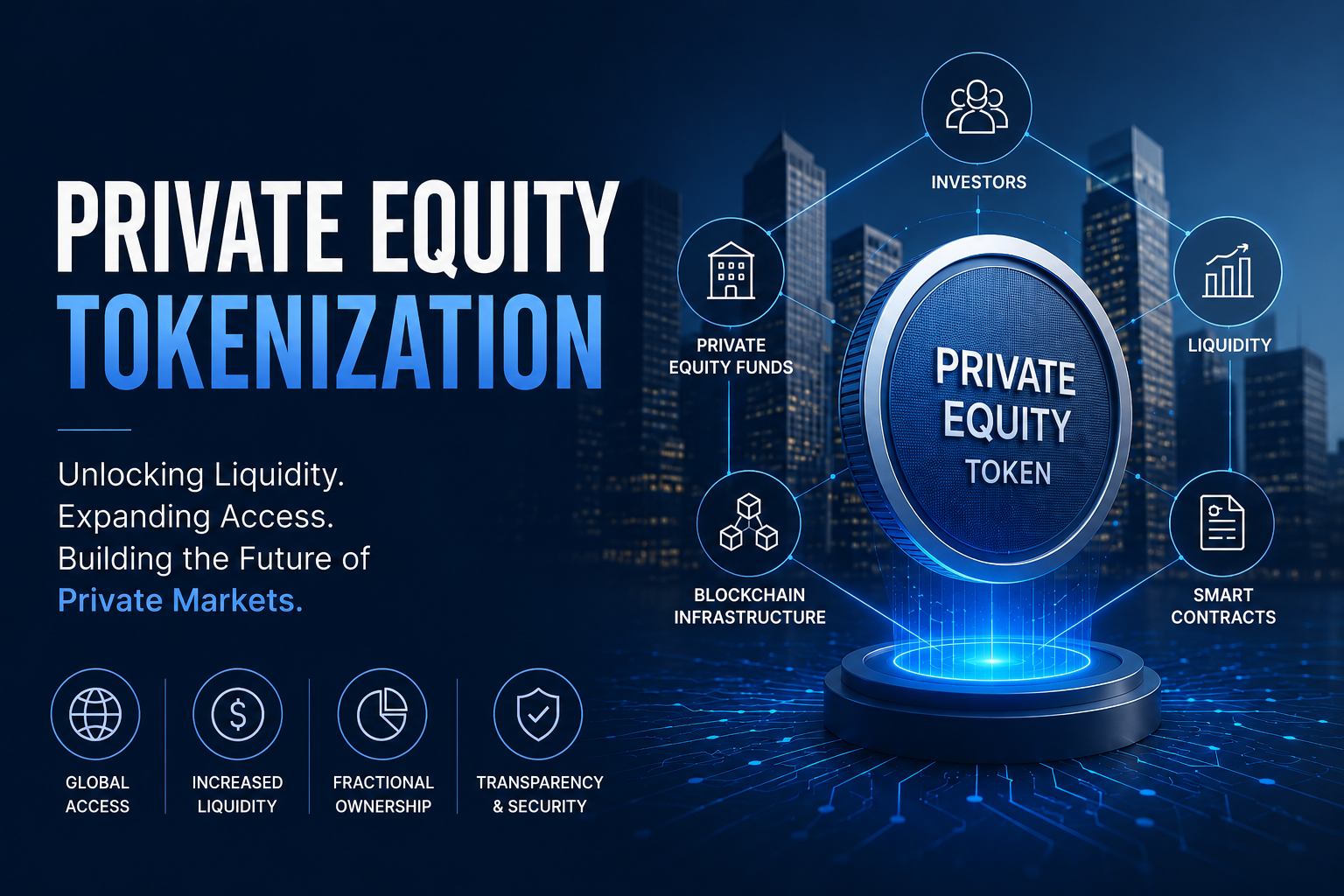
Private equity tokenization is the process of representing ownership interests in a PE fund, or in a fund's underlying portfolio company, as digital tokens on a blockchain. Each token corresponds to a fractional, cryptographically verifiable claim on the fund's economics, and it can be transferred, tracked, and settled through smart contracts rather than manual paperwork.
Tokenization does not change what a limited partner owns. It changes how that ownership is recorded, transferred, and serviced. Four elements make this possible:
- Ownership digitization: LP interests, capital commitments, and distribution rights are represented as records on a shared, permissioned ledger instead of spreadsheets and PDF capital account statements.
- Security tokens: Tokens are structured to comply with securities law, typically under exemptions such as Reg D or Reg S, and carry the same legal rights as traditional LP interests.
- Fractional ownership: A fund interest that once required a $5 million minimum can be split into much smaller units, widening the investor base without changing the underlying legal structure.
- Smart contracts and digital cap tables: Capital calls, distributions, transfer restrictions, and investor eligibility checks are encoded directly into the token, reducing manual reconciliation between GPs, fund administrators, and transfer agents.
Why Traditional Private Equity Funds Are Illiquid
Before evaluating the fix, it helps to be precise about the problem. Illiquidity in private equity isn't one issue; it's a stack of operational and structural frictions that compound each other.
- Lock-up periods: Fund life cycles of 7-12 years are standard, and LPs have limited contractual ability to exit early.
- Secondary market limitations: A secondary market exists, but it is thin, relationship-driven, and often settles at a discount because pricing and diligence take months.
- Manual transfers: Transferring an LP interest today typically requires GP consent, legal documentation, and a transfer agent process that can take weeks.
- Compliance overhead: Every transfer re-triggers KYC, AML, and accredited investor checks, usually manually re-verified by counsel.
- Investor onboarding: New LP onboarding into an existing fund involves subscription documents, wire instructions, and administrative back-and-forth that doesn't scale well below institutional check sizes.
- Settlement delays: Where public equities settle in a day or two, private fund transfers can take 30-90 days from agreement to recorded ownership change.
None of this is a defect in how private equity is run; it reflects infrastructure built for a small number of large, infrequent transactions. The problem shows up when investor demand shifts toward smaller, more frequent participation.
How Enterprise Blockchain Changes Everything
Enterprise blockchain platforms address the operational side of illiquidity without requiring GPs to change the fund's legal or economic structure. The core building blocks:
- Immutable ownership records: Every transfer, capital call, and distribution is recorded on a shared ledger that all authorized parties can see and no single party can quietly alter after the fact.
- Smart contracts: Distribution waterfalls, capital call notices, and transfer restrictions execute automatically based on pre-agreed rules, instead of relying on manual instructions between GP, administrator, and transfer agent.
- Permissioned blockchain: Unlike public crypto networks, permissioned infrastructure (such as Hyperledger Fabric) restricts network participation to verified, authorized entities, which matters for institutions that cannot operate on fully public rails.
- Compliance automation: Whitelisting, accreditation checks, and jurisdictional transfer restrictions are enforced by the token itself, so a transfer to an ineligible wallet is rejected before it happens rather than unwound after the fact.
- Investor identity and cap table automation: KYC/AML data is verified once and referenced for future transactions, and the cap table updates automatically as tokens move, eliminating a major source of reconciliation error.
- Digital asset issuance: GPs can issue new feeder funds or secondary tranches through a repeatable, templated process instead of building bespoke legal and administrative infrastructure each time.
For a broader technical walkthrough of how permissioned networks like Hyperledger Fabric support this model, see Spydra's enterprise blockchain guide.
How Tokenization Unlocks Liquidity
Liquidity in private equity doesn't require a fund to become a public stock. It requires enough structural flexibility that ownership can change hands without a 90-day legal process. Tokenization creates that flexibility through several mechanisms working together.
- Fractional ownership: Splitting a fund interest into smaller units lowers the effective minimum check size, which widens the pool of eligible buyers for any given secondary sale.
- Digital transferability: Because ownership and compliance checks are embedded in the token, a transfer that once took weeks of legal coordination can be executed in hours once both parties are verified.
- Regulated secondary markets: Broker-dealer-operated alternative trading systems (ATS) built for tokenized securities give LPs a venue to list interests, rather than relying on informal broker networks.
- Reduced settlement time: Smart contract-based settlement removes several of the manual reconciliation steps that stretch traditional private fund transfers to 30-90 days.
- Global investor participation: Digital rails make it operationally realistic to serve investors across multiple jurisdictions from a single fund structure, subject to the applicable securities exemptions in each market.
- Smaller investment sizes: Feeder fund structures, like the tokenized vehicles Hamilton Lane and Securitize have brought to market, have cut effective minimums from several million dollars to as low as $10,000-$20,000.
Why this matters now
Boston Consulting Group has estimated that private equity and venture capital could represent roughly $3 trillion of a much larger tokenized asset market by 2030. Whatever the precise number turns out to be, the direction is consistent across every major research house tracking the space: private equity is one of the asset classes where tokenization's structural benefits, fractionalization and faster transfer, matter most.
Enterprise Blockchain Features Needed for Institutional-Grade Tokenization
Not every blockchain platform is built for regulated fund structures. GPs and fund administrators evaluating infrastructure should look for a specific set of capabilities:
- KYC and AML tooling, ideally verified once and reusable across products
- Investor whitelisting enforced at the smart contract level, not just in a back-office system
- Identity verification integrated with existing subscription and transfer-agent workflows
- Role-based permissions for GPs, LPs, administrators, and auditors
- A compliance engine that encodes jurisdictional and accreditation rules directly into the token
- Custody integration with institutional-grade custodians, not just self-custody wallets
- APIs that connect to existing fund administration, ERP, and CRM systems
- Support for multi-party workflows spanning GP, administrator, transfer agent, and custodian
- A complete, exportable audit trail for regulators and auditors
Benefits for Asset Managers
- Lower administration costs, since manual reconciliation across GP, administrator, and transfer agent is reduced
- A better LP experience, with faster onboarding and clearer visibility into capital account status
- Faster fundraising for feeder structures, since smaller minimums widen the addressable investor base
- Automated distributions, executed by smart contract rather than manual wire instructions
- Built-in compliance, since eligibility and transfer restrictions are enforced at the token level
- Real-time reporting, since the ledger reflects the current cap table rather than a monthly snapshot
Benefits for Investors
- Liquidity options that didn't exist in a traditional LP structure
- Greater transparency into fund positions and transaction history
- Easier portfolio diversification across a wider range of private market strategies
- Fractional access to funds that previously required multi-million-dollar minimums
- Faster settlement on secondary transactions
- A digital record of ownership that is easier to verify and transfer than paper-based documentation
Traditional PE vs. Tokenized PE: A Side-by-Side View
Traditional vs Tokenized Private Equity
| Dimension |
Traditional Private Equity |
Tokenized Private Equity |
| Minimum investment |
Typically $1M–$5M+ |
As low as $10,000–$20,000 via feeder structures |
| Transfer process |
Manual, GP-consent driven, weeks to months |
Smart contract-enforced, hours to days once parties are verified |
| Compliance checks |
Re-verified manually on each transfer |
Encoded into the token; enforced automatically |
| Cap table |
Updated periodically by administrator |
Reflects ownership in near real time |
| Secondary liquidity |
Thin, relationship-driven, discount-prone |
Regulated ATS venues purpose-built for digital securities |
| Reporting |
Periodic capital account statements |
Continuous, auditable on-chain record |
Manual vs. Smart Contract Operations
Manual vs Smart Contract Process
| Function |
Manual Process |
Smart Contract Process |
| Capital calls |
Emailed notices, manual tracking of responses |
Triggered and tracked automatically per pre-set terms |
| Distributions |
Wire instructions processed by administrator |
Executed on-chain per waterfall logic |
| Investor eligibility |
Checked by counsel on each transaction |
Verified once, enforced automatically on every transfer |
| Audit trail |
Assembled from disparate records on request |
Continuously available and exportable |
Traditional Settlement vs. Blockchain Settlement
Traditional vs Blockchain Settlement
| Stage |
Traditional Settlement |
Blockchain Settlement |
| Legal transfer documentation |
Weeks |
Automated once terms are agreed |
| Compliance re-verification |
Days to weeks |
Instant, rule-based check |
| Ownership record update |
Periodic, batch-based |
Near-real-time ledger update |
| Total time to settle |
30–90 days typical |
Hours to a few days |
Industry Use Cases
- Venture capital: Early-stage funds use tokenized feeder structures to open access to accredited retail and smaller institutional investors.
- Infrastructure funds: Long-duration infrastructure vehicles use tokenization to offer interim liquidity windows that traditional structures can't easily support.
- Real estate funds: Property-focused private funds combine asset-level tokenization with fund-level tokenization for layered liquidity.
- Private credit: Direct lending and credit funds, already a leading tokenized asset category, use smart contracts to automate interest distributions.
- ESG funds: Impact-focused vehicles use on-chain reporting to give LPs transparent, verifiable evidence of fund-level ESG metrics.
- Family offices: Smaller allocators use tokenized feeder funds to access strategies that previously required institutional-scale commitments.
Regulatory Considerations
Regulation is the single biggest variable in how fast this market grows, and it is genuinely moving. In the U.S., tokenized fund interests are treated as securities and typically issued under Regulation D or Regulation S exemptions, with transfer agents and broker-dealers subject to existing SEC and FINRA oversight. The UK's Digital Securities Sandbox and Singapore's Project Guardian give firms supervised environments to test issuance and settlement of digital securities under regulator observation. The EU's evolving digital asset framework is doing similar work for European markets.
- Securities regulations: Tokenized LP interests remain securities and must be issued and transferred in compliance with applicable law, not treated as a workaround.
- Digital securities frameworks: Jurisdiction-specific sandboxes and interpretive guidance are steadily reducing ambiguity around how digital securities should be issued and traded.
- Investor accreditation: Accredited or qualified investor status still applies; tokenization changes how it's checked, not whether it's required.
- Transfer restrictions: Whitelisting and jurisdictional controls must be built into the token design from day one, not retrofitted after issuance.
- Compliance automation: Regulators increasingly expect a complete, exportable audit trail, which is one area where blockchain infrastructure can outperform legacy systems rather than merely match them.
Challenges
- Regulatory fragmentation across jurisdictions still complicates cross-border fund distribution.
- Custody for tokenized securities requires institutional-grade providers, and the market for these is still consolidating.
- Market adoption depends on secondary trading venues reaching enough depth to make tokenized interests genuinely liquid, not just technically transferable.
- Legacy fund administration infrastructure at some GPs and administrators requires real integration work, not just a plug-in.
- Interoperability between blockchain networks remains a work in progress, though cross-chain protocols are maturing quickly.
Future Outlook
Institutional adoption is no longer speculative. Securitize alone has tokenized more than $4 billion in assets in partnership with managers including BlackRock, Apollo, KKR, and Hamilton Lane, and multiple industry forecasts, from Boston Consulting Group to Mordor Intelligence, put tokenized private equity and venture capital in the trillions of dollars by 2030, even though the exact figures vary widely across research houses. What's converging faster than the dollar estimates is the infrastructure layer: AI-assisted valuation and risk monitoring, cross-chain interoperability standards, and clearer regulatory guardrails in the U.S., UK, EU, and Asia-Pacific are all maturing at the same time. For GPs and fund administrators, the strategic question is shifting from whether to tokenize to which infrastructure partner can do it without compromising the compliance rigor institutional LPs expect.
Enterprise Implementation Strategies
Organizations evaluating private equity tokenization generally move through a similar sequence:
- Start with a single feeder fund or secondary vehicle rather than tokenizing an entire fund complex at once.
- Select a permissioned blockchain infrastructure that supports compliance automation, custody integration, and API connectivity to existing fund administration systems.
- Work with legal counsel to structure the token under an appropriate securities exemption from the outset.
- Partner with a transfer agent and broker-dealer experienced in digital securities to support issuance and secondary trading.
- Build investor education into the rollout, since many LPs are still unfamiliar with how tokenized structures work operationally.
Spydra's Token Engine and workflow automation tools are designed to support exactly this kind of phased implementation, letting fund managers issue and manage tokenized structures without building custom infrastructure from scratch. For a wider look at how enterprises evaluate tokenization platforms in general, see Spydra's complete guide to asset tokenization, which covers token standards, compliance frameworks, and platform selection criteria in more depth.
Frequently Asked Questions
What is private equity tokenization?
Private equity tokenization is the process of representing ownership in a PE fund or its underlying assets as digital tokens on a blockchain, enabling fractional ownership, faster transfers, and automated compliance while preserving the legal rights of a traditional LP interest.
How does blockchain improve liquidity?
Blockchain improves liquidity by embedding compliance checks and transfer rules directly into the token, which shortens settlement from weeks to hours or days, and by enabling fractional ownership that widens the pool of eligible buyers for secondary transactions.
Are tokenized funds regulated?
Yes. Tokenized fund interests are still securities in most jurisdictions and must be issued and transferred in compliance with applicable securities law, typically under exemptions such as Regulation D or Regulation S in the U.S.
What are security tokens?
Security tokens are blockchain-based digital assets structured to represent a regulated financial interest, such as an LP stake or equity position, and are subject to the same securities laws as their traditional counterparts.
Can private equity be fractionalized?
Yes. Tokenization allows a single fund interest to be divided into smaller units, which is how tokenized feeder funds have lowered effective minimum investments from several million dollars to as low as $10,000-$20,000.
What is enterprise blockchain?
Enterprise blockchain refers to permissioned distributed ledger platforms, such as Hyperledger Fabric, built for organizations that need controlled network access, identity verification, and compliance tooling rather than fully public, anonymous networks.
How do smart contracts automate fund operations?
Smart contracts execute predefined rules automatically, such as processing a capital call, distributing proceeds according to a waterfall, or rejecting a transfer to an unverified investor, without manual intervention from the GP or administrator.
What are the risks of tokenization?
Key risks include regulatory fragmentation across jurisdictions, dependency on institutional-grade custody providers, limited secondary market depth in early-stage products, and integration work required with legacy fund administration systems.
Who uses tokenized private equity?
Asset managers including Hamilton Lane, KKR, and Apollo have launched tokenized fund vehicles in partnership with infrastructure providers such as Securitize, primarily targeting accredited investors, family offices, and smaller institutional allocators.
What platforms support enterprise tokenization?
Platforms built on permissioned blockchain infrastructure, with compliance automation, custody integration, and API connectivity to fund administration systems, are best suited to institutional private equity tokenization. Spydra's enterprise tokenization platform is one example of this category.
Conclusion
Private equity tokenization doesn't eliminate the fundamentals of the asset class: capital still needs to be committed for a fund to execute its strategy, and returns are still driven by the GP's ability to create value in portfolio companies. What tokenization changes is the operational layer sitting on top of that structure, replacing manual, paper-based processes with automated, compliant, and auditable digital infrastructure. For fund managers, the near-term opportunity is straightforward: reduce administrative overhead, widen the investor base through fractional access, and give LPs liquidity options that didn't exist a decade ago, all without compromising the regulatory rigor institutional capital requires.
Next steps
Organizations exploring tokenized private equity should evaluate enterprise-grade blockchain platforms that support compliant digital asset issuance, lifecycle management, investor onboarding, and smart contract automation. Learn more about how Spydra's enterprise tokenization platform helps financial institutions modernize private market infrastructure at spydra.app.