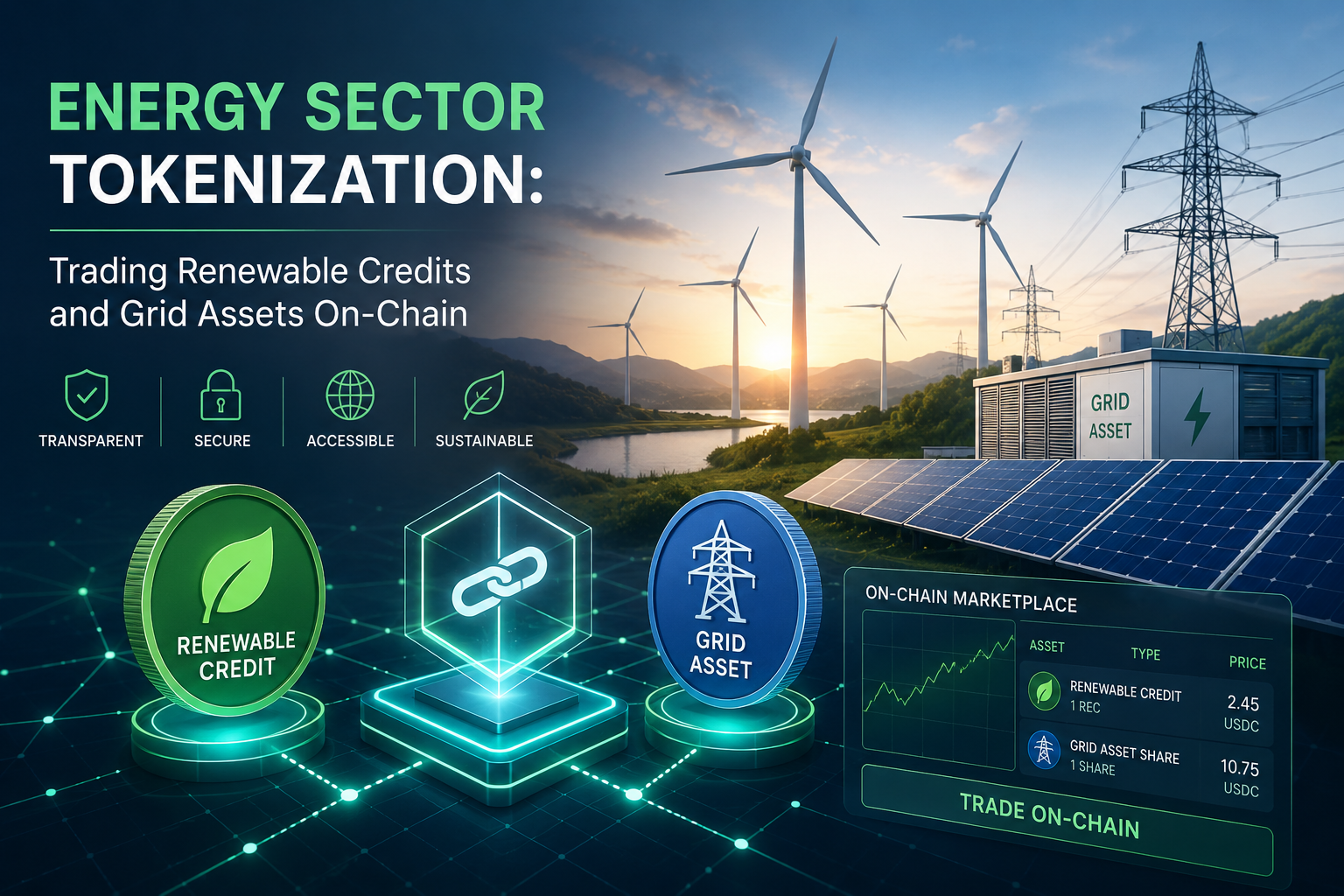
The global energy industry is undergoing a profound transformation. Renewable energy generation is expanding rapidly, distributed energy resources are becoming more common, and investors are seeking new ways to participate in infrastructure projects. Yet many energy markets remain fragmented, burdened by intermediaries, and constrained by inefficient trading systems.
This is where energy sector tokenization is gaining attention. By representing renewable energy credits, power infrastructure, and other energy-related assets as blockchain-based digital tokens, tokenization introduces new possibilities for ownership, financing, and trading. From solar farms and battery storage facilities to renewable energy certificates (RECs), tokenization can help make traditionally illiquid assets more accessible and transparent.
As blockchain technology continues to mature, energy companies, utilities, investors, and regulators are exploring how on-chain markets can reshape the future of energy trading and infrastructure investment.
Energy sector tokenization is the process of converting ownership rights, economic interests, or contractual claims associated with energy assets into digital tokens recorded on a blockchain.
These tokens can represent:
Unlike traditional ownership records that often rely on multiple intermediaries and centralized databases, tokenized assets can be managed through blockchain-based registries and smart contracts.
The goal is not merely digitization but creating programmable, transferable assets that can be traded, monitored, and settled more efficiently.
The energy sector faces several structural challenges that make tokenization attractive.
Governments and private investors continue to fund renewable energy projects at unprecedented levels. As project pipelines expand, developers require innovative financing mechanisms that can attract broader pools of capital.
Energy systems are becoming more decentralized. Solar installations, battery storage facilities, electric vehicle charging networks, and microgrids create new categories of assets that require efficient ownership and trading models.
Many infrastructure investments involve long holding periods and high minimum investment requirements. Tokenization can improve liquidity by enabling fractional ownership and secondary trading.
Traditional energy investments often involve complex legal structures and administrative hurdles. Blockchain-based systems can simplify participation for qualified investors across multiple jurisdictions.
Investors increasingly seek verifiable data regarding energy production, environmental impact, and asset performance. Blockchain provides immutable records that can improve trust and auditability.
Renewable Energy Certificates (RECs) are market-based instruments that certify electricity was generated from renewable energy sources.
Typically:
Traditional REC systems face several challenges:
Tokenized renewable energy credits can address many of these inefficiencies.
Key advantages include:
For example, solar farms and wind energy projects can issue blockchain-based representations of verified renewable energy production, allowing buyers to acquire and trade credits more efficiently.
Blockchain technology enables renewable credits to move through a digital marketplace with fewer intermediaries.
Transactions can be executed and recorded almost instantly compared to traditional systems that may require days or weeks.
Automation reduces manual processing and reconciliation requirements.
Every transaction is recorded on a tamper-resistant ledger.
Organizations can verify the origin and transfer history of renewable credits.
Tokenized systems can support broader participation and potentially improve market liquidity.
Beyond renewable credits, tokenization can also apply to physical energy infrastructure.
Grid assets include:
Traditionally, ownership of these assets is concentrated among utilities, institutional investors, and infrastructure funds.
Through tokenization, ownership interests can be divided into smaller digital units represented by blockchain tokens.
This approach allows qualified investors to participate in infrastructure projects that may otherwise be inaccessible due to large capital requirements.
One of the most significant benefits of energy asset tokenization is fractional ownership.
Instead of requiring investors to purchase an entire asset or large ownership stake, tokenization enables ownership to be divided into smaller units.
Investors can gain exposure to energy projects with smaller capital commitments.
Investors can spread capital across multiple energy assets rather than concentrating risk in a single project.
Tokenized ownership interests can potentially be traded in secondary markets.
Developers may gain access to new funding sources beyond traditional infrastructure financing channels.
Examples include:
Blockchain serves as the foundational technology supporting tokenized energy markets.
Smart contracts automate key functions such as:
Blockchain-based registries create transparent records of asset ownership and transaction history.
Participants can securely hold and transfer tokenized assets using approved digital wallets.
Rules related to investor eligibility, jurisdictional restrictions, and transfer limitations can be embedded directly into tokenized assets.
Blockchain networks can significantly reduce settlement times compared to traditional infrastructure investment transactions.
Benefit
Description
Liquidity
Enables more efficient trading of traditionally illiquid assets
Transparency
Provides immutable records and ownership tracking
Accessibility
Supports fractional ownership models
Efficiency
Automates settlement and administrative processes
Compliance
Allows regulatory requirements to be embedded into smart contracts
Global Participation
Facilitates broader access to qualified investors across regions
These benefits can create a more dynamic and accessible energy investment ecosystem.
While tokenization presents significant opportunities, compliance remains essential.
Many tokenized energy assets may qualify as securities depending on their structure and jurisdiction.
Renewable credits and infrastructure investments are often subject to sector-specific regulatory frameworks.
Investor onboarding processes typically require:
Tokenized renewable assets must still satisfy applicable environmental reporting and certification standards.
Independent verification remains critical to ensure underlying assets exist and perform as represented.
Projects involving international investors may need to comply with multiple regulatory regimes simultaneously.
Despite growing interest, several barriers remain.
Many jurisdictions are still developing frameworks for digital asset regulation.
Infrastructure assets often require sophisticated valuation methodologies.
Multiple blockchain networks and tokenization standards can limit interoperability.
Utilities and energy companies frequently operate on legacy technology platforms that are difficult to modernize.
Secure management of digital assets remains a critical operational requirement.
Organizations may require significant investment in education, infrastructure, and operational processes.
The convergence of blockchain technology and energy infrastructure is expected to continue evolving.
Several trends are driving this development:
Digitized energy systems can support more dynamic and automated market participation.
Consumers and producers may increasingly exchange energy through decentralized marketplaces.
Artificial intelligence can optimize energy production, storage, and trading decisions.
Infrastructure investment vehicles may leverage tokenization to improve accessibility and liquidity.
Carbon credits and environmental assets are increasingly being explored as tokenization candidates.
As real-world asset (RWA) markets mature, energy infrastructure is likely to become a major category within tokenized investment ecosystems.
Enterprise tokenization platforms such as Spydra can support organizations seeking to tokenize energy-related assets.
These platforms typically provide capabilities such as:
For energy companies, utilities, and infrastructure developers, such platforms can help reduce the technical complexity associated with launching tokenized asset programs while maintaining compliance requirements.
The emergence of energy sector tokenization represents a significant development in the modernization of energy markets. By bringing renewable energy credits, grid infrastructure, and other energy assets onto blockchain networks, tokenization can improve transparency, liquidity, accessibility, and operational efficiency.
Tokenized renewable credits have the potential to streamline environmental markets, while grid asset tokenization can open new pathways for infrastructure investment and capital formation. Although regulatory and operational challenges remain, the long-term trajectory points toward increasingly digital, data-driven, and interconnected energy markets.
As renewable energy adoption accelerates and real-world asset tokenization gains momentum, energy sector tokenization may become a foundational component of future energy financing and trading ecosystems.
Energy sector tokenization is the process of converting ownership rights or economic interests in energy-related assets into blockchain-based digital tokens that can be managed and traded electronically.
Renewable energy credits are verified, digitally represented as blockchain tokens, and recorded on a distributed ledger, allowing ownership transfers and trading to occur on-chain.
Grid assets include transmission infrastructure, distribution networks, substations, battery storage systems, microgrids, and EV charging infrastructure that can be represented through digital ownership tokens.
Yes. Tokenization enables fractional ownership, allowing investors to purchase smaller ownership interests in projects such as solar farms, wind farms, and battery storage facilities.
Benefits include increased liquidity, improved transparency, fractional ownership, faster settlement, reduced administrative costs, and enhanced compliance automation.
Regulatory treatment varies by jurisdiction. Depending on structure and investor rights, tokenized energy assets may fall under securities, energy market, and financial compliance regulations.
Blockchain provides transparent ownership records, automated settlement processes, immutable transaction histories, and reduced reliance on intermediaries.
Future developments may include tokenized infrastructure funds, decentralized energy trading, AI-powered energy management, smart grid integration, and expanded renewable and carbon credit marketplaces.