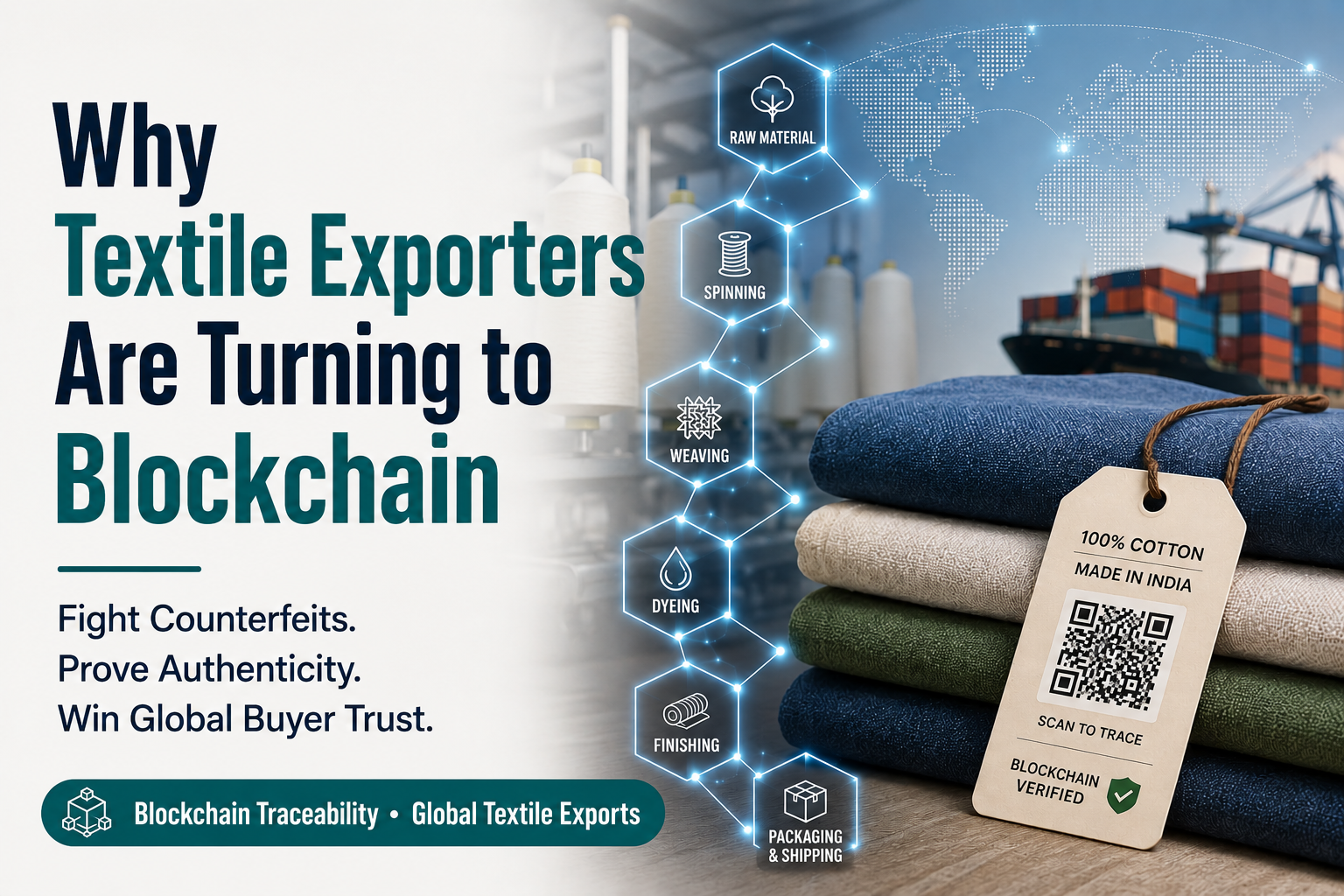
Counterfeit textiles are no longer a marginal enforcement problem — clothing, footwear, and leather goods account for the majority of all counterfeit seizures worldwide, and paper-based, spreadsheet-driven supply chains simply cannot prove authenticity at the speed global trade now demands. This article explains why a growing number of textile exporters, apparel manufacturers, and fashion brands are adopting blockchain-based traceability to combat counterfeiting, satisfy tightening export compliance requirements, and prepare for the EU's Digital Product Passport. It walks through how blockchain works in a textile supply chain, compares it against traditional tracking systems, profiles real enterprise deployments from LVMH's Aura Consortium to TextileGenesis, and lays out a practical implementation roadmap—including where enterprise platforms such as Spydra fit into that roadmap.
Global trade in counterfeit and pirated goods reached an estimated USD 467 billion in the most recent OECD and EUIPO customs-seizure analysis, and clothing, footwear, and leather goods together account for 62% of everything seized at borders. For textile exporters, that is not an abstract statistic — it is a direct threat to buyer trust, brand licensing relationships, and market access, arriving at the exact moment the EU's Digital Product Passport, tightening ESG disclosure rules, and increasingly skeptical retail buyers are raising the bar for proof of origin. Blockchain is emerging as the technology exporters are turning to because it answers a question paper documents cannot: can you prove, cryptographically and in real time, that this shipment is exactly what you say it is?
This guide is written for export managers, compliance officers, supply chain directors, and brand leaders evaluating whether blockchain traceability belongs in their 2026–2028 technology roadmap. It covers the scale of the counterfeit problem, why legacy tracking systems fall short, how blockchain-based traceability actually works on the factory floor and at the border, and what enterprise deployment looks like in practice.
Counterfeit textiles are apparel, footwear, and leather goods sold under a fraudulent brand identity, fake certification, or forged compliance label. According to the OECD and EUIPO's 2025 joint study, global trade in counterfeit and pirated goods was valued at approximately USD 467 billion, equivalent to roughly 2.3% of world trade, with EU imports of counterfeits alone estimated at USD 117 billion, or 4.7% of total EU imports. Clothing, footwear, and leather goods are consistently the most-seized category, accounting for 62% of all counterfeit items intercepted at customs.
Counterfeiters increasingly use a tactic the OECD calls "localization": shipping unbranded components or blank garments separately, then attaching counterfeit labels, hangtags, and certification marks closer to the destination market. This makes fakes harder to intercept at the point of origin and puts the burden of proof on legitimate exporters, who must be able to demonstrate — down to the individual shipment — that their labeling and certification claims are genuine.
Around 65% of counterfeit seizures now involve small parcels and postal shipments rather than bulk container fraud, reflecting a deliberate shift toward distribution channels that are cheaper to run and harder to inspect. For textile exporters relying on organic cotton, recycled fiber, or fair-trade certifications to command premium pricing, this same fragmentation makes certificate fraud easier: a single legitimate certificate can be copied and reused across shipments that were never actually inspected.
Beyond direct revenue loss, counterfeit textiles erode the pricing power that comes from genuine provenance — buyers who cannot verify authenticity discount every claim a supplier makes, genuine or not. China remains the largest reported source economy for counterfeit seizures, but the report notes fakes now originate across Asia, the Middle East, and Latin America as production has relocated closer to end markets.Why Traditional Tracking Systems Are No Longer Enough
Why do textile exporters need more than spreadsheets and paper certificates? Because manual, document-based tracking cannot be verified in real time, is trivially easy to falsify, and breaks down the moment a supply chain crosses more than one organization's systems — which every textile export shipment does, by definition.
Certificates of origin, mill invoices, and compliance declarations are still routinely exchanged as PDFs and physical paperwork. Each handoff — from spinner to weaver, weaver to garment factory, factory to freight forwarder — introduces a point where a document can be altered, lost, or simply never checked against the physical goods it describes.
Even well-run exporters typically manage supplier data across disconnected ERP instances, spreadsheets, and email threads. According to Fashion Revolution's transparency research, only 8% of fashion companies publish a list of their raw material suppliers, and just 5% disclose the names of the specific farms or facilities involved — not necessarily because brands are hiding information, but because most supply chain systems were never built to make that data verifiable or shareable in the first place.
A retailer or customs authority auditing a shipment today typically has visibility into only one or two tiers of the supply chain — the direct supplier and, at best, the Tier 1 manufacturer. Tier 2 and Tier 3 suppliers — the fabric mills, dye houses, and yarn spinners where much of the sourcing risk actually sits — remain largely invisible, which is precisely where DPP delegated acts and buyer compliance teams are now demanding data.
What is blockchain traceability? It is the use of a shared, tamper-evident digital ledger to record every material handoff in a supply chain — from raw fiber to finished garment — so that any participant, auditor, or customer can verify a product's history without relying on a single party's word for it. In a textile context, that means every stage of production writes a permanent, time-stamped entry that cannot be quietly edited after the fact.
A blockchain is a distributed ledger: instead of one company's database being the single source of truth, transaction records are replicated and cryptographically linked across every participating organization's node. Once a record—a fiber lot, a dye batch, or a quality inspection—is written, altering it would break the cryptographic chain and be immediately detectable by every other participant. This immutability is what allows a buyer, customs officer, or end consumer to trust a record they did not personally witness being created.
Each participant in the supply chain — spinning mill, weaving unit, dye house, garment factory, and logistics provider—writes to the same shared ledger as goods physically move through their facility. Because every entry is linked to the one before it, the full chain of custody for a single garment can be reconstructed and verified in seconds rather than requested from five different companies over several weeks.
Smart contracts are self-executing rules encoded on the blockchain that automatically trigger an action—releasing payment, flagging a quality exception, generating a compliance certificate—once predefined conditions are verifiably met. Combined with a unique digital identity assigned to each fiber lot or finished unit, smart contracts let exporters automate the compliance paperwork that currently consumes days of manual work per shipment.
Blockchain only proves what has been written to the ledger; it needs a way to connect a physical garment to its digital record. QR codes remain the lowest-cost option and, per European Commission guidance on Digital Product Passport implementation, the most common data-carrier choice for apparel. NFC tags and RFID inlays offer tamper-evident, higher-security alternatives increasingly used by luxury and premium brands where counterfeit risk is highest.
Blockchain Workflow for Textile Exporters
A typical enterprise blockchain traceability workflow follows the physical path of the product itself, with a digital record created or updated at every handoff:
Workflow diagram (Mermaid syntax) is included in the appendix below for direct embedding into the CMS.
Because every legitimate unit carries a verifiable digital identity anchored to an immutable production record, counterfeit goods become detectable by absence: a fake product either has no matching ledger entry or one that does not reconcile with the claimed batch, fiber composition, or facility.
Blockchain records map cleanly onto the structured data fields customs authorities and the EU's forthcoming textile Digital Product Passport will require—fiber composition, country of manufacture, chemical compliance, and certification status—because the data is captured once, at the source, rather than reconstructed retroactively from paperwork.
When every supplier's contribution to a garment is individually recorded and attributable, accountability shifts from contractual trust to verifiable data. Buyers can see exactly which Tier 2 or Tier 3 facility a defect or compliance gap traces back to, rather than treating the entire supply chain as a single opaque block.
Sustainability claims — organic cotton content, recycled fiber percentage, water usage — become auditable rather than self-declared. This directly addresses the transparency gap Fashion Revolution has documented, where the overwhelming majority of brands still cannot name their own raw material suppliers, let alone verify their claims to regulators or investors.
Because chain-of-custody data is captured continuously rather than assembled for each audit, compliance reviews shift from multi-week document hunts to direct ledger queries. Disputes over quality, quantity, or origin are resolved by referencing the shared, timestamped record instead of each party's separate—and sometimes contradictory—paperwork.
Verified provenance supports premium positioning: exporters who can cryptographically prove organic, recycled, or fair-trade sourcing claims are better positioned to command the price premiums those claims are meant to justify and to qualify for luxury and premium retail programs that increasingly require traceability as a baseline supplier requirement rather than a differentiator.
Enterprise blockchain traceability in textiles has moved well past pilot projects. TextileGenesis, an IBM-backed platform, reports tracking more than 1.2 billion discrete fiber and product units in partnership with over 150 global brands, including the H&M Group, Bestseller, Lululemon, and the Zegna Group, and recently expanded into recycled-material verification through a partnership with recycled cotton producer Recover. The platform assigns each certified fiber batch a digital token that cannot be transferred in a volume exceeding what was physically produced—structurally preventing the double-counting of sustainability claims across multiple garments.
In luxury, LVMH founded the Aura Blockchain Consortium in 2021 together with the Prada Group and Cartier, building a shared ledger that lets a consumer scan a product and see verified origin, material, and ownership history—turning what was previously a marketing claim into a queryable record. VeChain has pursued a comparable model outside the LVMH ecosystem, and Levi Strauss and Patagonia have both piloted blockchain-based visibility into cotton sourcing and responsibly sourced materials respectively.
By comparison, IBM Food Trust — built for perishable food supply chains with short shelf lives and high-frequency handoffs — established many of the technical patterns (permissioned ledgers, batch-level tracking, retailer-facing dashboards) that textile-specific platforms like TextileGenesis have since adapted for fiber-to-retail traceability, where the relevant unit is a certified fiber lot rather than a perishable batch.
Blockchain vs. Traditional Textile Traceability
Answer: Blockchain outperforms traditional, document-based traceability on nearly every dimension buyers and regulators now evaluate — transparency, fraud resistance, audit speed, and scalability across multi-tier supply chains.
What is a Digital Product Passport? It is a structured, machine-readable digital record—typically accessed via a QR code—that travels with a product and documents its material composition, origin, and sustainability attributes, mandated under the EU's Ecodesign for Sustainable Products Regulation (ESPR), which entered into force in July 2024.
ESPR is the framework regulation; the specific data fields required for textiles are set out in a product-specific delegated act. As of mid-2026, the European Commission's ESPR Working Plan 2025–2030 places adoption of the textiles delegated act around 2027, with mandatory compliance following an 18-to-36-month transition—meaning enforcement realistically begins in 2028, though brands should treat the underlying data requirements as effectively stable and begin building infrastructure now rather than waiting for final enforcement dates.
Current drafts and industry pilot programs — including the Trace4Value project run by TrusTrace with GS1 Sweden — point toward data covering:
The DPP applies to any brand selling into the EU market regardless of where it manufactures or is headquartered, and the underlying data infrastructure—supplier onboarding, verified data capture, and structured record-keeping—takes far longer to build than the regulatory deadline suggests. Brands and exporters piloting traceability systems now are already using DPP-readiness as a supplier qualification advantage with retail partners, ahead of any formal enforcement date.
Can any blockchain handle textile supply chain data? Not practically. Public blockchains are open to anyone, which creates real privacy and confidentiality problems for exporters who need to share verified data with specific buyers and regulators without exposing commercially sensitive supplier relationships to competitors.
Permissioned, or consortium, blockchains restrict participation to verified organizations—mills, factories, freight forwarders, retailers, auditors—while still giving every authorized participant a shared, tamper-evident ledger. Hyperledger Fabric is the most widely adopted framework for this model in enterprise textile deployments because it supports fine-grained access control: a fiber supplier can prove certification status without exposing pricing, and a retailer can verify compliance without seeing a competitor's order volumes.
Enterprise deployments require governance structures that decide who can write to the ledger, how disputes are resolved, and how new supply chain partners are onboarded—none of which public blockchain infrastructure is designed to handle at the scale and confidentiality level global textile exporters require. This is where permissioned network design, identity and access management, and workflow automation become as important as the underlying ledger technology itself.
Spydra is an enterprise blockchain platform built on Hyperledger Fabric that gives textile exporters and apparel manufacturers a permissioned traceability network without requiring an in-house blockchain engineering team. Rather than treating asset tokenization and supply chain tokenization as separate initiatives, Spydra's platform tokenizes physical assets — a fiber lot, a production batch, a finished-goods shipment—so that ownership, custody, and certification status move together on the same verifiable record as the goods themselves.
In practice, this means exporters can onboard mills, dye houses, and logistics partners onto a shared permissioned network, encode compliance and quality-inspection logic as smart contracts that execute automatically as goods move through each stage, and expose that verified data through API integrations to existing ERP systems rather than replacing them. For compliance teams preparing for the EU's textile DPP, the same underlying data structure—fiber composition, origin, certification, and chain of custody — that Spydra captures for internal traceability can be surfaced as DPP-compliant records without a separate reporting exercise. Workflow automation and built-in analytics give supply chain directors visibility into where bottlenecks, quality exceptions, or certification gaps are occurring across supplier tiers, turning what was previously a quarterly audit exercise into continuous monitoring.
The same digital asset infrastructure underpins Spydra deployments across adjacent industries — from raw material and finished-goods tracking to real estate tokenization — giving textile exporters a proven, already-audited architecture to build on rather than a first-of-its-kind implementation. Readers new to the underlying concept can also see Spydra's broader explainer on how real-world assets move on-chain for additional context.
AI is increasingly layered on top of blockchain traceability data to detect anomalies — a shipment volume that doesn't reconcile with certified fiber input, for example — faster than manual audit review ever could. IoT sensors are extending real-time monitoring into transit and storage conditions, not just discrete handoff events.
Carbon tracking is moving from voluntary disclosure to a structured DPP data field, and tokenized supply chains are beginning to support genuine circular-economy use cases — recycling, resale, and rental — by giving a garment a persistent digital identity across multiple ownership cycles, not just its first sale. Zero-knowledge proofs are an emerging technique that could let exporters prove compliance with a specific rule — for example, that a shipment's fiber content meets a certification threshold — without exposing the underlying commercially sensitive data itself, addressing one of the most persistent objections to supply chain transparency. Machine-readable compliance and real-time ESG reporting are converging toward a future where regulatory disclosure is a continuous data feed rather than a periodic filing.
Why are textile exporters turning to blockchain?
Textile exporters are turning to blockchain because paper documentation and disconnected ERP systems cannot prove authenticity or origin at the speed global trade now demands. Blockchain creates a shared, tamper-evident record across every supply chain tier, making counterfeit detection, export compliance, and ESG reporting verifiable rather than self-declared.
What is blockchain traceability in textiles?
Blockchain traceability in textiles is the use of a distributed, tamper-evident ledger to record each stage a garment passes through — from raw fiber sourcing to retail — so that origin, certification, and chain-of-custody claims can be independently verified rather than taken on trust.
How does blockchain stop counterfeit apparel?
Blockchain assigns each legitimate unit a unique digital identity anchored to an immutable production record. Counterfeit goods either lack a matching ledger entry or contain data that fails to reconcile with the claimed batch, fiber composition, or manufacturing facility, making fakes detectable at the point of verification.
Can blockchain improve textile export compliance?
Yes. Blockchain captures compliance-relevant data — fiber composition, origin, certification status — once, at the source, rather than reconstructing it retroactively from paperwork. This maps directly onto the structured data fields customs authorities and the EU Digital Product Passport require.
What is a Digital Product Passport?
A Digital Product Passport (DPP) is a structured, machine-readable digital record, typically accessed via a QR code, that documents a product's material composition, origin, and sustainability attributes. It is mandated under the EU's Ecodesign for Sustainable Products Regulation.
When does the EU Digital Product Passport become mandatory for textiles?
The ESPR framework entered into force in July 2024. The textile-specific delegated act setting exact data requirements is expected around 2027, with mandatory compliance realistically beginning in 2028 after an 18-to-36-month transition period.
Does the EU DPP apply to brands outside the EU?
Yes. Any brand or exporter selling textile products in the EU market is subject to DPP requirements, regardless of where the company is headquartered or where manufacturing takes place.
What blockchain platform is best for textile traceability?
Enterprise deployments typically use permissioned blockchain frameworks such as Hyperledger Fabric rather than public blockchains, because textile supply chains require confidentiality controls that let participants share verified data without exposing sensitive commercial relationships.
What is the difference between public and permissioned blockchain for supply chains?
Public blockchains are open to any participant and expose all data broadly, which creates privacy risks for commercially sensitive supplier relationships. Permissioned blockchains restrict participation to verified organizations while still providing a shared, tamper-evident ledger.
How do QR codes, RFID, and NFC relate to blockchain traceability?
These technologies bridge the physical product to its digital blockchain record. QR codes are the lowest-cost and most common option; NFC and RFID offer higher tamper-resistance and are increasingly used by premium and luxury brands facing elevated counterfeit risk.
Which brands are already using blockchain for textile traceability?
TextileGenesis tracks over 1.2 billion units across 150+ brands including H&M Group, Bestseller, Lululemon, and Zegna. LVMH's Aura Blockchain Consortium, founded with Prada and Cartier, verifies luxury product authenticity and origin.
How much does blockchain textile traceability cost to implement?
Costs vary by network scope and supplier count, but typically include permissioned network setup, ERP integration, and physical tagging infrastructure (QR, NFC, or RFID). Most exporters start with a single high-risk product line to manage upfront investment before expanding network-wide.
What data does a textile Digital Product Passport require?
Current pilot programs and delegated act drafts point toward fiber composition by percentage, country of manufacture, carbon footprint, chemical compliance data, recycling instructions, a repairability score, and verified certifications at the product level.
Can blockchain help with ESG and sustainability reporting for textile exporters?
Yes. Blockchain makes sustainability claims — organic content, recycled fiber percentage, water usage — auditable rather than self-declared, directly addressing the transparency gap most fashion brands currently face in disclosing supplier-level sourcing data.
Is blockchain traceability only for luxury and large enterprise brands?
No. While luxury brands like LVMH were early adopters, permissioned enterprise platforms now serve mid-market exporters and manufacturers, particularly as EU DPP compliance and retail buyer requirements extend traceability expectations across the entire market, not just premium segments.
The counterfeit textile problem is not shrinking, and the compliance bar — from EU customs authorities to the forthcoming Digital Product Passport — is rising faster than paper-based systems can keep up with. Blockchain gives textile exporters a way to answer the authenticity and origin questions buyers, regulators, and consumers are all asking with increasing specificity: not a promise, but a verifiable record. Exporters who begin building that infrastructure now — starting with their highest-risk product lines and highest-value buyer relationships—will be qualifying for premium retail programs and clearing EU market-access requirements while competitors are still assembling paperwork.
For textile exporters and apparel manufacturers evaluating where to start, Spydra's enterprise blockchain platform provides a permissioned, Hyperledger Fabric-based foundation for supply chain tokenization, smart-contract-driven compliance automation, and DPP-ready data capture—built to integrate with the ERP and supplier systems exporters already run, rather than replace them.