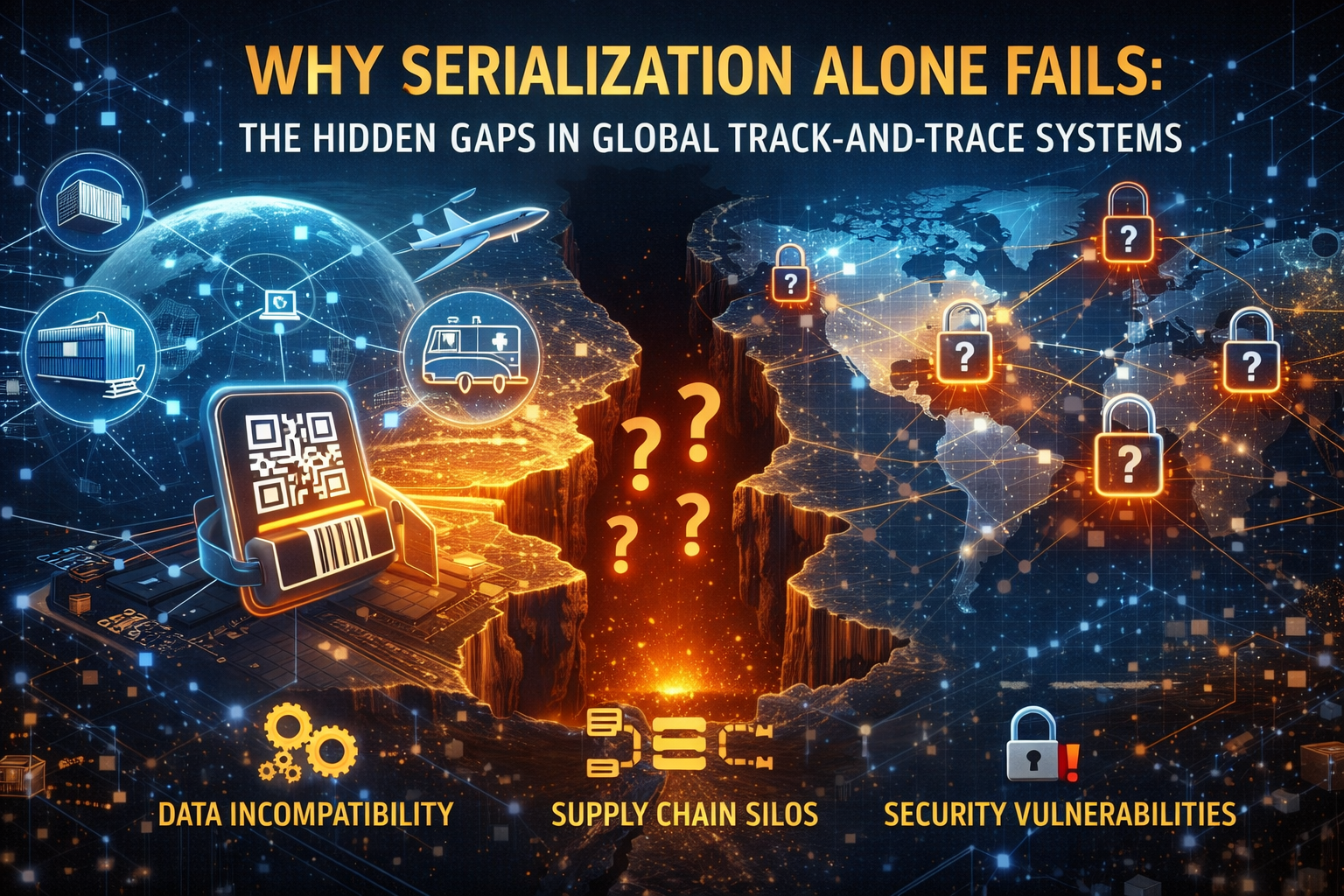
Global supply chains are under more scrutiny than ever before. According to the World Economic Forum, supply chain disruptions now cost companies an estimated $1.6 trillion annually, while OECD data shows that counterfeit goods account for nearly 3.3% of global trade. To combat these issues, many industries rely heavily on serialization as a track-and-trace solution.
However, despite widespread adoption, cracks are starting to show. Serialization vs tokenization has become a critical debate as companies realize that serialization alone cannot eliminate track and trace limitations or close growing supply chain blind spots. In fact, relying solely on serialized identifiers often creates a false sense of visibility—one that breaks down under real-world complexity.
Let’s unpack why serialization falls short and what modern supply chains truly need.
Serialization assigns a unique identifier—such as a barcode, QR code, or serial number—to each product unit. Regulators mandate serialization in industries like pharmaceuticals, food, and electronics to improve traceability and compliance.
On paper, it sounds solid. In practice, serialization:
Yet, serialization focuses on identity, not context. That distinction explains many of today’s track and trace limitations.
Serialization gained traction because it was:
Governments worldwide reinforced its use. For example, the U.S. Drug Supply Chain Security Act (DSCSA) and the EU Falsified Medicines Directive (FMD) both mandate serialized tracking.
However, regulatory compliance does not equal operational excellence—and that’s where problems begin.
Serialization records that something happened, but it doesn’t explain why or how. This gap creates major supply chain blind spots.
For example:
Because serialization lacks asset intelligence, it fails to deliver end-to-end trust.
Despite its popularity, serialization introduces several systemic weaknesses.
Serialization only tracks IDs, not conditions. It doesn’t natively capture:
According to McKinsey, over 30% of supply chain data remains unused or inaccessible due to shallow tracking models—one of the biggest track and trace limitations today.
Most serialized systems operate in isolated databases. Manufacturers, distributors, and retailers often maintain separate records.
As a result:
These silos directly contribute to supply chain blind spots, especially in cross-border logistics.
Here’s where the serialization vs tokenization debate becomes critical.
Serialization identifies a product but does not represent ownership or rights. When disputes arise, companies struggle to answer:
Tokenization solves this gap—but serialization alone does not.
Serialized codes can be copied. Counterfeiters exploit this weakness aggressively.
The World Health Organization estimates that 1 in 10 medical products in low- and middle-income countries is counterfeit—despite serialization mandates.
This statistic alone exposes how serialization fails to prevent fraud at scale.
Global supply chains are dynamic, multi-party, and nonlinear. Serialization was designed for linear flows.
When products:
Serialization loses continuity. These breaks introduce serious track and trace limitations, especially in industries like food, pharmaceuticals, and electronics.
Blind spots don’t announce themselves. They surface during crises.
Common examples include:
According to Gartner, poor supply chain visibility increases operational costs by up to 20%. Serialization alone cannot close these gaps.
To understand why serialization falls short, we need to compare it with tokenization.
In the serialization vs tokenization comparison, serialization answers “What is this?” while tokenization answers “What is happening to this asset right now?”
That distinction matters.
Tokenization treats products as digital assets, not just labeled items.
It enables:
Because tokens move with the asset, they eliminate many supply chain blind spots that serialization cannot detect.
Data reinforces the limitations of serialization:
These metrics explain why companies are reassessing serialization-only strategies.
Even regulators see the cracks. While serialization remains mandatory, agencies increasingly encourage:
The European Commission has acknowledged that serialized compliance systems lack real-time intelligence—one of the biggest track and trace limitations in regulated markets.
When organizations ignore blind spots, consequences compound:
In 2023 alone, major recalls cost global brands over $10 billion. Many of these failures traced back to incomplete or fragmented traceability.
Serialization alone didn’t prevent them.
Leading organizations now treat serialization as a starting point, not a solution.
They combine:
This hybrid approach closes supply chain blind spots while maintaining regulatory alignment.
The biggest limitation is lack of context. Serialization tracks IDs but not ownership, condition, or real-time asset state.
Serialization identifies products, while tokenization represents assets with ownership, history, and programmable rules.
No. Serialized codes can be duplicated, which is why counterfeit goods persist despite serialization mandates.
They delay recalls, increase fraud risk, and raise operational costs, often surfacing only during crises.
Yes, for regulatory compliance—but it must be supplemented with smarter systems to overcome track and trace limitations.
Serialization helped supply chains take their first step toward transparency. But first steps aren’t enough anymore.
In a world of global trade, counterfeit risks, and constant disruption, companies need systems that reflect reality—not just labels. Until organizations move beyond serialization-only models, track and trace limitations and supply chain blind spots will continue to undermine trust.
The future of traceability lies not in more serial numbers—but in smarter, asset-centric systems that see the whole picture.