For many Indian farmers, harvest is the moment of greatest financial pressure, not greatest reward. Loans taken for seed, fertiliser and labour fall due. Household expenses continue. Storage may be unavailable or unaffordable. And because most farmers harvest the same crop at roughly the same time, markets are flooded with supply and prices often sit at their seasonal low.
The result is distress selling: selling produce immediately after harvest, at prices below what the same commodity may fetch a few months later, simply because cash is needed now. Traders and Farmer Producer Organisations (FPOs) face a version of the same problem, as working capital gets locked in inventory while obligations keep running.
The challenge is compounded by limited access to formal credit. Smallholders often lack land records that lenders can easily accept, credit histories, or the documentation banks require. Many therefore turn to informal lenders, commission agents or input suppliers, frequently at high effective cost and sometimes with an implicit obligation to sell through the lender at a pre-agreed price.
Professional warehouse storage offers a way out. When a commodity is stored in a scientifically managed, regulated warehouse, its quantity and quality are assessed and its condition preserved. That stored commodity can become collateral. A well-designed warehouse receipt is the instrument that turns grain in a godown into something a bank can lend against, so the owner gets liquidity without being forced to sell at harvest-time prices.
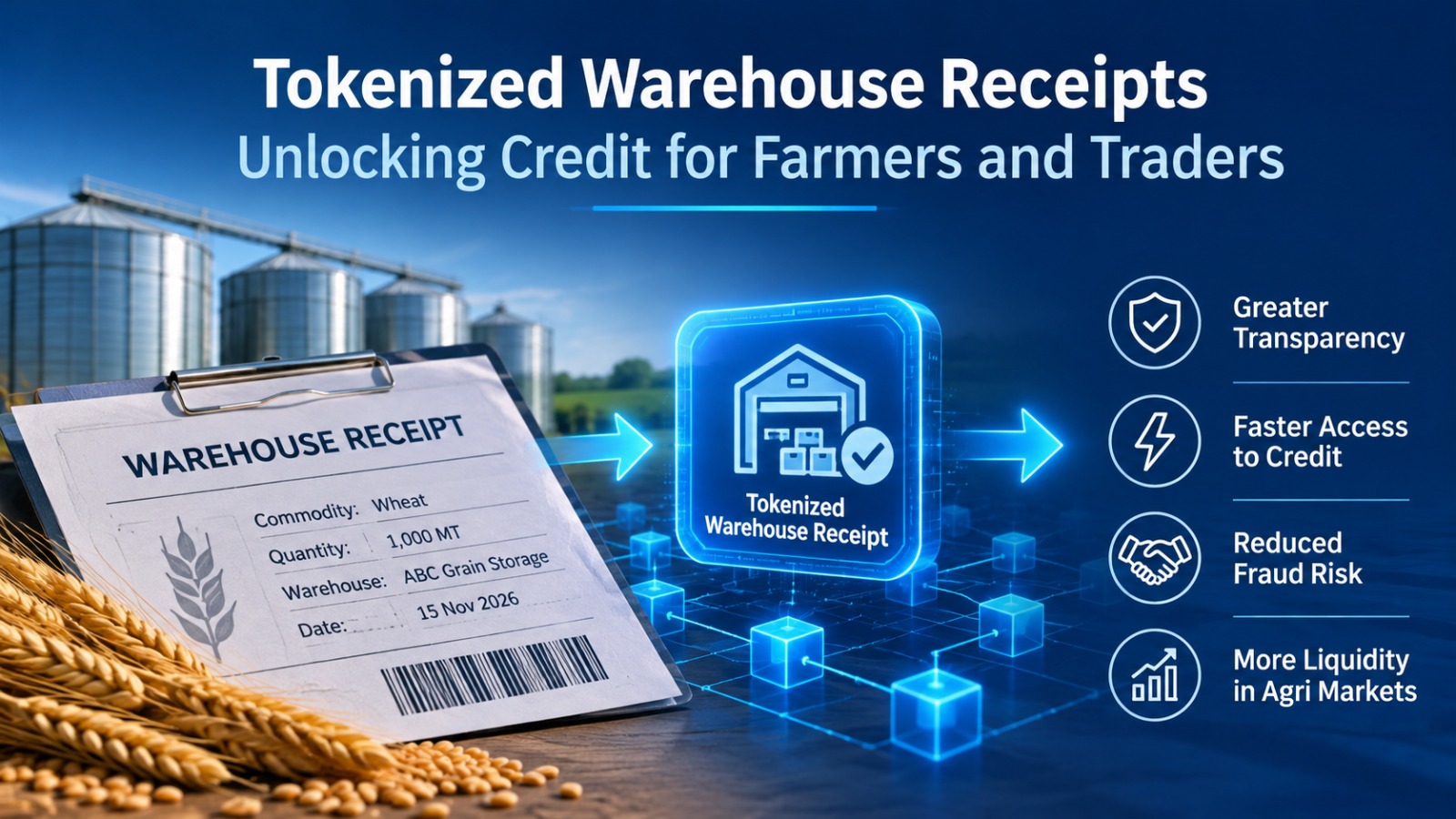
India already has a regulated framework for this: the Electronic Negotiable Warehouse Receipt (e-NWR) system under the Warehousing Development and Regulatory Authority (WDRA). This blog looks at how tokenized warehouse receipts and e-NWR blockchain infrastructure could complement that system, improving ownership tracking, collateral verification and workflow automation, without replacing the regulated foundation it rests on.
A note on positioning: nothing in this article suggests that blockchain is currently integrated into India's official e-NWR infrastructure. Tokenization here is discussed as a potential infrastructure enhancement, to be explored within the applicable legal and regulatory framework.
An Electronic Negotiable Warehouse Receipt (e-NWR) is a digital document issued by a WDRA-registered warehouse that acknowledges the deposit of a specified commodity, in a stated quantity and quality, and which can be transferred or pledged by its holder. In effect, it represents the holder's entitlement to the stored commodity.
These three terms are often used loosely, but they mean different things:
The key point: a receipt being digital does not make it negotiable. Negotiability depends on the legal framework, the regulated issuer and the repository record.
Because an e-NWR is a regulated, verifiable claim on a stored commodity, lenders can treat it as security. In India, warehouse-receipt-backed lending has also been recognised in policy frameworks such as priority sector lending guidelines, though specific eligibility conditions and limits should be confirmed against current RBI circulars and WDRA notifications.
The existing regulated process can be summarised in seven steps. The exact procedures, forms and fees are set by WDRA and the repositories, and readers should refer to current official guidelines for operational detail.
This ecosystem is a strong foundation. The opportunity for new infrastructure lies in the friction that still exists around it: reconciliation between parties, status visibility across institutions, manual workflows and integration with digital lending platforms.
Tokenization means representing an asset, or rights relating to an asset, as a digital token on a blockchain. In the warehouse receipt context, a token could carry a verifiable representation of a receipt or the rights attached to it, along with rules about who may hold or transfer it.
The term is used loosely, so it helps to separate three distinct models:
For India's regulated context, the third model is the most natural fit, because it works alongside the existing legal framework rather than competing with it.
Creating a blockchain token does not automatically make it a legally negotiable warehouse receipt. For a token-based approach to carry legal weight, several things must be addressed:
Any enterprise exploring this space should treat regulatory engagement as a design requirement, not an afterthought.
When used as a complementary infrastructure layer, e-NWR blockchain solutions could offer five main benefits.
Lenders spend time confirming that a receipt is genuine, that the commodity is as described and that no one else has a claim. Blockchain-based records, synchronised with authoritative sources, can give lenders a consistent view of receipt-related information and let them track changes in collateral status without chasing multiple parties.
Double financing, where the same commodity is pledged to more than one lender, is a known risk in commodity finance. Coordinated digital records and integration with authoritative repositories can help surface conflicting claims over the same receipt or commodity earlier.
To be clear: blockchain alone does not eliminate double financing. The protection comes from the combination of a legally recognised repository record, institutional participation in a shared system and disciplined processes. Blockchain contributes a shared, tamper-evident record within that system.
Permissioned blockchain networks, where only vetted participants can read or write, can provide an auditable record of authorised transactions. Regulators, lenders and auditors could review a consistent history of events, while access controls protect sensitive commercial and personal data.
Smart contracts can encode business rules to support:
These capabilities are subject to regulatory and institutional approval, and any automation touching legal rights must be designed so that the regulated record remains authoritative.
Commodity-backed lending is attractive to banks when risk is well understood and operations are efficient. Better verification, lower reconciliation effort and smoother workflows could reduce the cost of serving smaller borrowers, which may help make credit more accessible to farmers, FPOs and traders who are currently under-served. This is a potential outcome, not a guarantee, and depends on lender appetite, pricing and policy support.
The scenario below is entirely hypothetical. All quantities, loan amounts, valuations and interest rates are illustrative assumptions and do not represent actual products, rates or approval outcomes.
The situation. Ramesh, a farmer in Uttar Pradesh, has just harvested 100 quintals of a commodity. Local mandi prices are low and he needs funds to repay a seasonal loan and prepare for the next sowing cycle.
Step 1: Deposit and verification. Ramesh deposits the 100 quintals at a WDRA-registered warehouse. The warehouse verifies quantity and quality.
Step 2: e-NWR issuance. An e-NWR is issued through the authorised infrastructure and recorded in the repository.
Step 3: Approaching a lender. Ramesh approaches a participating bank or NBFC with his e-NWR.
Step 4: Lender checks. The lender verifies the receipt, the commodity valuation, ownership and any existing encumbrances.
Step 5: Infrastructure layer. A blockchain-based layer records authorised collateral-related events, such as the pledge request, pledge confirmation and status changes, in step with the authoritative repository record.
Step 6: Loan sanction. Suppose the commodity is assumed to be valued at ₹2,500 per quintal, giving a notional value of ₹2,50,000. If the lender's policy allowed lending up to, say, 70% of value (an illustrative figure), the eligible amount would be ₹1,75,000, subject to its credit assessment and policies.
Step 7: Repayment and release. After Ramesh repays the loan, the lender releases its claim through the prescribed process, and the receipt becomes free of the pledge.
Why this matters for the farmer. With funds in hand, Ramesh does not need to sell at the harvest-time low. He retains the option to sell when market conditions improve, either by repaying and withdrawing the commodity or by transferring the receipt through the regulated mechanism. If prices rise as he hopes, he keeps that upside. If they do not, he bears that market risk, as with any stored commodity, plus storage and financing costs.
Important: tokenization does not guarantee loan approval. Lenders still apply their own credit, valuation and risk criteria.
The table below compares the existing regulated e-NWR process with a potential blockchain-enhanced model. The right-hand column describes possibilities that depend on regulatory acceptance, not current official infrastructure.
The takeaway: blockchain is best understood as an enhancement layer, not a substitute for the regulated e-NWR system.
An honest view of tokenized warehouse receipts must include the obstacles:
Farmers and traders should not have to sell their produce the moment it leaves the field just to meet short-term liquidity needs. India's e-NWR framework already gives the country a regulated foundation for turning stored commodities into usable collateral. Tokenized warehouse receipts and e-NWR blockchain infrastructure may add value on top of it, through verifiable records, shared collateral visibility, reduced reconciliation and programmable workflows.
The path forward is collaborative and regulation-first. Success will depend on respecting the legal role of WDRA and repositories, integrating with authoritative records, protecting the commodity and data behind every receipt, and designing for the farmer at the end of the chain. Done thoughtfully, this approach can help move agricultural finance from distress selling toward informed, better-timed decisions.
What is an e-NWR?
An Electronic Negotiable Warehouse Receipt is a digital receipt issued by a WDRA-registered warehouse for a commodity deposit, recorded in a repository, which can be transferred or pledged as collateral.
Is a tokenized warehouse receipt the same as an e-NWR?
No. A token is not automatically a legally negotiable warehouse receipt. Legal recognition, repository integration and regulatory compliance are required.
Is blockchain currently part of India's official e-NWR system?
This article does not claim so. Blockchain is discussed as a potential complementary infrastructure layer.
Can blockchain prevent double financing on its own?
No. It can support detection and coordination, but protection depends on authoritative repository records, institutional participation and sound processes.
Does tokenization guarantee a loan?
No. Lenders continue to apply their own credit assessment, valuation and risk policies.