Real-world asset (RWA) tokenization has moved from proof-of-concept to production. Tokenized bonds, fund units, private credit and real estate interests are now being issued by banks, asset managers and property developers, and regulators have responded with guidance, licensing regimes and supervised pilots.
For institutions, the question is no longer whether tokenization is permitted, but under which rules, and with whose approval. Institutional capital depends on legal certainty: who the regulator is, whether a token is a security, who may hold it, and what happens when investors are in several countries. Clarity on these points is usually a bigger adoption gate than the technology.
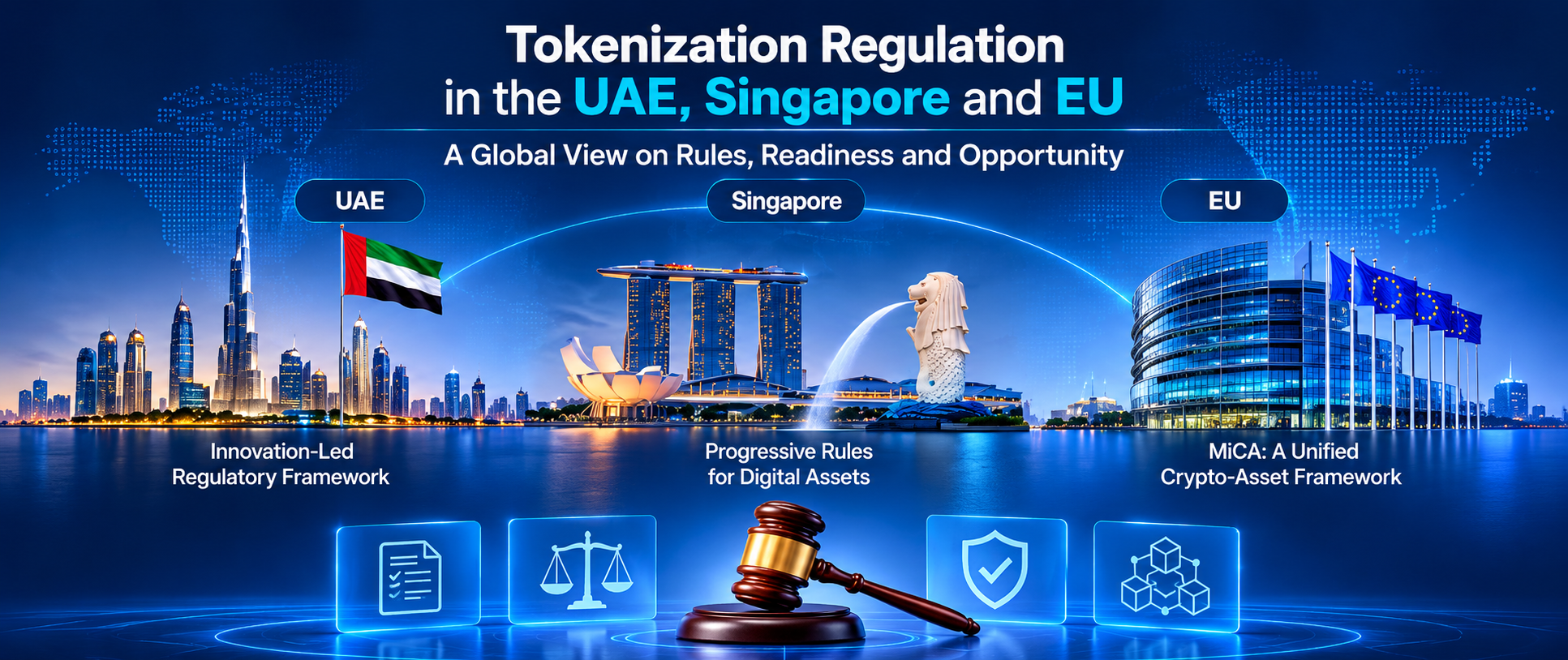
Three jurisdictions come up most often in enterprise planning: the United Arab Emirates, Singapore and the European Union. Each has a serious framework, and each takes a different route. This guide explains tokenization regulation in the UAE, Singapore and the EU under the Markets in Crypto-Assets Regulation (MiCA), so that enterprises can see how asset tokenization regulations differ before choosing where to issue, distribute or operate.
One point runs through all three: there is no single rulebook for "tokenization". The legal treatment depends on what the token represents, who offers it, to whom, and what services surround it. A tokenized bond, a tokenized property interest and a payment stablecoin can all sit under different regimes in the same jurisdiction.
The UAE does not have one tokenization regulator. It has a federal layer and several territorial regulators, and the right one depends on where you are established, where you offer the token, and what the token legally is. For enterprises planning a UAE tokenization project, identifying the correct regime comes first.
This is the most common source of confusion. In practice, tokenized assets fall into broadly three groups:
The SCA's token regulation, for example, covers tokens that represent securities or commodity contracts. Tokenized real-world assets that are not structured as securities are left to VARA or other sector-specific regimes. Classification, not the technology, decides the path.
Real estate is a natural fit for the UAE, and it shows the layered nature of the rules. Property and title law, securities and collective investment rules, and virtual asset rules can all be relevant at once. The Dubai Land Department has run a real estate tokenization pilot with VARA-licensed participants, which shows the direction of travel. A property token can fall under VARA, or under DFSA, FSRA or CMA frameworks, depending on its structure. Enterprises should not assume a pilot is a general permission.
Regulators coordinate, for example through cooperation arrangements between VARA, the DFSA and the federal authority, but coordination is not the same as one licence covering the whole country. An enterprise serving both a free zone and the mainland market may need more than one entity or permission.
Across the UAE regimes, enterprises should expect licensing or registration for regulated activities, custody and safeguarding rules, AML/CFT and KYC controls, investor-protection and disclosure requirements, marketing restrictions and ongoing reporting. The details differ by regulator and by activity.
Singapore's approach is easier to summarise: existing law applies, regardless of the technology. The Monetary Authority of Singapore (MAS) is the principal regulator, and there is no separate "security token" statute.
If a token represents a security, bond, fund unit or derivative, it is a capital markets product regulated under the Securities and Futures Act (SFA), with the Financial Advisers Act relevant where advice is given. MAS reissued its earlier digital-token guidance in November 2025 as the Guide on the Tokenisation of Capital Markets Products, which explains how existing securities laws apply to issuing, offering and facilitating tokenized products and confirms MAS's technology-neutral position.
In practice, that means:
Digital payment tokens (DPTs) are not tokenized securities. They are regulated mainly under the Payment Services Act (PSA), with AML/CFT requirements for DPT service providers. Singapore has also introduced licensing requirements for digital token service providers that serve customers outside Singapore, so offshore-facing businesses should check their position carefully. The line between a DPT and a tokenized capital markets product is a legal question about the token's rights and features.
Project Guardian is a collaboration between MAS and the financial industry that tests tokenization in areas such as fixed income, funds, foreign exchange and wealth management. It has produced industry trials and published frameworks, such as the Guardian Fixed Income Framework and the Guardian Funds Framework.
Project Guardian is an industry initiative. It is not a standalone regulatory approval or a blanket exemption. Participants generally operate under their existing licences and must meet the same regulatory requirements. Its value for enterprises is in shared standards, partners and institutional credibility.
Singapore applies licensing, safeguarding, AML/CFT and KYC rules, and conduct and disclosure requirements, in line with the underlying activity. Investor-protection expectations tend to be tighter for retail-facing products, and many tokenization projects begin with institutional or accredited investors.
MiCA is the headline EU framework, but it is often misunderstood. It is not a general tokenization law, and it does not regulate every tokenized asset.
The Markets in Crypto-Assets Regulation (Regulation (EU) 2023/1114) creates a harmonised EU regime for crypto-assets and crypto-asset service providers that fall outside existing financial services legislation. Its rules for asset-referenced tokens and e-money tokens applied from 30 June 2024, and the full regime has applied since 30 December 2024. The maximum transitional period for existing providers ended on 1 July 2026, so unauthorised providers can no longer serve EU clients under national grandfathering.
MiCA's objectives are investor and consumer protection, market integrity, financial stability and a single market for crypto-asset activity.
Crypto-asset service providers (CASPs) such as custodians, trading platforms, exchange providers and transfer service providers need authorisation from a national competent authority. MiCA sets requirements on governance and fit-and-proper management, prudential safeguards, custody and segregation of client assets, complaints handling, conflicts of interest, operational resilience and transparent disclosure. AML/CFT obligations, including travel-rule requirements for crypto transfers, apply alongside MiCA under separate EU legislation.
A CASP authorised in one member state can provide services across the EU/EEA through notification, without separate authorisation in each country. This is one of MiCA's most commercially significant features. Supervision still sits largely with national authorities, and the Commission's proposed Market Integration and Supervision Package would shift more supervision towards ESMA. That proposal is still in the legislative process.
MiCA excludes crypto-assets that qualify as financial instruments under MiFID II. A tokenized bond, share or fund unit generally remains a financial instrument, so it stays under the existing securities rulebook: prospectus rules, MiFID II conduct and trading rules, and central securities depository and settlement rules. Tokens that are not financial instruments, and are not otherwise excluded, may be in scope as "other crypto-assets", but that conclusion needs case-by-case legal analysis. ESMA has issued guidance on how to assess whether a crypto-asset qualifies as a financial instrument. MiCA also does not replace national property, company or contract law, which still governs the underlying asset.
The DLT Pilot Regime (Regulation (EU) 2022/858) lets authorised operators run DLT-based multilateral trading facilities and settlement systems for tokenized financial instruments, with targeted, time-limited exemptions from some existing rules. It is a supervised pilot with caps, conditions and case-by-case approval. It is not a blanket exemption, and uptake has been limited. In December 2025 the Commission proposed changes to broaden and ease it as part of the Market Integration and Supervision Package, but that package is still being negotiated in the European Parliament and Council, so enterprises should treat the proposed changes as proposals until adopted.
The table below summarises the position. It simplifies, and each cell hides real variation by activity, investor type and structure.
No jurisdiction is universally best. The right choice depends on the asset class, target investors, business model and intended distribution markets. These are the factors to compare.
Examples. A real estate developer targeting Gulf and international investors might begin with the UAE. An asset manager launching a tokenized fund for institutional investors in Asia could look first at Singapore. A European bank issuing a tokenized bond to EU investors would work mainly within the EU securities framework, and use MiCA only for crypto-asset services outside it.
Regulation sets the obligations. Infrastructure helps an enterprise meet and evidence them. The following capabilities matter most.
Spydra is an enterprise-grade, low-code blockchain platform for real-world asset tokenization. It is built on Hyperledger Fabric and supports both private and public blockchain environments, which lets enterprises combine permissioned control with public-network connectivity. Teams exploring asset management or real estate tokenization use cases can use this kind of infrastructure to implement access controls, transfer rules and audit trails faster.
One caveat matters: technology does not make a project compliant. Blockchain infrastructure supports compliance processes, but it does not replace legal classification, licences, regulatory approvals or sound legal documentation. Each project still needs its own legal analysis in each jurisdiction.
The three frameworks take different routes. In the UAE, tokenization regulation is multi-regulator and activity-specific: VARA, the ADGM FSRA, the DFSA and the federal Capital Market Authority (formerly the SCA) each apply in their own territory and scope. Singapore applies existing securities and payments law through MAS, with Project Guardian as an industry initiative rather than an exemption. The EU separates crypto-assets under MiCA from financial instruments under MiFID II, with the DLT Pilot Regime supporting market infrastructure and reforms still under negotiation.
For enterprises, jurisdiction choice should follow four questions: how the asset and token are classified, where the investors are, which licences are needed, and what the business wants to achieve. Understanding tokenization regulation in the UAE, Singapore and the EU is the first step, and local legal advice is the next one.
Enterprises exploring compliant real-world asset tokenization can explore the Spydra platform or book a product demonstration to see how enterprise blockchain infrastructure fits their regulatory and operational requirements.
The UAE has no single tokenization law. Regulation depends on location and token type: VARA for virtual assets in Dubai outside DIFC, the FSRA in ADGM, the DFSA in DIFC, and the federal Capital Market Authority (formerly the SCA) onshore. Licensing, custody, AML/KYC and investor-protection rules apply according to the activity.
Yes. Singapore applies existing laws regardless of technology. Tokens representing securities, bonds or fund units are regulated as capital markets products under the SFA, and may need licences or exemptions. Payment tokens fall under the Payment Services Act.
Not generally. MiCA covers crypto-assets that are not already financial instruments. Tokenized securities and similar instruments are usually regulated under MiFID II and related law. Some non-financial-instrument RWA tokens may fall within MiCA, so classification needs legal analysis.
MiCA regulates crypto-assets and crypto-asset service providers that fall outside existing financial services law. MiFID II regulates financial instruments and the firms that deal in them. A token that qualifies as a financial instrument falls under MiFID II rather than MiCA.
Tokenized securities are generally regulated as securities: by the DFSA in DIFC, the FSRA in ADGM, and the federal Capital Market Authority onshore. The regulator and rules depend on where the issuer and platform are established and where investors are targeted.
There is no universal answer. The UAE, Singapore and the EU each suit different asset classes, investor bases and distribution goals. The best choice depends on asset classification, licensing needs and where the target investors are.
Consider legal classification of the asset and token, issuance and distribution permissions, KYC/AML and investor eligibility, custody, transfer restrictions, secondary-market rules, cross-border obligations, data privacy, smart contract security and system integration.