A single bag of specialty coffee can pass through a smallholder farm, a washing station, a cooperative, a dry mill, an exporter, a shipping line, an importer, a roaster and a retailer before anyone drinks it. Each handoff produces records in different formats, held by different parties, with different incentives. By the time the coffee reaches a buyer, the claims on the label (origin, variety, altitude, organic status, fair pricing) are often supported by documents the buyer cannot independently check.
This is why coffee traceability blockchain systems are moving from pilot ideas to serious enterprise evaluation. Buyers want proof of origin, regulators want due diligence evidence, and premium producers want their provenance to be credible. Blockchain does not solve all of this, but a permissioned network gives every participant a shared, tamper-evident record of what was declared, by whom, and when. This article explains how that works, where it falls short, and how enterprises can implement it.
Coffee traceability is the ability to follow a coffee lot, and the information attached to it, through every stage from farm to cup. A traceable supply chain can answer questions such as: Which farms contributed to this lot? When was it harvested and how was it processed? Which inspections and certifications apply? Where has it been stored and shipped?
Traditional traceability relies on paper records, spreadsheets, ERP entries and supplier-held databases. Each party keeps its own version, and reconciling them is slow. Records can be edited after the fact, and a buyer must usually trust the party that supplied the document.
Blockchain-based coffee traceability changes the record-keeping model rather than the physical process. Participants write events to a shared ledger where entries are append-only, time-stamped and cryptographically linked. Changes leave a visible trail, and every authorised party sees the same history. Farm-to-cup traceability then becomes a continuous chain of verifiable events instead of a set of disconnected documents.
Origin fraud and mislabeling. Origin carries a price premium, so lots can be blended, relabeled or misdescribed. Coffee origin verification is hard when the only evidence is a document that travels separately from the physical bags.
Fragmented supply chain information. Smallholders, cooperatives, mills, exporters and importers often use different systems, or none. Lot identities get merged, split and renamed along the way, and the link back to individual farms is frequently lost.
Certification verification. Organic, Fairtrade, Rainforest Alliance and similar claims depend on certificates and audits. Checking that a certificate is valid, covers the right volume and applies to the specific lot is manual work, and volume reconciliation is a recurring weak point.
Quality and batch management. Cupping scores, moisture readings, defect counts and processing method (washed, natural, honey) affect value. If these are recorded inconsistently, quality disputes are hard to resolve and premium lots lose their story.
Sustainability and responsible sourcing. Buyers increasingly need evidence about farming practices, plot location and working conditions, not just assertions in a sustainability report.
International export requirements. Exporters assemble commercial invoices, certificates of origin, phytosanitary certificates, quality documents and sustainability evidence. Importing markets also impose due diligence rules. For example, the EU Deforestation Regulation covers coffee and calls for geolocation and due diligence information; its application dates have been adjusted more than once, so exporters should confirm the current timeline and scope with official sources before building compliance claims around it. [VERIFY]
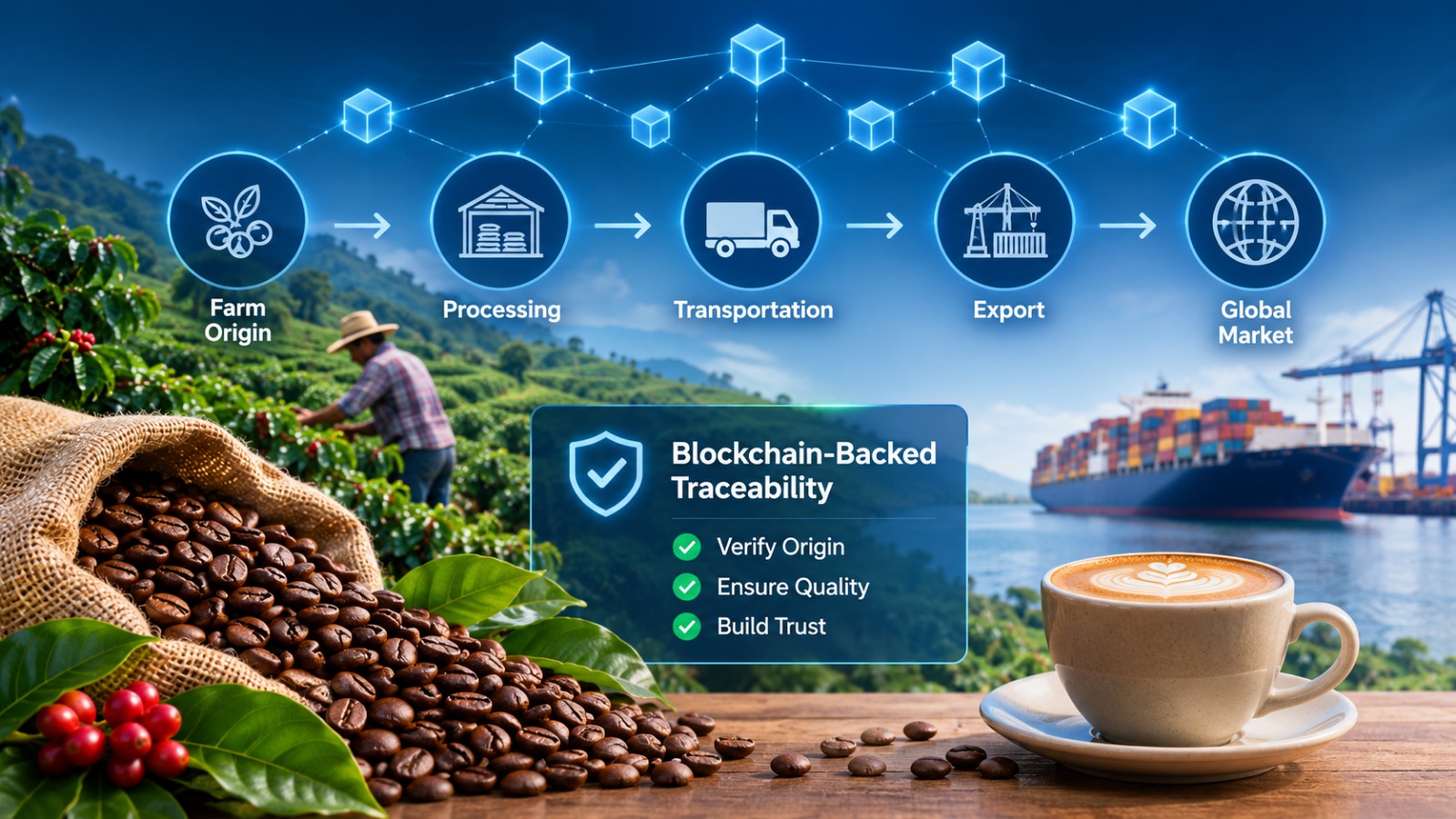
A permissioned blockchain network is operated by known participants: farmers or cooperatives, processors, quality labs, certifiers, warehouses, logistics providers, exporters, importers and roasters. Each organisation holds a defined role and can record only the events it is responsible for. The workflow below shows how a lot moves through the network.
1. Farm registration and farmer identification. Each farmer or farm plot receives a digital identity, typically with plot location, size, variety and certification status. Onboarding is usually done through a cooperative or buying station, which verifies the details before they are written to the network.
2. Harvest and origin data recording. At delivery, the buying station records harvest date, weight, cherry or parchment type and the contributing farm. This is the anchor for coffee origin verification: every later lot references these source records.
3. Batch identification and processing. Each lot gets a unique identifier, often linked to a QR code or barcode on bags. Processing events (washing, fermentation, drying, hulling, grading) are recorded, and the system tracks how lots are merged or split so that parentage is preserved.
4. Quality inspection and certification records. Labs and certifiers record cupping results, moisture and defect data, and certificate references against the lot. Smart contracts can check rules automatically, for example that certified volume sold does not exceed certified volume produced.
5. Warehousing and inventory tracking. Warehouses record receipt, storage conditions and release. Inventory on the ledger can be reconciled with physical stock counts.
6. Transportation and export documentation. Handovers between transporters, shipping lines and customs agents are logged. Export documents can be hashed and referenced on the ledger, giving auditors a verifiable link between a document and the lot it describes. Coffee export traceability improves because everyone works from the same lot history.
7. Roasting, distribution and final verification. Roasters record the lots used in each roast batch. A consumer or retailer can scan a code and view the verified lot history that the brand chooses to expose, while sensitive commercial data stays restricted.
In each step, the participant who performs the activity signs the entry. The network then provides a single history that no individual party can quietly rewrite.
A centralized database remains a sound choice when one organisation controls the whole chain. Blockchain earns its place when multiple independent parties need to trust a shared record without relying on a single owner.
The scenarios below are illustrative. They describe how a traceability network could be used and are not independently verified customer deployments.
Specialty coffee origin verification. A roaster selling single-origin lots records farm, altitude, variety and processing method at each stage. Customers can view verified lot history, and the roaster can defend its premium with evidence.
Organic and sustainability certification tracking. Certificate references, validity dates and certified volumes are attached to lots. Smart contracts flag lots whose declared volume exceeds the certified quantity, prompting review before shipment.
Cooperative and exporter collaboration. A cooperative records member deliveries and payments, while the exporter sees lot composition and quality data in near real time. Disputes about volumes or grades are resolved against a shared history.
Premium coffee authenticity verification. For high-value lots, bag-level identifiers tie physical units to ledger records. Retailers and importers can check that a lot matches its declared origin and chain of custody records.
International coffee export traceability. An exporter links export documents, inspection results and shipping events to each lot. Importers and customs-facing teams reconcile documentation faster and have a clearer evidence trail for due diligence requests.
Blockchain proves what was recorded, not whether it was true. This is the central limitation. A ledger makes entries tamper-evident after they are written, but it cannot independently confirm that a bag truly contains Ethiopian Yirgacheffe or that a farmer reported the right weight. Data integrity is not physical product verification. Reliable programmes combine blockchain with source controls: trained and accountable data entry points, third-party audits, lab testing, physical seals, GPS validation and, where appropriate, IoT sensors or isotopic and DNA testing for high-value lots.
Farmer onboarding. Many smallholders have limited literacy, smartphones or connectivity. Cooperatives and buying stations typically act as intermediaries, using simple mobile or offline-capable tools, with training and clear incentives for participation.
Digital infrastructure. Weak connectivity at farm and washing-station level requires offline data capture and later synchronization.
Data accuracy and governance. Networks need agreed data standards, validation rules and responsibility for corrections.
ERP and IoT integration. Most exporters and roasters already run ERP, warehouse and quality systems. The blockchain layer must integrate with them rather than force duplicate entry.
Data privacy. Pricing, supplier relationships and farmer personal data are sensitive. Permissioned networks, role-based access and keeping personal data off-chain (with only references or hashes on-chain) are important design choices. Privacy law obligations vary by country and should be reviewed. [VERIFY]
Interoperability. Different networks and certifiers use different formats. Using open standards and APIs reduces lock-in.
Looking to improve transparency across your coffee supply chain? Explore how Spydra's enterprise blockchain platform can help build secure, auditable and scalable traceability workflows.
Spydra is an enterprise-grade, low-code blockchain platform built on Hyperledger Fabric, supporting both private and public blockchain networks. For coffee traceability, the capabilities most relevant to enterprise teams are:
Spydra provides the blockchain layer. Source data quality, physical verification and onboarding programmes remain part of the overall traceability design, as described above.
What is blockchain-based coffee traceability? It is the use of a shared, tamper-evident ledger to record each event in a coffee lot's journey, from farm to roaster, so authorised parties can verify its history.
How does blockchain track coffee from farm to cup? Each stage (harvest, processing, inspection, storage, shipping, roasting) is recorded against a unique lot identifier, often linked to a QR code. Together these entries form a continuous chain of custody.
Can blockchain verify the origin of coffee? It can make origin claims tamper-evident and traceable to recorded sources. It cannot by itself prove the physical coffee matches the record, so it is combined with audits, seals, lab testing or GPS data.
How does blockchain prevent coffee fraud? It makes unrecorded changes and document reuse harder to hide, and lets buyers cross-check claims against a shared history. It reduces fraud opportunities but depends on reliable data at the source.
How can coffee exporters use blockchain for traceability? Exporters can link lot records, quality results, certificates and shipping documents in one auditable trail, simplifying buyer due diligence and compliance reporting.
Can blockchain track organic and Fairtrade coffee certifications? Yes, certificate references, validity and certified volumes can be recorded against lots, with smart contracts flagging mismatches. The certification itself still depends on the certifying body's audits.
What is the difference between traditional and blockchain coffee traceability? Traditional systems rely on separate, party-controlled records. Blockchain provides a shared, append-only record with role-based access and built-in audit history.
Is blockchain traceability suitable for small coffee farmers and cooperatives? Yes, when cooperatives or buying stations act as onboarding points with simple mobile or offline tools. Costs, training and incentives need to be planned so smallholders benefit rather than just supply data.
Coffee traceability blockchain solutions will not replace audits, lab testing or good field practice. What they offer is a trustworthy shared record that makes origin, certification and export claims easier to verify and harder to rewrite. Enterprises that start with a focused pilot, invest in source data quality and choose a permissioned platform with strong integration can build farm-to-cup traceability that buyers and regulators can rely on.
Ready to build secure, auditable coffee traceability workflows? Explore Spydra's enterprise blockchain platform.