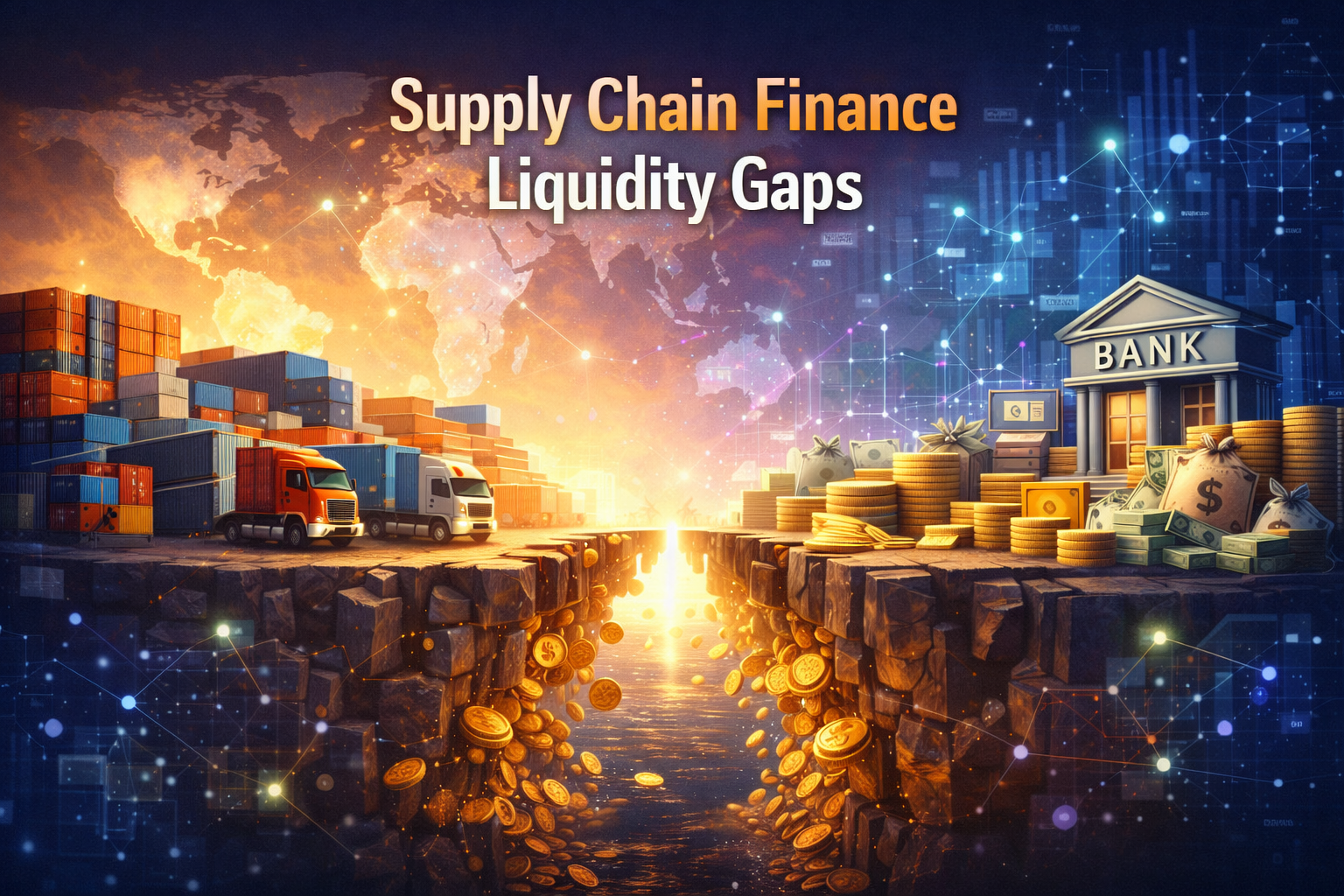
Global supply chains move more than $28 trillion worth of goods annually, according to the World Trade Organization. Yet, despite this massive scale, over $1.7 trillion in supply chain finance liquidity gaps persist worldwide, as reported by the International Finance Corporation (IFC). These gaps hit small and mid-sized suppliers the hardest, limiting cash flow and stalling operations. As supply chain liquidity challenges intensify due to inflation, geopolitical tensions, and rising interest rates, asset tokenization is emerging as a practical solution to close these gaps and restore financial balance.
Supply chain finance liquidity gaps occur when suppliers lack timely access to working capital needed to fulfill orders, pay vendors, or manage operations. Buyers may have strong credit ratings, but suppliers often wait 30, 60, or even 120 days for invoice payments.
As a result, liquidity gaps in supply chain finance create a ripple effect:
According to McKinsey, over 60% of SMEs globally struggle with consistent cash flow, making supply chain finance liquidity gaps a systemic issue rather than an isolated problem.
Several structural issues fuel supply chain liquidity challenges.
Large buyers extend payment terms to preserve cash. While this helps buyers, it deepens supply chain finance liquidity gaps for suppliers.
Traditional banks often view SMEs as high-risk. As a result, nearly 45% of small suppliers cannot secure affordable trade financing, according to the World Bank.
Paper-based invoicing, manual verification, and lack of transparency slow financing approvals and increase fraud risks.
Post-pandemic disruptions, higher borrowing costs, and geopolitical conflicts have intensified supply chain liquidity challenges worldwide.
Traditional supply chain finance relies heavily on intermediaries, manual assessments, and centralized decision-making. These systems often:
Deloitte reports that processing a single trade finance transaction can take up to 10 days, which directly worsens liquidity gaps in supply chain finance. Clearly, the legacy model no longer meets modern trade demands.
Asset tokenization introduces a digital-first approach that directly tackles supply chain finance liquidity gaps. But how does it work?
Asset tokenization converts real-world financial assets—such as invoices, purchase orders, or inventory—into blockchain-based digital tokens. These tokens represent verified ownership or payment rights and can be financed instantly.
According to BCG, asset tokenization could unlock $4 trillion in new financing opportunities, significantly reducing supply chain liquidity challenges.
Imagine a supplier waiting 90 days for payment. Instead of borrowing at high interest, the supplier tokenizes the invoice on a blockchain platform. Investors purchase the token at a discount, providing immediate liquidity.
This model directly closes liquidity gaps in supply chain finance while benefiting investors with predictable returns. Platforms using this approach report up to 40% faster cash conversion cycles, according to industry data.
Asset tokenization doesn’t just help suppliers—it strengthens the entire ecosystem.
The World Economic Forum estimates that digitized trade finance solutions could reduce global supply chain liquidity challenges by up to 50% over the next decade.
While asset tokenization shows promise, regulation remains a critical factor. Jurisdictions differ on how they classify tokenized assets—securities, commodities, or digital instruments.
However, progress is visible. Regulatory sandboxes in the UK, Singapore, and the EU are actively testing tokenized trade finance models. Combined with blockchain’s cryptographic security, these frameworks ensure trust while addressing liquidity gaps in supply chain finance.
Looking ahead, asset tokenization will likely integrate with AI, IoT, and smart contracts. These technologies can automatically verify shipment data, trigger payments, and release liquidity in real time.
Experts predict that 20–30% of global trade finance could become tokenized by 2030. As adoption grows, supply chain liquidity challenges will shift from being a chronic issue to a manageable operational concern.
Supply chain finance liquidity gaps are no longer just a financial inconvenience—they’re a global economic risk. Fortunately, asset tokenization offers a modern, transparent, and scalable solution. By digitizing assets and opening access to global capital, businesses can finally overcome long-standing liquidity gaps in supply chain finance.
In a world where speed and resilience matter more than ever, addressing supply chain liquidity challenges through tokenization isn’t just smart—it’s essential.
Supply chain finance liquidity gaps refer to the shortfall in working capital that suppliers face due to delayed payments, long invoice cycles, or limited access to financing. These gaps prevent suppliers from maintaining smooth operations and often disrupt the entire supply chain.
Small and mid-sized enterprises often lack strong credit profiles or collateral. As a result, banks hesitate to finance them, which deepens liquidity gaps in supply chain finance and forces SMEs to rely on costly short-term loans.
According to the International Finance Corporation (IFC), the global supply chain finance liquidity gap exceeds $1.7 trillion, with a significant portion affecting emerging markets and developing economies.
The biggest supply chain liquidity challenges include long payment terms, rising interest rates, limited trade finance access, manual documentation, and geopolitical disruptions that slow cross-border transactions.
Asset tokenization converts invoices, purchase orders, or inventory into blockchain-based digital tokens. These tokens can be financed instantly, allowing suppliers to access liquidity faster and reduce reliance on traditional lenders.
Yes, asset tokenization improves transparency, reduces processing time, lowers costs, and broadens investor access. Unlike traditional financing, it directly addresses liquidity gaps in supply chain finance by enabling near real-time funding.
Yes. Tokenized supply chain assets can be traded on compliant digital marketplaces, increasing liquidity and helping investors exit positions easily—something rarely possible with traditional trade finance instruments.
Asset tokenization uses blockchain technology, which provides immutable records, cryptographic security, and real-time auditability. This significantly reduces fraud and enhances trust across the supply chain ecosystem.
Common assets include invoices, receivables, purchase orders, inventory, and even shipping documents. Tokenizing these assets helps close supply chain finance liquidity gaps more efficiently.
Regulations vary by region, but many countries now offer regulatory sandboxes for blockchain-based finance. Compliance-focused tokenization platforms mitigate legal risks while addressing supply chain liquidity challenges.
Suppliers gain faster cash flow, buyers secure more reliable supplier networks, and investors access short-term, asset-backed investment opportunities with predictable returns.
Experts predict that up to 30% of global trade finance could be tokenized by 2030. As adoption grows, supply chain liquidity challenges will decline, creating more resilient and efficient global trade networks.