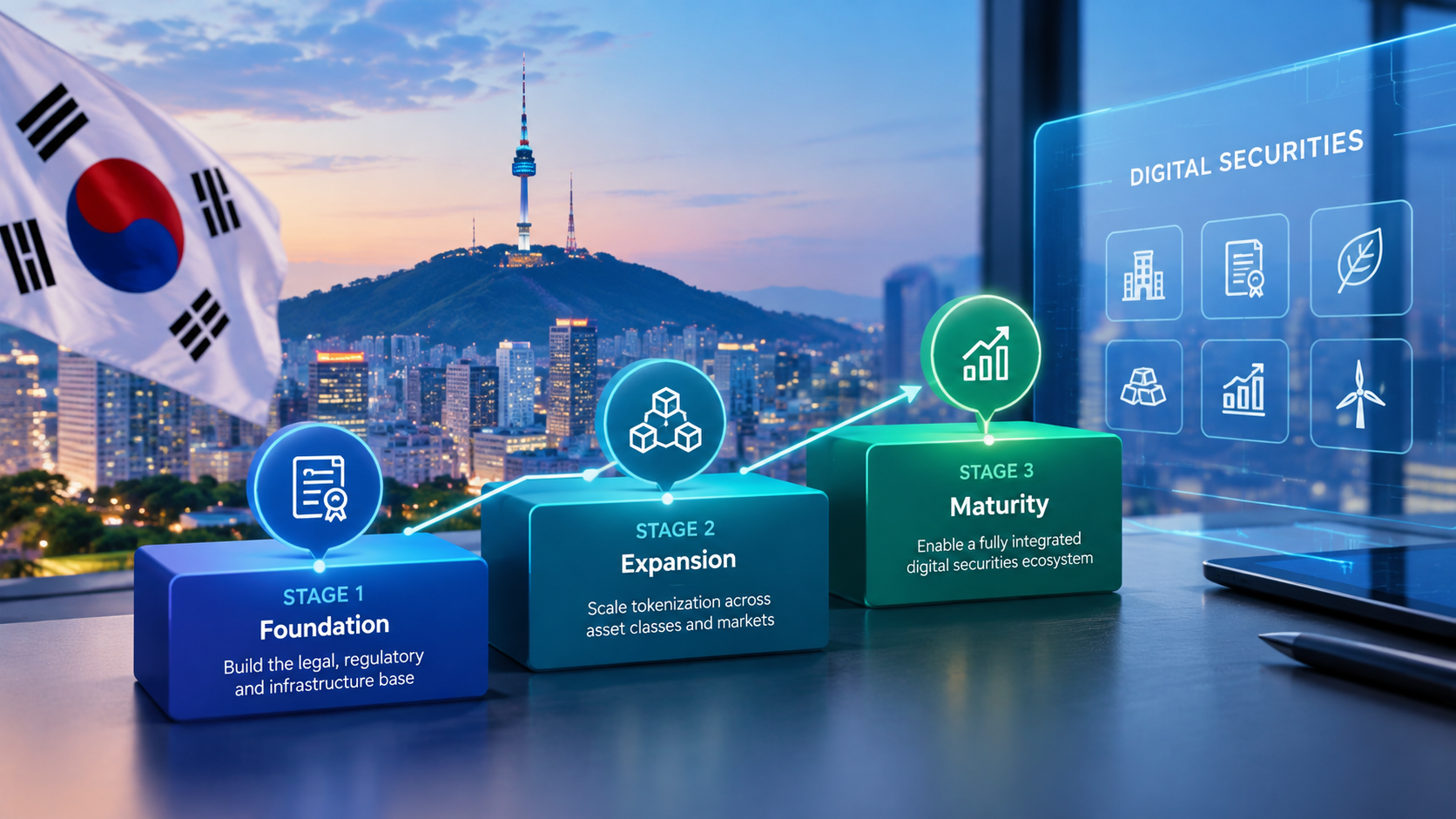
On September 4, 2026, South Korea's Financial Services Commission (FSC), together with the Financial Supervisory Service (FSS), introduced a policy roadmap for the digital transformation of securities issuance and circulation. The announcement, made at the third meeting of a public-private consultative body on securities tokenization, set out a three-phase framework that will govern how tokenized securities are issued, held, and eventually settled in South Korea's capital markets.
The South Korea tokenization roadmap is significant not because it launches a single tokenized product, but because it establishes a structured, multi-year path for integrating blockchain-based issuance into the country's formal capital markets infrastructure. For financial institutions watching global securities tokenization develop—in Korea, in India, in Europe, and elsewhere—the roadmap offers a useful reference point for how a major regulator is sequencing the shift from experimentation to production.
This is not a claim that South Korea will tokenize every stock, bond, and fund overnight. It is a phased regulatory and infrastructure plan, with the first phase beginning on a specific date and later phases contingent on how that first phase performs.
The roadmap was unveiled by FSC Vice Chairman Kwon Dae-young at the FSC's third private-public consultative meeting on securities tokenization. It directs securities firms and the Korea Securities Depository (KSD) to build the infrastructure needed to support tokenized securities issuance, while setting out the regulatory sequence under which different categories of securities become eligible.
The centerpiece of the timeline is February 4, 2027. That is the date on which amendments to the Act on Electronic Registration of Stocks and Bonds — passed earlier in 2026 alongside related changes to the Capital Markets Act — take legal effect. These amendments formally permit distributed ledger technology to record securities ownership, giving tokenized securities the same legal status as conventional electronically registered securities. February 2027 is therefore not an arbitrary target; it is the point at which tokenized securities gain legal recognition under Korean capital markets law, and the trigger for Phase 1 of the roadmap.
The FSC has said it plans to publish proposed revisions to subordinate regulations by the end of September 2026, ahead of that effective date.
Notably, the roadmap moves beyond South Korea's existing security token offering (STO) activity, which has largely centered on fractional investment products such as art or royalty shares. The FSC's stated intent is to extend tokenization into conventional securities types — stocks, bonds, and funds — as infrastructure and regulation mature.
It's worth stressing what the FSC has not done: it has not set fixed dates for Phase 2 or Phase 3. Both later phases are explicitly conditioned on the results of Phase 1, the pace of technology adoption among market participants, and—for Phase 3 in particular — the passage of separate stablecoin legislation that has not yet cleared Korea's National Assembly.
Phase 1 begins when the amended Act on Electronic Registration of Stocks and Bonds takes effect on February 4, 2027. It covers a deliberately narrow set of securities:
Starting with institutional and structurally simpler instruments is a common regulatory pattern in tokenization pilots elsewhere, and it reflects a practical logic: these categories carry lower systemic and investor-protection risk than public equities, making them a reasonable proving ground for new infrastructure.
The FSC has also indicated that securities firms and trading venues already holding standard securities licenses will not need a separate license to handle tokenized securities under this framework, though over-the-counter trading venues will need to consult the Financial Supervisory Service separately. Retail investors trading tokenized securities over the counter will face an annual net purchase cap, and non-bank issuers that maintain their own investor accounts will face registration and capital requirements — reporting suggests a threshold around 4 billion won in equity capital, along with dedicated personnel for account management, internal controls, and IT security.
The KSD's role matters here. As Korea's central securities depository, its systems for registration, transfer, and ownership records are the backbone the FSC is directing toward tokenized infrastructure — meaning Phase 1 is as much about integrating distributed ledger technology with existing market infrastructure as it is about issuing new instruments.
Phase 2 is described as an expansion toward publicly offered securities more broadly, building on the operational experience gained during Phase 1. The FSC has not published a start date for this phase, and this article avoids speculating on one — the regulator has said explicitly that timing depends on how the first phase performs.
Moving from a narrow institutional pilot to publicly offered securities introduces a different order of infrastructure challenge. Systems need to handle:
None of this is simple to bolt onto Phase 1 infrastructure after the fact. It is one reason regulators and institutions alike tend to think about tokenization projects as infrastructure builds rather than one-off product launches.
The third phase is the most architecturally ambitious, and the most conditional. It envisions connecting tokenized securities to on-chain payment infrastructure, including mechanisms involving stablecoins, subject to South Korea's evolving stablecoin regulatory framework.
The logic behind this phase is a familiar one in market infrastructure circles: a tokenized security only realizes its full efficiency potential when the cash leg of a transaction can also move on-chain. Today, even a fully tokenized security typically still settles against conventional bank-mediated payment rails, which reintroduces timing gaps and reconciliation work that tokenization was partly meant to remove.
If securities and cash sit on the same ledger, Delivery versus Payment (DvP) can become atomic — the security and the payment transfer simultaneously, as a single event, rather than as two separate legs reconciled after the fact. That structurally reduces settlement risk and can shorten settlement cycles well below the conventional T+2 standard still common in many markets. It also opens the door to programmable settlement, where corporate actions, interest payments, and redemptions execute automatically according to smart contract logic, with payment finality built into the same transaction as the securities transfer.
It's important to separate what the FSC has actually committed to here from broader industry analysis. The FSC has stated that Phase 3 is a target contingent on the passage of stablecoin legislation that Korean lawmakers have not yet enacted. The specific design of that on-chain payment layer — which stablecoins, which settlement rails, which institutions operate it — remains undetermined. What the roadmap establishes is direction, not a finished architecture.
South Korea is not the only major Asian market moving on securities tokenization in 2026. In September, India's Securities and Exchange Board of India (SEBI) and the Reserve Bank of India (RBI) launched "Demat 2.0," a pilot for tokenized corporate bonds unveiled at the Global Fintech Fest 2026 in Mumbai. Three issuers — REC Ltd, L&T, and IIFL — raised a combined ₹1,025 crore (roughly $107 million) in tokenized bond issuances shortly after launch, with settlement conducted through the RBI's wholesale central bank digital currency via a Unified Market Interface.
The two initiatives are best understood as different approaches shaped by different regulatory starting points, not as a ranked competition — an analytical framing rather than any official designation by either regulator.
The practical difference is sequencing: South Korea is building legal recognition and registration infrastructure first, with payment-layer integration held for a later, legislation-dependent phase. India has moved directly to CBDC-linked atomic settlement within a live pilot, but on a narrower initial product set. Both approaches point toward the same underlying goal — connecting tokenized securities to programmable, on-chain settlement — reached from different starting positions.
Reading the roadmap alongside developments in India, Hong Kong's tokenized green bonds, and asset managers' tokenized fund products (which the FSC itself referenced as a point of comparison), a pattern emerges: the harder problem in tokenization isn't creating a token. It's building the surrounding market infrastructure that makes a token usable, compliant, and tradable at institutional scale.
That infrastructure typically spans a stack that looks something like this:
Asset Data → Identity → Compliance → Tokenization → DLT → Smart Contracts → Custody → Digital Money → Settlement → Reporting
South Korea's roadmap effectively works through this stack in sequence: legal recognition and registration infrastructure first (Phase 1), broader issuance and market infrastructure second (Phase 2), and digital money integration last (Phase 3). That sequencing is instructive for any institution planning its own tokenization strategy — the token is rarely the hard part.
As regulated markets like South Korea's move tokenization out of pilot territory and into defined legal frameworks, institutions face a practical question: what infrastructure actually supports this transition? This is where the concept of a security token platform becomes relevant — not as an abstract technology category, but as a specific operational requirement.
A platform capable of supporting the full lifecycle of tokenized securities generally needs to handle:
Each of these capabilities exists because a regulator like the FSC — or SEBI and the RBI in India — is not simply asking whether an asset can be put on a blockchain. They're asking whether the resulting system preserves investor protection, auditability, and market integrity at the same standard as conventional securities infrastructure. A security token issuance platform that can't demonstrate compliance controls, eligibility enforcement, and audit trails isn't a viable candidate for regulated markets, regardless of how efficient its token mechanics are.
It's worth separating two things that often get conflated: token issuance and tokenized market infrastructure.
Issuing a token — creating a digital representation of an asset on a ledger — is a relatively well-understood technical exercise. What determines whether that token functions as a usable, compliant security is everything around it:
A token without this surrounding infrastructure is a proof of concept. A token with it is a component of regulated market infrastructure — which is precisely the distinction South Korea's phased roadmap, and India's pilot-to-scale approach, are both navigating in their own ways.
Spydra is an enterprise asset-tokenization platform built on Hyperledger Fabric, designed to help organizations tokenize and manage real-world assets across both permissioned private networks and public-chain deployments. Its platform includes a configurable Token Engine for issuing and fractionalizing assets, Oracle integrations for bringing off-chain data on-chain, no-code Workflow automation, Custom Chaincode support for tailoring smart-contract logic to specific use cases, and REST API and Zapier-based integrations for connecting to existing enterprise systems.
For financial institutions, Spydra's platform is applied to use cases such as securitization of assets, lending, cross-border payments, and trade finance — areas that map directly onto the infrastructure layers discussed above: configurable asset and token models, permissioned network governance, compliance-oriented workflows, and integration with existing tech stacks rather than requiring institutions to replace them.
This is a natural extension of the infrastructure conversation, not a claim that Spydra is involved in South Korea's or India's specific regulatory initiatives. As national frameworks like the one the FSC has outlined mature, institutions evaluating their own tokenization strategy will need to assess platforms against exactly these infrastructure requirements — configurability, compliance tooling, integration options, and network governance — regardless of which regulatory jurisdiction they operate in.
Across multiple regulated markets, tokenization is following a broadly similar arc: Experiments → Pilots → Regulated Issuance → Market Infrastructure → Integrated Settlement.
South Korea's roadmap and India's Demat 2.0 pilot represent two different points along — and approaches to — that arc. South Korea has published a phased legal and regulatory sequence with a defined starting date and conditional later stages. India has moved directly into a live pilot with real issuances and CBDC-linked atomic settlement, with expansion to other asset classes framed as a next step rather than a scheduled phase.
Neither approach can yet be judged as more advanced in an absolute sense — they reflect different regulatory starting points and priorities. What both make clear is that securities tokenization, in markets serious about institutional adoption, is no longer primarily a technology question. It's an infrastructure and regulatory sequencing question, and the answers different regulators reach will shape how global capital markets connect over the next several years.
The South Korea tokenization roadmap announced by the FSC on September 4, 2026, doesn't tokenize the country's stock and bond markets overnight. It establishes a structured, three-phase path: legal recognition and initial infrastructure for a defined set of institutional and fractional securities starting February 4, 2027; expansion toward publicly offered securities in a second, undated phase contingent on Phase 1's success; and, eventually, integration with on-chain payment infrastructure pending stablecoin legislation.
Why February 2027 matters is straightforward — it's the date tokenized securities gain formal legal status under Korean capital markets law. Why the three phases matter is more structural: they reflect a deliberate sequencing of risk, starting narrow and institutional before scaling to public markets and, eventually, payment integration.
For financial institutions watching this unfold — in Korea, India, or any regulated market moving toward digital securities — the underlying lesson holds regardless of jurisdiction: tokenization requires more than smart contracts and a ledger. It requires identity verification, compliance enforcement, asset lifecycle management, custody integration, and reporting built to institutional standards. That's the difference between issuing a token and operating a security token platform capable of supporting regulated markets at scale.
Institutions evaluating tokenized securities strategy — whether in response to South Korea's roadmap, India's pilot, or their own market's regulatory direction — should be thinking about that complete technology stack now, not after the first phase of their local framework takes effect.
Exploring infrastructure for tokenized securities? Learn how Spydra can support enterprise tokenization workflows.