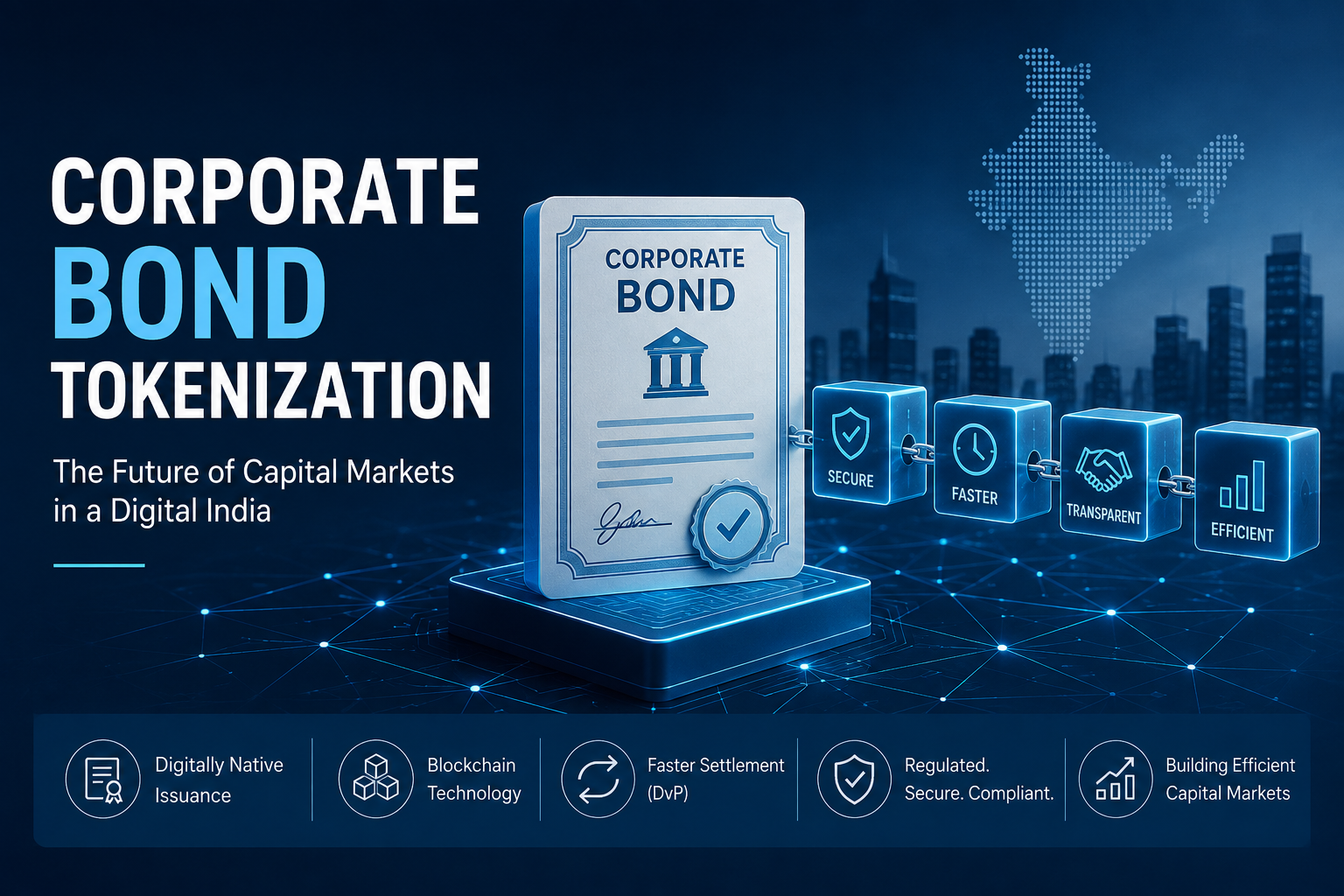
SEBI’s corporate bond tokenization pilot is a regulator-led experiment, confirmed by SEBI Chairman Tuhin Kanta Pandey in May 2026 and reaffirmed in SEBI’s Annual Report 2025–26, that will test whether distributed ledger technology (DLT) can support the issuance, settlement and servicing of corporate bonds inside India’s existing regulated market structure. What changed in August 2026 is scope: SEBI has now confirmed the pilot is being run in coordination with the Reserve Bank of India, will test simultaneous transfer of securities and money on a shared ledger, will explore automated coupon payments through smart contracts, and will examine integration with CBDC-based settlement mechanisms. That is no longer a bond-digitisation experiment. It is a settlement-infrastructure experiment.
What is the initiative?
A pilot project—not a sandbox cohort, not a production system—to test tokenization of corporate bonds using Announcing on 26 May 2026 by Chairman Tuhin Kanta Pandey; listed as a FY2026–27 priority in SEBI’s Annual Report 2025–26.
Who is involved?
SEBI is leading it in coordination with the RBI (confirmed 20 Aug 2026 by WTM Amarjeet Singh). Specific banks, issuers, exchanges, depositories, custodians, or technology vendors have not been publicly confirmed.
What assets are involved?
Corporate bonds (debt securities). Specific issuers, ratings, tenors, ISINs, or issue sizes have not been publicly confirmed.
What technology is involved?
Distributed ledger technology with smart-contract functionality, described by SEBI as a “shared ledger.” The specific network, whether permissioned or public, consensus design and token standard have not been publicly confirmed.
What is being tested?
Faster settlement; traceability; automated servicing; transparency; operational efficiency; programmability via smart contracts; simultaneous transfer of securities and money (delivery-versus-payment) on a shared ledger; reduced reconciliation cost; automated coupon payments and servicing events; integration with CBDC-based settlement mechanisms.
What is the current status?
Confirmed and active in SEBI’s forward roadmap. Pandey’s May guidance was six to nine months to implementation at limited scale. No launch date, go-live confirmation, or participant list has been published.
What has not been confirmed?
Participants, platform, token standard, legal characterization of the token versus the demat record, retail eligibility, transaction volumes, custody model, and whether the pilot will run in a simulated or live environment.
Editorial note on the headline claim. The reason the pilot is bigger than the May framing suggested is not volume—no volumes have been disclosed. It is scope. Between May and August 2026, SEBI’s public description moved from “can bonds be tokenized and settled faster?" to "Can the securities leg and the money leg move together on a shared ledger, with servicing automated in smart contracts and settlement integrated with central bank digital money?" That is a materially larger question.
Corporate bond tokenization is the representation of a corporate bond—and the rights attached to it—as a digital token on a distributed ledger so that issuance, ownership, transfer, settlement, and servicing can be recorded and, in some designs, executed programmatically within a regulated framework.
The useful mental model:
Corporate bond + blockchain-based representation + regulated ownership + programmable financial logic = tokenized corporate bond infrastructure
Tokenization does not necessarily mean replacing India’s existing securities ecosystem. SEBI has said the opposite — that the objective is to make the existing market simpler and faster, not to create a separate one. In practice, a tokenized bond sits at the intersection of several layers that must stay aligned:
A tokenized corporate bond follows the same lifecycle as a conventional bond, but the record of ownership sits on a shared ledger and parts of the lifecycle are executed by code. The issuer’s debt obligation, disclosure duties and investor rights are unchanged; the plumbing beneath them changes.
Process flow:
Issuer → Compliance → Token Issuance → Investor → Settlement → Transfer → Coupon → Redemption
Step by step:
Corporate bonds are operationally heavy and structurally fragmented—which is precisely why they attract tokenization interest in India and globally.
The friction points:
India’s specific problem is fragmentation. Nearly 33,000 outstanding instruments across roughly 7,200 issuers, with only 400–500 trading on a typical day, means most bonds are effectively buy-and-hold paper. Corporate bond repo — the natural liquidity mechanism — accounts for under 1% of the overall repo market, at roughly ₹6,000 crore on a typical day.
An important caveat: tokenization does not create liquidity. Liquidity comes from market makers, benchmark-size issuance, repo access, and a viable buy-side. Tokenization can reduce the operational cost of participating; it cannot manufacture demand. SEBI is pursuing the liquidity question separately—through ISIN consolidation, issuer buybacks, the request-for-quote platform, a formalized market-making framework proposed in the Union Budget 2026–27, and deepening corporate bond repo. Read the tokenization pilot alongside those measures, not instead of them.
Note the conditional language. Every benefit above is implementation-dependent. A tokenized bond on a poorly integrated ledger is operationally worse than a demat bond on mature infrastructure.
Forward-looking analysis — clearly separated from confirmed fact.
The confirmed facts are narrow: a pilot, limited scale, no participants named. The implications are wider because of what SEBI chose to test.
Testing tokenized issuance alone would be a documentation experiment. Testing simultaneous securities-and-money transfer with CBDC-based settlement integration is a test of whether India’s regulated capital markets can operate a digitally native settlement layer at all. Every asset class that later moves in that direction would inherit the answer.
For capital markets: faster settlement, digitally native securities, automated compliance, and reduced reconciliation are the stated objectives—but the transferable output is a template for how a DLT layer coexists with clearing corporations and depositories.
For banks: digital issuance capability, programmable products, and back-office automation. Banks are also the natural bridge to the money leg, given RBI’s wholesale CBDC pilots already cover government securities settlement, call money, and tokenized certificates of deposit.
For issuers: potentially more efficient issuance, automated servicing, and cleaner lifecycle management—most valuable to frequent issuers with many outstanding ISINs.
For investors: transparent ownership, automated distributions, and, over time, potentially improved accessibility. Retail access is not confirmed for the pilot.
For regulators: better auditability, the potential for near-real-time supervisory visibility, and compliance enforced in code rather than after the fact.
The thesis: SEBI’s initiative may matter less because bonds are being placed on a ledger, and more because it could become the test case for how India’s regulated capital markets integrate programmable, digitally native securities with existing financial infrastructure—including central bank money.
SEBI has not confirmed any specific technology choice. What follows describes the architecture such systems generally require.
Blockchain network. Regulated securities deployments overwhelmingly use permissioned networks, where participants are known, admitted and accountable—a fit with SEBI’s supervisory model. Public networks offer openness and composability but raise finality, privacy, governance and accountability questions in a regulated market. Hyperledger Fabric is a widely used example of enterprise permissioned infrastructure; there is no official confirmation that it, or any other platform, is being used in the SEBI pilot.
Smart contracts encode issuance parameters, transfer eligibility, coupon schedules, maturity, redemption and restrictions. Automated coupon payment is an explicitly confirmed SEBI test objective.
Digital identity binds holdings to verified, eligible investors, enabling KYC/AML and eligibility checks to be enforced at transaction level rather than reconciled afterwards.
Token standards matter because non-standard token models fragment custody, wallet support and integration. Standardisation is what makes a tokenised instrument portable across custodians and venues.
Compliance layer — whitelisting, lock-ins, holder caps, jurisdictional restrictions — enforced pre-trade rather than post-trade.
Oracle and data layer feeds external inputs: benchmark rates for floating-rate coupons, rating actions, business-day calendars, payment confirmations. Oracles are a dependency and a risk surface; a smart contract is only as reliable as its inputs.
Storage. Ledgers hold state and transaction history, not documents. Offer documents, trustee agreements and KYC files stay off-chain with cryptographic hashes anchored on-chain — necessary for scale and for data-protection compliance.
Interoperability with banks, depositories, exchanges, custodians, payment systems and existing capital-market infrastructure is the make-or-break layer. This is also where RBI’s conceptualised Unified Markets Interface — described as having the capability to tokenise financial assets and settle using wholesale CBDC — becomes relevant context, though no official source has confirmed a formal link between UMI and SEBI’s bond pilot.
Several Indian initiatives are moving in adjacent directions. They should be read as parallel developments, not a coordinated program—except where officially stated.
Collectively these may contribute to India’s digital financial infrastructure. No official source has stated that they form a single integrated program.
India is a late-but-deliberate entrant, and its design choice is distinctive.
Most large digital bond issuances internationally have been sovereign, supranational, or agency paper or issued by financial institutions—not corporates. The European Investment Bank issued a €100 million digital bond in 2021 settled in central bank money tokens with Banque de France, followed by further issuances, including a 2022 €100 million bond settling same-day. Genuine corporate digital bonds remain rare: Siemens has issued two digital bonds totalling €360 million, and Korea’s POSCO International issued a $100 million digital bond in Hong Kong.
On infrastructure, the Hong Kong Monetary Authority’s Project Ensemble sandbox tests interoperability between tokenised assets, tokenized deposits, and wholesale CBDC, co-led with the securities regulator. The Eurosystem is pursuing a dual-track approach—Pontes as a near-term pilot for settling DLT transactions in central bank money, Appia as a longer-term integrated ecosystem.
India’s differentiator: most jurisdictions began with sovereign or supranational digital bonds. SEBI is starting with the corporate segment — the harder, more fragmented, more operationally intensive market — and pairing it with central bank money settlement from the outset. If it works, the finding is more transferable. If it stalls, the reason will be instructive.
A tokenized bond is a security first and a token second. Blockchain infrastructure must operate within the applicable securities and financial-market framework, not alongside it.
Challenge
The core question
Legal ownership
Is the token the authoritative record of title or a mirror of the depository record?
Securities classification
Treatment under the SCRA, Depositories Act, and SEBI’s debt securities regulations.
Investor protection
Disclosure, suitability, grievance redress, and compensation parity with conventional bonds.
KYC/AML
Identity binding at wallet level and travel-rule-equivalent obligations on transfers.
Custody
Who is the regulated custodian of a token, and what is the segregation standard?
Settlement finality
When is settlement legally final on a ledger, and how does that align with existing finality protections?
Smart-contract risk
Code defects, upgrade governance, and what happens when code and contract diverge.
Cybersecurity
Node compromise, key theft, oracle manipulation, and quantum exposure — a risk Pandey specifically flagged in May 2026.
Data privacy
Reconciling immutability with data-protection obligations.
Governance
Who operates the network, admits participants, and authorizes changes?
Interoperability
Integration with depositories, clearing corporations, and payment systems.
Regulatory reporting
Supervisory access without compromising participant confidentiality.
Dispute resolution
Which forum, and on what evidentiary basis.
Recovery mechanisms
Reversal of erroneous transfers on an append-only ledger.
Key management
Loss, theft and institutional-grade recovery for holders.
No cost-saving or liquidity figures have been published for the SEBI pilot. Treat efficiency gains as hypotheses to be measured, not outcomes.
Banks—Position for both legs: digital issuance and arranging on the securities side, and settlement participation given existing RBI wholesale CBDC pilots. Treasury and back-office readiness matter more than blockchain expertise.
NBFCs — Frequent bond issuers with heavy servicing loads stand to gain from automated coupon and covenant processing. Watch the pilot’s servicing findings closely.
Corporate issuers — No action required yet. Map your current issuance and servicing cost per ISIN so you can evaluate any efficiency claim on evidence.
Institutional investors—Assess custody, valuation, accounting, and mandate eligibility for tokenized holdings before, not after, an allocation decision arises.
Exchanges — SEBI has said tokenization is not intended to create a separate trading market, so the opportunity is integration and RFQ/repo platform capability, not a rival venue.
Depositories (NSDL, CDSL) — Central to the unresolved question of whether the ledger mirrors or replaces the depository record. Existing DLT experience under the 2021 covenant-monitoring framework is directly relevant.
Custodians — Build regulated key-management and segregation capability; this is currently the thinnest layer in the stack.
Fintech companies — Opportunities in identity, reconciliation, reporting, and lifecycle tooling rather than in issuing tokens.
Blockchain infrastructure providers—enterprise-grade permissioned deployments with audited smart contracts, standards compliance, and integration to legacy market systems. Vendor selection for the pilot has not been publicly confirmed.
The following are scenarios, not regulatory commitments. SEBI has published no roadmap beyond the pilot.
Near term (next 6–12 months): Pilot design finalized with RBI, limited-scale testing with a small participant set, and technical findings on DvP and smart-contract servicing. Expect learning outputs, not volume.
Medium term (1–3 years): If the pilot succeeds, a consultation paper and regulatory framework for tokenized debt securities, broader issuance among willing institutional issuers, and integration work with depositories and clearing infrastructure.
Long term (3+ years): Potentially a programmable, interoperable digital securities layer spanning multiple asset classes and settled in central bank money—conditional on legal clarity on title and finality, standards convergence, and demonstrated institutional demand.
1. What is SEBI corporate bond tokenization?
It is SEBI’s initiative to test representing corporate bonds as digital tokens on a distributed ledger within India’s regulated securities framework. Confirmed in May 2026 and reaffirmed in SEBI’s Annual Report 2025–26, the pilot tests faster settlement, operational efficiency, smart-contract programmability, and integration with CBDC-based settlement mechanisms, in coordination with the RBI.
2. What is a tokenized corporate bond?
A tokenized corporate bond is a corporate debt instrument whose ownership is represented as a digital token on a distributed ledger. The issuer’s repayment obligation, coupon terms, and investor rights remain those of a conventional bond; what changes is how ownership is recorded, transferred, settled, and serviced—potentially with lifecycle events executed by smart contracts.
3. How does corporate bond tokenization work in India?
The lifecycle mirrors a conventional bond: the issuer defines terms, investors complete KYC, the bond is issued as tokens, allocations are made, settlement exchanges securities against cash, ownership is recorded on the ledger, secondary transfers execute under programmed rules, coupons are distributed automatically, and tokens are retired at redemption. The exact architecture for SEBI’s pilot has not been publicly confirmed.
4. Why is SEBI exploring blockchain for corporate bonds?
SEBI’s stated objectives are faster settlement, better traceability, automated servicing, greater transparency, operational efficiency, programmability through smart contracts, and integration with CBDC-based settlement. Underlying this is a structural problem: India’s corporate bond market is large but fragmented, with tens of thousands of instruments and very few trading daily.
5. Are tokenized corporate bonds legal in India?
Corporate bonds are legal and regulated securities. There is currently no notified SEBI framework specifically governing tokenized securities in India’s domestic market—which is precisely why SEBI is running a pilot. Any tokenized instrument must comply with existing securities law. Retail investors should be cautious of any platform marketing "tokenized bonds” without clear regulatory authorization.
6. Can retail investors buy tokenized corporate bonds?
Not through SEBI’s pilot. Retail eligibility has not been publicly confirmed, and Pandey indicated the pilot would begin at limited scale. SEBI has separately noted low retail awareness and penetration in the bond market as a broader challenge. Any current retail offering of "tokenized bonds” is not part of this pilot.
7. What blockchain can be used for corporate bond tokenization?
Regulated deployments typically use permissioned enterprise blockchains, where participants are identified and accountable—Hyperledger Fabric is one widely cited example of such infrastructure. SEBI has not confirmed which platform, network type, or token standard the pilot will use. Public-network designs raise additional finality, privacy, and governance questions in regulated markets.
8. What are the benefits of tokenized corporate bonds?
Potential benefits include faster and atomic settlement, automated coupon distribution, programmable compliance, reduced reconciliation across intermediaries, a single auditable ownership record, improved lifecycle management and integration with digital settlement rails. These depend entirely on implementation — no cost or efficiency figures have been published for SEBI’s pilot.
9. What are the risks of tokenized corporate bonds?
Key risks include smart-contract vulnerabilities, cybersecurity and key-management failures, unresolved legal enforceability of on-chain title, custody immaturity, settlement-finality ambiguity, oracle and data-integrity risk, infrastructure fragmentation across incompatible ledgers, and liquidity risk—tokenization does not by itself attract buyers to thinly traded instruments.
10. How does blockchain improve bond settlement?
A shared ledger can allow the securities leg and the money leg to move simultaneously, so settlement either completes fully or not at all. This removes the gap where one party has delivered and the other has not and eliminates reconciliation between separate securities and cash systems. SEBI has confirmed this simultaneous-transfer capability as a specific test objective.
11. What is the difference between tokenized bonds and traditional bonds?
Economically, nothing—the issuer’s obligation, coupon, and credit risk are identical. Operationally, tokenized bonds record ownership on a shared ledger rather than across multiple reconciled systems, can enforce transfer restrictions in code, can automate coupon payments, and can settle atomically against digital cash. Traditional bonds run on mature, well-understood infrastructure with settled legal treatment.
12. What could SEBI’s pilot mean for India’s capital markets?
If successful, it could establish a template for how programmable, digitally native securities coexist with depositories, clearing corporations, and central bank money in India. The significance would extend beyond bonds to any asset class that follows. If it stalls, the reasons—legal title, finality, interoperability, or demand—would themselves shape the next attempt.
The provocation in the headline is defensible, but not for the reason most coverage implies. Nothing about the volume of SEBI’s pilot has been disclosed, and no participants have been named. What grew between May and August 2026 was ambition: from testing whether a bond can live on a ledger to testing whether securities and central bank money can move together on one, with servicing executed in code, in coordination with the RBI.
That is a question about India’s settlement architecture, not about bonds.
Whether it turns out to matter will depend on things blockchain cannot supply: regulatory clarity on whether a token is title or a mirror, institutional participation beyond a proof of concept, interoperability with depositories and exchanges that already work well, settlement design that preserves legal finality, investor protection at parity with conventional instruments, and measurable real-world usage.
Corporate bond tokenization in India is worth watching closely. It is not yet worth treating as settled. The next disclosure to watch is the pilot’s participant list and technical design — neither of which has been published.