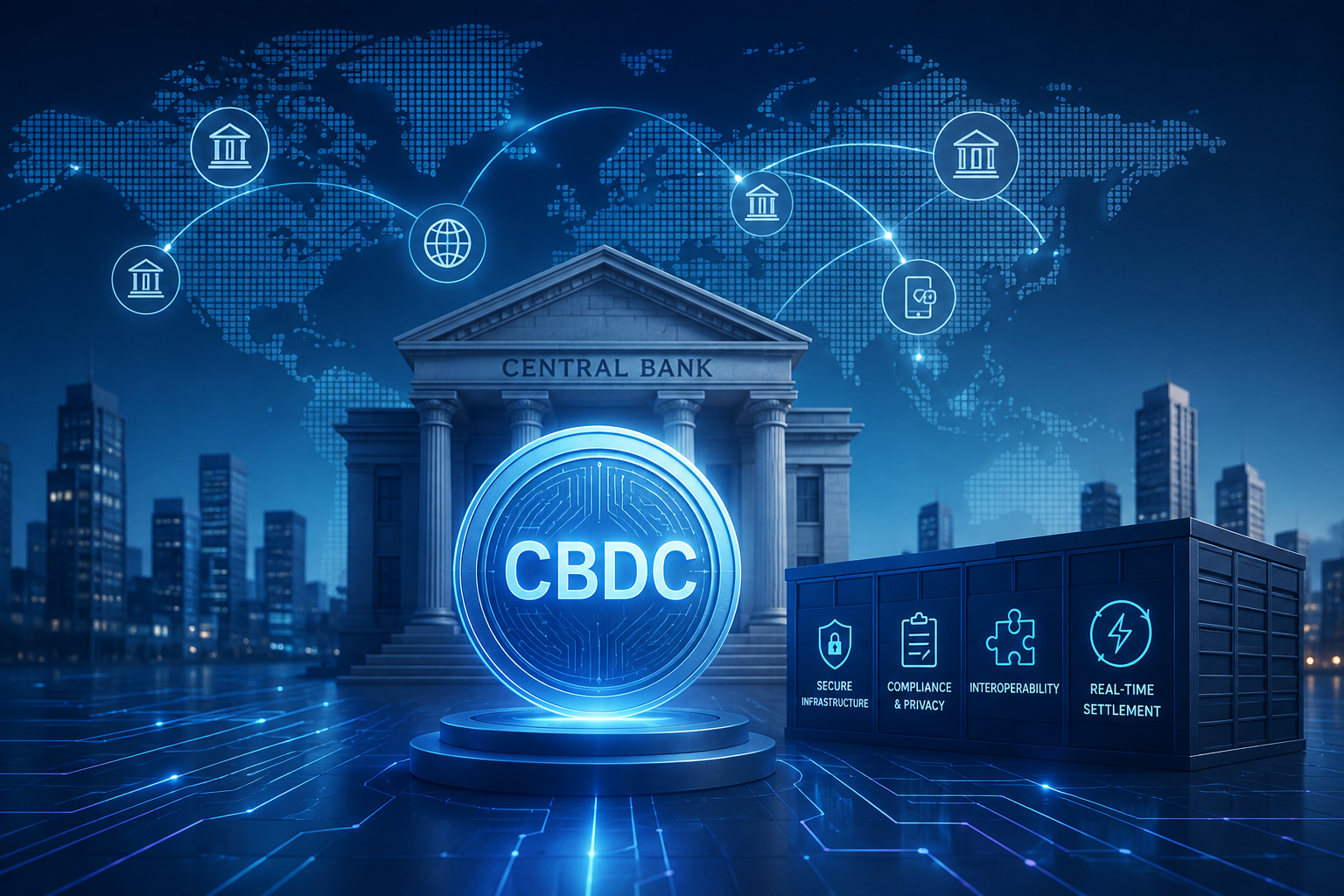
Central bank digital currencies have moved from theoretical papers to funded pilots. As of mid-2026, more than 146 countries and currency unions are exploring a CBDC, 41 pilot projects are running worldwide, and a handful of jurisdictions — the Bahamas, Jamaica, and Nigeria — have already completed formal retail launches. China's e-CNY has processed billions of transactions, the UAE's Digital Dirham is expanding toward a late-2026 full launch, and the European Central Bank has moved into a pilot phase for the digital euro. None of this means CBDCs are mainstream yet. It does mean the settlement environment enterprises operate in is changing faster than most treasury, ERP, and payment stacks were built to handle.
This article is not an introduction to CBDCs. It is a practical guide for enterprise technology and finance leaders who are already asking a more specific question: what infrastructure does our organization actually need to build, and when? We walk through the enterprise CBDC infrastructure stack, the capabilities that matter most, a vendor evaluation framework, and a phased readiness roadmap — and we explain where Spydra's enterprise blockchain and tokenization infrastructure fits into that build.
Money is becoming programmable. Assets are becoming tokenized. Settlement is becoming automated. These three shifts are happening in parallel, and CBDCs are only one part of the picture — alongside tokenized bank deposits, regulated stablecoins, and faster domestic payment rails. Enterprises that sell, lend, invest, insure, or move capital across borders will increasingly need systems capable of talking to whichever digital settlement rail their counterparties, regulators, or banking partners adopt.
That raises a more useful question than "what is a CBDC?" The real question is:
What does an enterprise actually need to build before CBDC becomes an important settlement rail?
The honest answer starts with a caveat that most vendor content skips: CBDC maturity differs enormously by jurisdiction, and not every CBDC design uses blockchain or supports the same degree of programmability. China's e-CNY, for example, was reclassified by the People's Bank of China in January 2026 as a deposit liability, a shift that changes how it behaves relative to its original cash-like design. The European Central Bank's digital euro remains in a pilot phase, with full issuance not expected before 2029, subject to legislation. Some designs are account-based, some are token-based, and some rely on centralized ledgers rather than distributed ones. Given that variation, enterprises cannot design their infrastructure around a single CBDC model — they need infrastructure that stays useful regardless of which model wins in their market.
That is the core argument of this article: enterprises do not need to predict which CBDC architecture will dominate. They need to build the surrounding digital-asset, tokenization, compliance, and settlement infrastructure now, so they can connect to whichever rail matters when the time comes.
CBDC infrastructure for enterprises is not a single API that lets a company accept a new form of digital money. It's the full set of systems an organization needs to originate, move, verify, and reconcile value on a digital settlement rail — while staying compliant and connected to the rest of the business.
In practice, enterprise CBDC infrastructure spans:
The distinction worth underlining: CBDC infrastructure is more than a payment gateway. A payment gateway moves money. Enterprise CBDC infrastructure has to move money and verify counterparties and enforce compliance and settle against a tokenized asset and reconcile back into existing books — often in the same transaction. Spydra's work on CBDC integration into financial infrastructure alongside asset tokenization and blockchain consultancy reflects that broader scope; see CBDC and digital payment transformation for a deeper look at how these pieces connect.
Most enterprises run fragmented stacks: an ERP for operations, a separate treasury management system, one or more banking portals, a payment processor, a reconciliation tool, and — increasingly — an asset management platform that doesn't talk to any of the above. Adding a CBDC rail on top of that fragmentation without rethinking the architecture just adds a sixth system nobody's other systems can see.
Tokenized assets — invoices, bonds, real estate shares, carbon credits — require infrastructure for issuance, ownership records, transfers, compliance checks, and lifecycle events (coupon payments, maturity, redemption). If an enterprise plans to settle these assets against digital money, the tokenization layer and the settlement layer need to be designed together, not stitched on after the fact.
Even in an environment where CBDCs are live, enterprises will likely still deal with tokenized commercial bank deposits, regulated stablecoins, and traditional payment rails — often for the same counterparty on different transactions. The practical implication: enterprises need flexibility across settlement mechanisms, not a hard dependency on any single one. Building only for a specific CBDC design risks a costly rebuild the moment that design shifts, changes scope, or gets outpaced by a different digital-money instrument, as happened with the PBOC's reclassification of e-CNY.
A useful way to think about the build is as seven layers, each depending on the one below it.
Each layer feeds the next: compliance decisions gate what can be tokenized, tokenized assets are what gets settled, settlement events are what get reconciled back into the ERP. A gap in any single layer — say, tokenization without compliance-aware permissioning — undermines the layers above it.
Before an enterprise can settle anything against a CBDC or tokenized deposit, it needs the ability to represent assets digitally in the first place — with defined issuance rules, ownership records, transfer restrictions, compliance checks at each transfer, and support for lifecycle events like fractionalization or redemption. This is foundational, not optional: without it, a CBDC connection has nothing enterprise-relevant to settle against. Spydra's work on tokenized real-world assets for enterprises covers how this plays out for illiquid asset classes specifically.
Enterprise wallets are not consumer wallets. They need custody controls, multi-party authorization for transaction approval, configurable transaction policies, and rigorous key management — because a single compromised key in an institutional context can mean a material loss, not a personal one. It's worth noting explicitly: not every CBDC design will use blockchain-style wallets in the same way, so wallet infrastructure needs to be flexible enough to support account-based and token-based models alike.
Smart contracts let enterprises automate what used to require manual reconciliation: conditional payments, escrow release, coupon payments, collateral management, and maturity events. The degree of programmability actually available depends heavily on the CBDC or digital-money instrument in question — some architectures support rich conditional logic, others are closer to simple ledger entries. Infrastructure should be built to take advantage of programmability where it exists without assuming it everywhere.
KYC, KYB, AML, sanctions screening, and investor-eligibility checks need to be embedded directly into the transaction workflow — not run as a separate step before or after the transfer. Permissioned transfers, where compliance rules are checked at the point of transaction rather than retroactively, are becoming the practical standard for institutional tokenization.
This is arguably the single most important vendor-evaluation criterion for CBDC readiness. A real enterprise settlement chain may need to connect CBDCs ↔ banks ↔ tokenized deposits ↔ stablecoins ↔ blockchains ↔ ERP ↔ treasury — and it may need to do so differently depending on the counterparty, jurisdiction, and asset class involved. Cross-border wholesale CBDC projects like mBridge, which links central banks across China, Hong Kong, Thailand, and the UAE, already illustrate why interoperability — not allegiance to one rail — is the design principle enterprises should prioritize.
Every layer above needs to be reachable by the systems the enterprise already runs. A practical architecture looks like:
ERP → API Layer → Tokenization/Blockchain Infrastructure → Wallet → Settlement Rail
APIs should exist for token issuance, wallet management, asset transfers, payment instructions, compliance checks, settlement execution, and reporting — so integration work doesn't turn into a custom project every time a new counterparty or rail is added.
Digital settlement changes reconciliation from a batch, end-of-day process into something that can happen in near real time. On-chain transaction records, automated payment confirmation, and exception management give treasury teams visibility they don't currently have — but only if the reconciliation layer is designed to consume that data as it's generated, rather than importing it later through a manual process.
The most commercially relevant use case for enterprises isn't "accepting CBDC as a payment method." It's combining tokenized assets, digital money, and smart contracts into programmable settlement:
Tokenized Asset + Digital Money + Smart Contract = Programmable Settlement
Consider a simplified tokenized bond settling against a CBDC:
This is a delivery-versus-payment (DvP) workflow — asset and payment move simultaneously, eliminating the settlement risk that exists when the two legs of a trade happen at different times. Brazil's Drex project is explicitly designed around integrating tokenized assets into its payment infrastructure this way, and several wholesale CBDC pilots are testing DvP mechanics directly. It's worth being precise here: actual DvP capability varies by CBDC architecture and jurisdiction, and not every live CBDC supports this today. Building the infrastructure now means an enterprise is ready when its relevant rail does.
For treasury teams specifically, the practical pain points that CBDC-ready infrastructure addresses include:
None of these benefits require an enterprise to wait for a CBDC to be live in every market it operates in. They come from building the surrounding infrastructure — APIs, reconciliation, wallets — that make any given rail usable the moment it becomes relevant.
These forms of digital money are likely to coexist rather than one replacing the others outright — which is precisely why interoperability matters more than picking a favorite. For a deeper look at how these instruments compare technically, see Spydra's piece on tokenized money infrastructure.
Spydra's work with institutional partners illustrates several of these criteria in practice — for example, its collaboration with Hitachi Payment Services focused specifically on developing secure digital payment solutions, particularly for cross-border transactions and real-time settlement. For a broader look at evaluating platforms on these dimensions, see enterprise blockchain infrastructure.
It's tempting to treat CBDC readiness as a payments integration project: add an API, accept the new currency, done. That framing misses the point.
Payment integration alone is not CBDC infrastructure. A payment API moves value from one place to another. It doesn't verify the counterparty, tokenize the asset being settled, enforce compliance rules, execute conditional logic, or reconcile the transaction into the general ledger. An enterprise that builds only a CBDC payment interface will likely end up with the same fragmented, manual processes it has today — just with one more digital rail bolted onto the pile.
Real CBDC readiness requires an ecosystem connecting:
Digital Identity → Compliance → Tokenization → Wallets → Smart Contracts → Digital Money → Settlement → Reconciliation
Each piece depends on the others. Skipping any one of them just moves the fragmentation problem downstream instead of solving it.
Building your digital asset infrastructure now? Explore how Spydra can help your enterprise build tokenization and blockchain infrastructure designed for the next generation of digital finance.
Enterprises do not need to build a CBDC themselves — that's a central bank's job. What they need is infrastructure capable of interacting with the digital-money ecosystem that is emerging around them.
Spydra is an enterprise blockchain and asset tokenization platform. Its low-code approach lets enterprises deploy private, permissioned blockchain networks, build tokenization applications, upload custom smart contracts, and integrate existing systems using REST APIs — without requiring a large in-house blockchain engineering team. The platform has been positioned by partners specifically around blockchain-powered solutions, CBDC, and Web 3.0 technologies for the payments ecosystem, and Spydra's own tokenization work spans real estate, financial instruments, supply chain goods, carbon credits, and intellectual property converted into compliant, blockchain-based digital tokens.
In the context of CBDC readiness specifically, that translates into practical capability across the stack this article has covered:
Spydra's earlier work on CBDC solutions for digital currency infrastructure and its collaboration model with institutional partners like Hitachi Payment Services, whose CEO noted that leveraging Spydra's blockchain and CBDC capabilities positions the company to develop secure, cutting-edge digital payment solutions, reflect the kind of enterprise-integration work this article describes — not a claim that Spydra issues or operates any CBDC itself.
To be clear about scope: Spydra is not a central bank, does not issue CBDCs, and does not control any CBDC network. Its role is as an infrastructure and tokenization partner that helps enterprises build the systems described above, so they're ready to connect to whichever settlement rails become relevant to their business.
Evaluating enterprise blockchain and tokenization infrastructure? Talk to the Spydra team about your use case.
CBDC adoption does not require enterprises to wait for a single global standard. Given how differently jurisdictions are approaching design — account-based versus token-based, retail versus wholesale, centralized versus distributed-ledger — waiting for consensus means waiting indefinitely. The better strategy is to build flexible infrastructure that can connect digital assets, enterprise systems, compliance workflows, and emerging settlement rails as they mature.
That's the infrastructure layer Spydra helps enterprises build: tokenization, digital asset management, smart contract automation, and API-first integration designed to work across multiple settlement environments rather than betting on one.
Talk to Spydra about building your enterprise's tokenization and digital settlement infrastructure.
CBDC designs vary significantly across jurisdictions. Some are account-based, some are token-based, some use distributed-ledger technology, and others rely on centralized architectures. As of mid-2026, only three countries — the Bahamas, Jamaica, and Nigeria — have completed full retail CBDC launches, while dozens more remain in pilot or research phases with materially different technical approaches. Enterprise infrastructure should therefore prioritize interoperability and adaptability rather than assuming any one technical model will prevail.
Looking ahead, several trends are likely to shape how enterprise infrastructure needs to evolve:
None of this is certain, and timelines continue to shift — the digital euro's own target date moved from earlier pilot expectations to a 2029 issuance goal contingent on legislation. What is reasonably clear is the direction of travel: toward more digital, more programmable, and more interoperable settlement infrastructure.
CBDCs are not simply another payment method. They are one piece of a broader transformation toward digital money, tokenized assets, programmable transactions, and automated settlement. Enterprises that prepare their infrastructure early — tokenization, compliance, wallets, APIs, interoperability — can adapt as this landscape develops. Enterprises that wait risk having to rebuild under pressure once a settlement rail becomes commercially unavoidable in their market.
The goal is not to predict exactly which CBDC architecture will dominate. The goal is to build an enterprise infrastructure layer flexible enough to connect with the digital financial system as it evolves.
Prepare your enterprise for programmable digital settlement. Explore Spydra's blockchain and tokenization infrastructure today.
What is CBDC infrastructure for enterprises?
CBDC infrastructure for enterprises is the full set of systems needed to originate, verify, move, and reconcile transactions on a digital settlement rail. It includes digital wallets, APIs, identity and compliance checks, tokenization capability, smart contracts, settlement logic, and reconciliation tools — not just a single payment connection.
What infrastructure does an enterprise need for CBDC adoption?
At minimum, enterprises need tokenization infrastructure to represent digital assets, institutional wallet infrastructure for custody, compliance systems embedded in the transaction workflow, API connectivity to core enterprise systems, and interoperability across multiple settlement mechanisms. Settlement logic like DvP and automated reconciliation round out the stack.
How can enterprises integrate CBDCs with existing payment systems?
Integration typically runs through an API layer that connects ERP and treasury systems to a tokenization and blockchain infrastructure platform, which in turn connects to the relevant settlement rail. This preserves existing workflows while adding the new rail as a connected option rather than a replacement system.
Can CBDCs settle tokenized assets?
In some CBDC architectures, yes — particularly wholesale designs built to support delivery-versus-payment (DvP) transactions between tokenized securities and digital central bank money. Capability varies significantly by jurisdiction and design, and not every live or piloted CBDC supports this today.
What is the difference between CBDC infrastructure and traditional payment infrastructure?
Traditional payment infrastructure typically moves value between accounts. CBDC infrastructure adds tokenization, embedded compliance, programmable settlement logic, and near real-time reconciliation — designed to work with digital, potentially programmable money rather than traditional account-based transfers alone.
How do CBDCs work with tokenized deposits and stablecoins?
These three forms of digital money are likely to coexist rather than one displacing the others. CBDCs are central bank liabilities, tokenized deposits are bank liabilities represented digitally, and stablecoins are issued by private entities under varying regulatory frameworks. Enterprise infrastructure needs to interoperate across all three rather than assuming only one will be relevant.
How should enterprises choose a CBDC infrastructure provider?
Evaluate providers against tokenization capability, institutional wallet and custody support, compliance integration, API-first architecture, interoperability across settlement rails, security and auditability, scalability, and the ability to adapt as CBDC standards continue to evolve. Avoid providers that lock enterprises into a single blockchain or settlement mechanism.
How can Spydra help enterprises prepare for CBDC settlement?
Spydra provides enterprise blockchain and tokenization infrastructure — including asset tokenization, smart contract workflows, and API-driven integration with existing enterprise systems — that enterprises can use to build the surrounding infrastructure needed for CBDC and broader digital-asset settlement readiness. Spydra does not issue or operate CBDCs; it helps enterprises build the systems that connect to them.