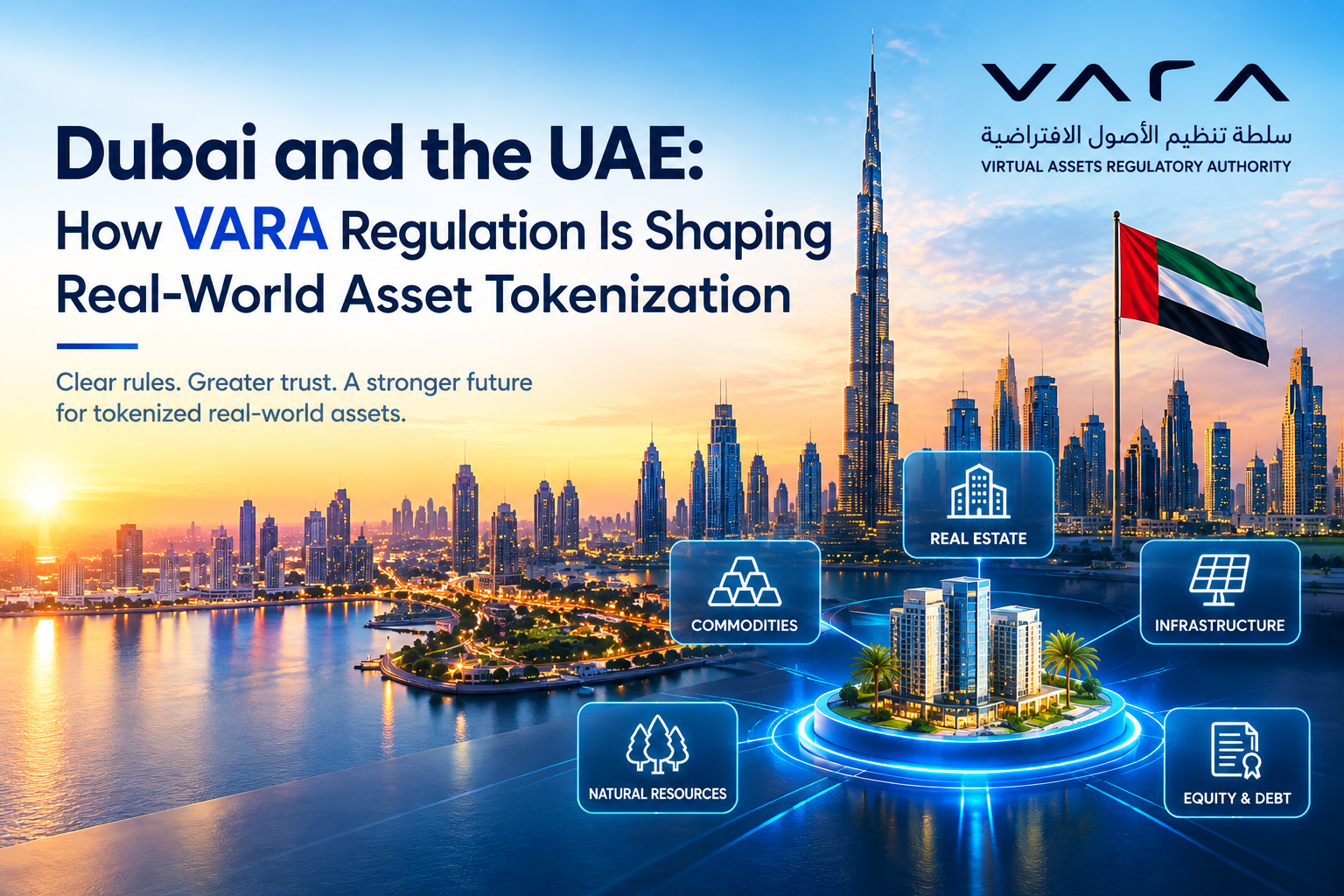
Dubai has made its position clear: tokenized real-world assets are welcome, provided the issuer can prove control, ownership and reserves at every step. For asset managers, real estate developers and banks, the regulatory door is open. The harder question is operational: how do you build compliant infrastructure fast enough to be first to market?
This case-study-style walkthrough covers what VARA expects, why building on raw Hyperledger Fabric slows teams down, and how Spydra turns RWA tokenization software in Dubai into a configuration exercise rather than a software program.
The Virtual Assets Regulatory Authority (VARA) governs virtual asset activity across Dubai (excluding the DIFC). Its Virtual Asset Issuance Rulebook is the central reference for anyone tokenizing real-world value. Three themes matter most for RWA issuers:
1. Asset-Referenced Virtual Assets (ARVAs). Tokens whose value is tied to an underlying asset, such as a property, a fund interest, a commodity or a receivable, fall into a more demanding category than a standard utility token. ARVA issuers face heightened requirements around disclosure, governance and the backing of the token.
2. A staged issuance pathway. Issuance is not a single filing. Issuers move through a structured, multi-step process in which the entity, the product and the token design are reviewed before and alongside the offering. Your technical architecture needs to be ready to evidence decisions at each stage, not just at launch.
3. Legal title and reserve tracking. The token must map credibly to an asset that exists, is legally held and is verifiably backed. That means a defensible record of who holds legal title, what reserves stand behind the token supply, and how both are audited over time.
The common thread: VARA does not just ask what you issued. It asks how you can prove, continuously, that the token still reflects reality.
Note: rulebook requirements are updated periodically. Confirm current obligations with VARA and your legal counsel before finalizing your issuance design.
Most enterprises start the same way. The innovation team selects Hyperledger Fabric for its permissioned model, privacy controls and enterprise pedigree. Then the engineering estimate arrives:
That is typically a multi-month program with specialist hires, and the compliance features VARA cares about are still on the backlog when the budget is spent. The result is a launch date that slips, a cost line that grows and a regulator-facing evidence trail that is assembled after the fact.
Spydra removes the infrastructure build entirely. It provides enterprise-grade Hyperledger Fabric networks as a managed, low-code platform, so your team configures the tokenization workflow instead of engineering the stack beneath it.
Low-code architecture. Define your asset model, roles and workflows through configuration. Business and product teams can iterate on the structure of a tokenized offering without waiting on a chaincode release cycle.
Token engines. Pre-built token engines handle issuance, transfer, restriction and redemption logic for fungible and non-fungible representations. Transfer restrictions, investor eligibility rules and lifecycle events can be encoded at the token level rather than bolted on later.
Asset stores. Each tokenized asset has a structured on-chain record tied to its off-chain documentation: title deeds, valuation reports, SPV details, custody attestations. This directly supports the legal title tracking that ARVA issuance depends on.
Plug-and-play REST APIs. Your existing systems integrate through standard REST endpoints. Investor onboarding, KYC outcomes, property management data and treasury systems connect without custom ledger engineering.
The business impact:
The real saving is not just engineering hours. It is the months of market exposure you recover by launching while competitors are still provisioning infrastructure.
Speed only matters if the result survives regulatory scrutiny. Spydra's architecture maps to the controls VARA-regulated issuers need most.
Private consortium networks. Tokenization often involves several parties: the issuer, a custodian, a trustee, an auditor, perhaps a regulator-facing observer. Spydra's private consortium networks let you admit only vetted, identified participants, and control exactly which data each can see. Permissioned membership supports the governance and access discipline that regulators expect, while keeping commercially sensitive deal data confidential.
Oracles for reserve and valuation data. A token is only as trustworthy as the data backing it. Oracles bring verified external data, such as custodian balances, valuation updates, rental income or price feeds, onto the ledger in a consistent, timestamped way. That gives issuers a reliable basis for demonstrating that reserves match token supply.
Real-time Event Listeners. Compliance cannot be a quarterly exercise. Event Listeners monitor on-chain activity as it happens: mints, burns, transfers, ownership changes, threshold breaches. They can trigger alerts and push events into your compliance, reporting and audit systems the moment something occurs. When an auditor asks for the history of a reserve position, you have an immutable, continuous record rather than a reconstruction.
What this means in practice:
Spydra provides the infrastructure and tooling for these controls. Your legal and compliance teams still define the policies, and VARA licensing and approvals remain your responsibility. The platform's job is to make those policies enforceable and provable.
A typical first session is designed to produce something tangible, not a slide deck:
By the end, your team has a working model of the asset lifecycle to take to legal counsel, investors and, ultimately, your VARA engagement.
Every month spent building infrastructure is a month your tokenized offering is not in market. Spydra gives you $400 in free platform credits so you can validate your use case on real, production-grade Hyperledger Fabric infrastructure before committing budget or headcount.
Ready to see what a VARA compliant asset tokenization platform looks like when it is configured, not coded?
Claim your $400 free credits and launch your first tokenization workflow at spydra.app
Asset managers, developers and financial institutions across the UAE are moving from pilot to production. The difference between leading and following is how quickly you start.
What is a VARA compliant asset tokenization platform?
It is infrastructure that lets you issue and manage tokens backed by real-world assets while supporting the controls VARA expects: permissioned participants, legal title records, reserve data and auditable activity history. The platform supports compliance, but VARA licensing and approvals remain the issuer's responsibility.
Which assets can be tokenized under VARA's framework?
Common candidates include real estate, fund interests, commodities and receivables. Tokens tied to an underlying asset generally fall under the ARVA category, which carries stricter requirements. Confirm the classification of your specific asset with legal counsel.
How long does it take to build RWA tokenization software in Dubai?
Building a secure Hyperledger Fabric application from scratch typically takes months. With a low-code platform such as Spydra, teams can configure a working tokenization workflow in days and test a first use case in a 30-minute session.
Do we need blockchain developers to use Spydra?
Not for core tokenization workflows. Token engines, asset stores and REST APIs are configured rather than coded, so product, operations and existing IT teams can lead the build.
How does Spydra support reserve and audit requirements?
Oracles bring verified reserve and valuation data on-chain, Event Listeners capture mints, burns and transfers in real time, and private consortium networks restrict visibility to vetted participants. Together they produce a continuous, timestamped audit trail.
What does the $400 free credit cover?
The credits let you run a proof of concept on Spydra's platform before committing budget. Check Spydra's current terms for what the credits include and how long they remain valid.