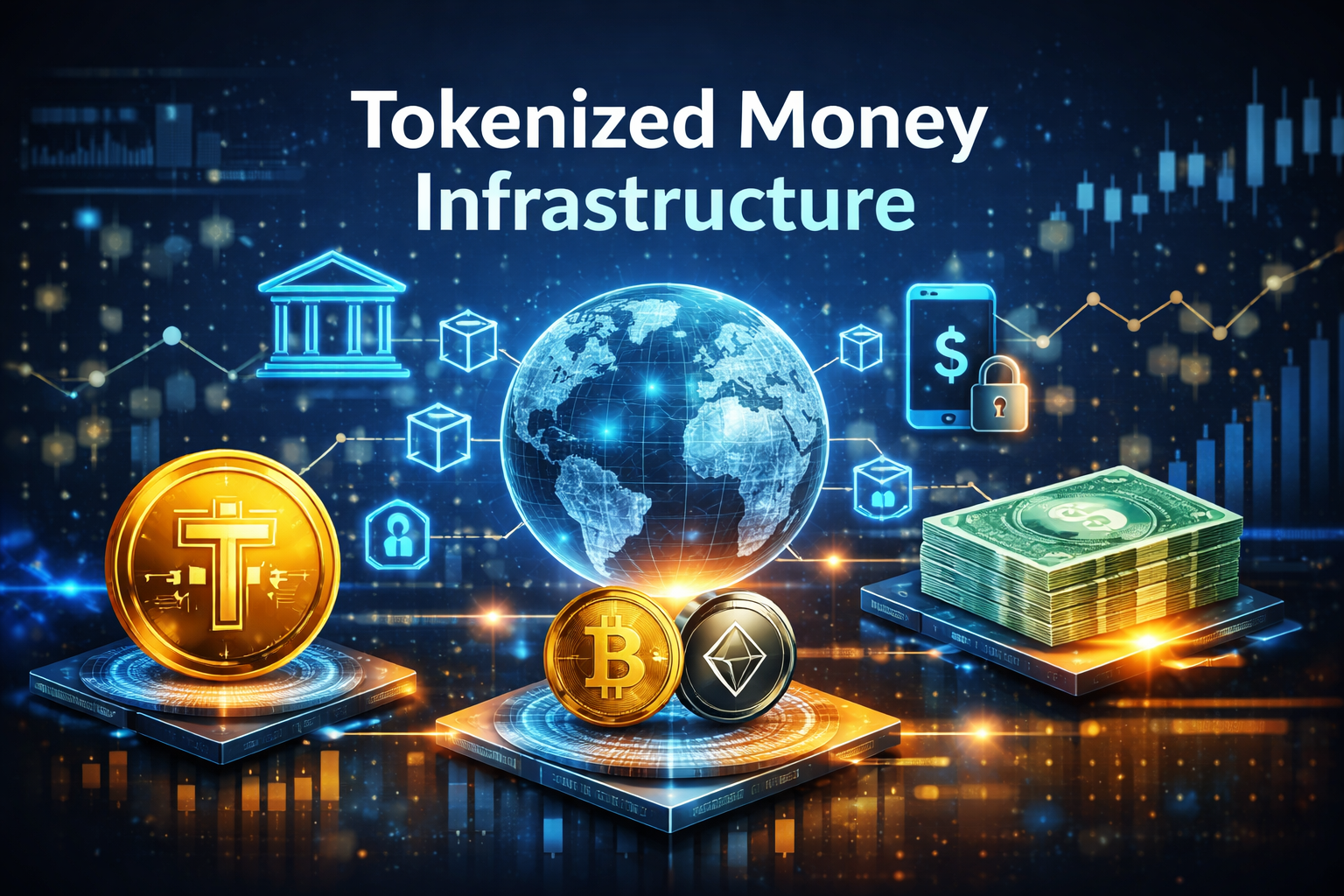
The global financial ecosystem is undergoing a structural transformation. As enterprises and financial institutions push for faster, more efficient, and transparent operations, legacy banking infrastructure is increasingly proving inadequate. In this context, tokenized money infrastructure is emerging as a foundational layer for modern finance.
Recent industry insights, including analysis from FTI Consulting, highlight how digital representations of money—whether in the form of tokenized deposits or stable-value instruments—are reshaping how value moves across financial systems. However, the real opportunity lies beyond individual instruments. It lies in building the underlying infrastructure that enables these assets to function seamlessly at scale.
This shift is not incremental—it represents a move toward programmable, real-time, and interoperable financial systems.
Tokenized money infrastructure refers to the integrated framework that enables fiat money to be issued, transferred, and settled as digital tokens on distributed ledger networks.
Unlike traditional financial systems where money moves through multiple intermediaries, this infrastructure allows value to move directly between parties with embedded logic and automation.
At its core, tokenized money infrastructure consists of:
This multi-layered architecture transforms money into a dynamic, programmable asset, rather than a static store of value.
Traditional financial systems are constrained by structural inefficiencies:
As noted in industry discussions, including those from FTI Consulting, these inefficiencies create friction, particularly in cross-border payments and institutional liquidity management.
Tokenized money infrastructure addresses these challenges by enabling:
This makes it a critical enabler of financial infrastructure modernization.
This layer represents fiat currency in digital form. Whether issued by banks or other regulated entities, tokenized cash enables seamless, on-chain value transfer.
Smart contracts introduce programmable money use cases, allowing transactions to execute automatically based on predefined conditions.
Examples include:
A defining feature of tokenized systems is blockchain-based settlement, which enables transactions to be finalized instantly.
This eliminates:
To support institutional adoption, infrastructure must incorporate:
This ensures that innovation aligns with evolving regulatory expectations.
The true value of tokenized money infrastructure lies in its ability to unlock programmable financial workflows.
Enterprises can automate internal financial processes, such as:
This reduces manual intervention and improves operational efficiency.
Tokenized infrastructure enables instant (T+0) settlement, significantly reducing counterparty risk and improving liquidity access.
Traditional cross-border payments involve multiple intermediaries, leading to delays and high costs.
With tokenized systems:
This aligns with the broader industry push toward more efficient global payment networks.
Smart contracts can automate trade finance processes by linking payment execution to real-world events, such as shipment confirmation.
This reduces disputes and accelerates transaction cycles.
Tokenized systems enable real-time visibility and control over liquidity, allowing enterprises to optimize capital allocation across markets and geographies.
Adopting tokenized money infrastructure provides tangible business advantages:
Automation reduces manual processes and lowers operational costs.
Real-time access to funds improves capital efficiency.
Instant settlement minimizes counterparty exposure.
Distributed ledgers provide a verifiable record of transactions.
These benefits are driving institutional digital asset adoption, particularly among banks exploring next-generation digital money rails.
Despite its potential, implementation is complex and requires careful consideration.
Global regulatory frameworks for digital assets are still evolving, creating ambiguity for institutions.
Different blockchain networks often operate in silos, limiting seamless interaction.
Financial institutions must bridge new infrastructure with existing systems, which can be technically challenging.
Enterprise-grade security and governance are critical for adoption at scale.
Building tokenized money infrastructure from the ground up requires significant technical expertise and resources. This is where platforms like Spydra play a strategic role.
Spydra provides:
By abstracting the complexity of blockchain implementation, Spydra enables organizations to focus on use case development and business value creation, rather than infrastructure challenges.
The evolution of tokenized money infrastructure is expected to accelerate over the next decade.
Key trends include:
As these trends unfold, financial institutions will increasingly adopt blockchain-based settlement systems to remain competitive.
Tokenized money infrastructure represents a fundamental shift in how financial systems operate. By enabling real-time settlement, programmability, and transparency, it addresses the core inefficiencies of traditional banking systems.
Insights from industry leaders like FTI Consulting reinforce that while instruments such as tokenized deposits and stable-value assets are important, the real transformation lies in the infrastructure that supports them.
For enterprises and financial institutions, the path forward is clear: investing in tokenized infrastructure is no longer optional—it is a strategic imperative.
Platforms like Spydra make this transition achievable by providing the tools and frameworks needed to build scalable, compliant, and future-ready financial systems.