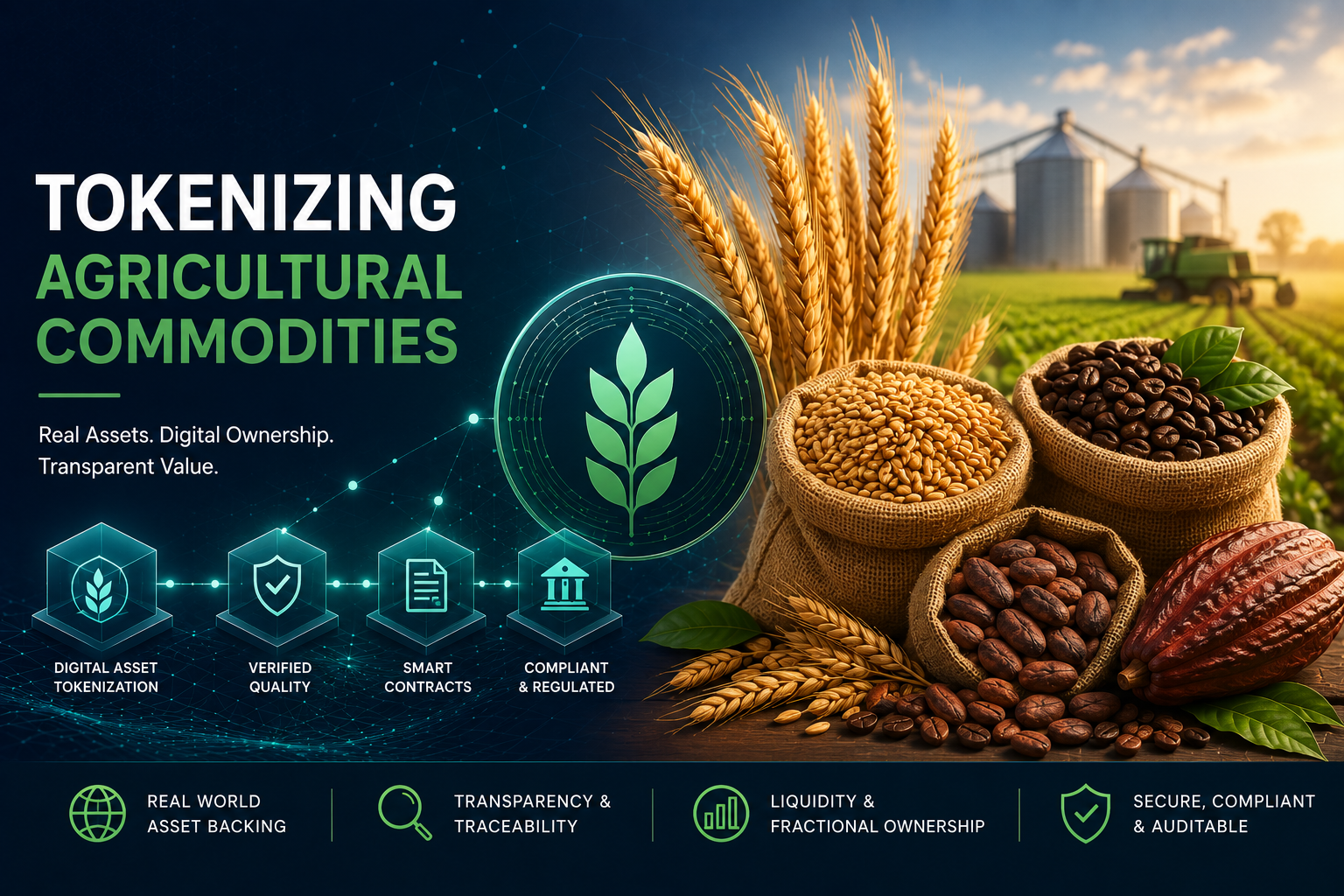
Tokenized agricultural commodities are emerging as one of the more structurally interesting frontiers in the broader real-world asset (RWA) tokenization movement. Unlike tokenized gold or tokenized government bonds, wheat, coffee, and cocoa are perishable, quality-variable, and physically dispersed across thousands of farms, warehouses, and cooperatives. That complexity is exactly why enterprises are paying attention: soft commodities carry enormous friction in trading, financing, and settlement—friction that tokenization, paired with rigorous verification infrastructure, may be able to reduce. This is not the same conversation as putting a shipment's location on a blockchain ledger. Tokenization implies creating a digital instrument—a token—that represents a defined legal or economic claim tied to a verified quantity of a physical commodity. For commodity trading houses, cooperatives, banks, exporters, and RWA platforms, understanding that distinction is the starting point for any serious evaluation of this space.
Agricultural commodity markets share a set of structural characteristics that make them attractive—and challenging—candidates for tokenization.
Each of these characteristics represents friction. Tokenization does not eliminate that friction by itself, but it creates a framework in which verified, digitized commodity claims can move, be financed, and settle with less manual reconciliation—provided the legal and verification infrastructure underneath the token is sound.
Tokenized agricultural commodities are digital tokens issued on a blockchain that represent a defined legal or economic interest connected to a verified quantity, grade, and location of a physical agricultural commodity such as wheat, coffee, or cocoa. The token itself is not the commodity—it is a digital representation of a claim, right, or interest tied to it, and what exactly that claim consists of depends entirely on how the structure is designed.
It's useful to separate several structures that often get collapsed into a single idea of "commodity tokenization":
These five structures carry meaningfully different legal, regulatory, and economic consequences. A warehouse-receipt token and a price-tracking financial token might both be labeled "tokenized wheat," yet one confers a redeemable claim on physical grain and the other does not. Tokenization does not, by itself, create legal ownership of an underlying commodity—that depends entirely on the contracts, custody arrangements, and jurisdictional law behind the token. Enterprises evaluating this space need to ask, precisely, what a given token legally represents before assuming it behaves like the physical asset.
Much of the current RWA commodity-tokenization market has been built on precious metals. According to 2026 market analysis from Tiger Research, tokenized gold products such as XAUT and PAXG account for roughly three-quarters of the entire commodity tokenization market, and tokenized gold trading volume in 2025 reportedly outpaced every major gold ETF except GLD. Gold tokenization has worked, in large part, because gold is a nearly ideal tokenization asset: it is fungible, non-perishable, easily assayed, and stored in a small number of high-security vaults.
Soft agricultural commodities look almost nothing like that:
This comparison matters because it shapes what "tokenization infrastructure" needs to look like. Tokenizing wheat, coffee, or cocoa requires far more than deploying a smart contract and minting tokens against a stated quantity. It requires an ongoing chain of physical verification — grading, moisture testing, warehouse audits, and quality certification — that has to be trusted and periodically re-confirmed, because the underlying asset can change condition, degrade, or be commingled with other lots in ways gold simply cannot.
Wheat is a strategically significant, highly traded staple commodity, which makes it a natural subject for tokenization conversations—though a liquid, standardized, tokenized wheat market does not yet exist at institutional scale. What has emerged are early, largely regional pilots. Agrotoken, an Argentina-founded agricultural tokenization platform, has issued tokens representing tonnes of grain—including wheat, soy, and corn—that farmers can use as loan collateral, with Santander piloting Agrotoken-collateralized lending for Argentine producers. Each token in that model corresponds to a delivered tonne of grain validated through a reserve certificate confirming both the physical existence of the grain and an associated sale or purchase agreement.
A conceptual lifecycle for tokenized wheat might look like this:
Producer → Aggregator → Grading → Warehouse → Verification → Tokenization → Investor/Buyer → Transfer/Redemption
Potential token representations include:
Before any of this can function reliably, a set of verification questions has to be answered for every batch: What quantity is being tokenized? What grade and protein content does it carry? What is its verified origin? Where is it physically stored, and by which licensed warehouse operator? What did the most recent independent inspection confirm? Is the underlying grain encumbered by any other financing arrangement? Who holds legal ownership or entitlement, and under what conditions can a token be redeemed for the physical grain or its cash equivalent? Enterprises should treat each of these as a design requirement, not an afterthought—the credibility of the token depends entirely on the rigor of the answers.
Coffee is an especially complex—and especially interesting—tokenization candidate because so much of its value depends on origin, grade, and story. Specialty coffee routinely commands significant premiums tied to cupping scores, farm-level traceability, and certification, all of which are exactly the kind of granular, verifiable data that a tokenization and oracle framework is well suited to capture and preserve on-chain.
Coffee tokenization has to account for:
An early real-world example is Waga, an Ethiopia-focused pilot building an ERC-1155-based tokenization platform intended to connect coffee inventory data, IoT-supported traceability, and smart contracts across the supply chain — explicitly framed by its founders as a real-world asset tokenization effort for one of the world's largest coffee-producing origins. Projects like this illustrate the direction of travel more than they represent a mature market: the technical architecture is being tested well ahead of any large-scale, liquid tokenized coffee trading infrastructure.
Conceptually, coffee tokenization aims to connect inventory + certification + ownership or claim + financing + settlement into a single digitized workflow. Because coffee grade and origin materially affect price, token design has to avoid treating all "coffee tokens" as fungible—a Yirgacheffe lot and a commodity-grade robusta lot are not economically interchangeable, and a token structure that ignores that distinction will misprice the underlying asset.
Cocoa tokenization remains largely at the conceptual and early-pilot stage relative to wheat and coffee, but the underlying structural case is similar. Cocoa production is concentrated in a small number of West African and Latin American origins, moves through exporters and processors before reaching manufacturers, and increasingly carries sustainability and provenance requirements tied to deforestation and labor regulations in major consuming markets.
A tokenization framework for cocoa would need to account for:
Rather than representing "cocoa" as an undifferentiated commodity, a credible token structure would need to represent a specific, verified quantity — tied to origin, certification status, and storage location — so that the token's economic meaning stays anchored to a real, auditable lot rather than a generic commodity label.
A defensible tokenization architecture for agricultural commodities generally follows a sequence like this:
Step 1: Commodity Origination. The commodity enters an approved supply chain or trading ecosystem with documented chain of custody from the point of production.
Step 2: Physical Verification. Independent inspectors or certified agencies verify quantity, quality grade, origin, and storage condition.
Step 3: Custody / Warehousing. The commodity is placed under an approved custodian or licensed warehouse operator, ideally one with insurance and regulatory standing.
Step 4: Legal Structuring. The issuer defines, in enforceable legal terms, precisely what the token represents — ownership, a warehouse receipt, a financial claim, or something else — and under which jurisdiction's law.
Step 5: Token Creation. Digital tokens are minted on a blockchain in proportion to the verified commodity quantity or the contractual right being represented.
Step 6: Compliance and Identity. Participants complete KYC, AML, sanctions screening, and any eligibility checks required for the token structure and jurisdiction.
Step 7: Trading / Transfer. Tokens move between approved participants or on permissioned marketplaces, consistent with the legal structure chosen.
Step 8: Settlement. Payment and token transfer can potentially become more synchronized than in traditional paper-based trade, reducing settlement lag.
Step 9: Redemption. Where legally and operationally supported, token holders redeem their entitlement—receiving physical delivery, a cash settlement, or another defined outcome.
Tokenized agricultural commodities depend on an enterprise technology stack that extends well beyond the blockchain layer itself:
The blockchain is only one component of this system — arguably not even the most difficult one to build. The harder engineering and governance problem sits in connecting reliable physical-world data to the digital ledger.
Blockchain infrastructure can protect the integrity of records once data is on-chain — but it cannot independently verify whether the underlying physical facts are true. A blockchain ledger cannot, on its own, confirm that 10,000 tonnes of wheat physically exist in a stated warehouse, that a coffee lot actually meets the grade recorded against its token, that cocoa is stored where a document claims it is, that a commodity's quantity hasn't silently changed, that a warehouse receipt is genuine and not duplicated, or that the same physical inventory hasn't already been pledged as collateral elsewhere.
This is the oracle problem, and it is arguably the single largest risk in tokenized agricultural commodities. The trust required doesn't disappear with tokenization — it simply moves to whichever party is responsible for feeding verified physical data onto the chain. That role typically falls to:
Enterprises evaluating tokenized commodity platforms should scrutinize this layer more closely than the blockchain layer itself. A technically elegant token built on unreliable physical verification is not a safer asset than a traditional paper warehouse receipt — it may simply be a faster way to distribute the same underlying fraud risk.
Tokenization offers a set of potential — not guaranteed — benefits when built on sound legal and verification foundations:
Increased transparency. Shared, tamper-resistant records can improve visibility into commodity ownership and transaction history across counterparties.
Faster settlement. Digitized transfer and payment mechanisms can potentially reduce the friction and delay associated with paper-based trade documentation.
Fractionalization. Where legally permitted, tokenization can allow eligible participants to gain exposure to smaller portions of a commodity-backed asset than traditional trade lot sizes allow.
Improved liquidity potential. Digitized claims may enable new secondary-market structures, though actual liquidity depends heavily on market adoption and trading infrastructure — it is not automatic.
Better trade finance workflows. Tokenized, verifiable commodity claims could support more efficient financing processes than manual document-based underwriting.
Reduced reconciliation burden. A shared ledger can reduce the duplicate record-keeping and manual reconciliation that occurs when each counterparty maintains separate systems.
Programmable transactions. Smart contracts can automate predefined conditions, such as releasing payment upon confirmed delivery or quality certification.
Improved auditability. A blockchain-based transaction history is inherently more resistant to retroactive alteration than paper trails.
Better collateral management. Lenders and financiers may gain improved real-time visibility into the status of commodity-backed collateral.
None of these benefits are guaranteed outcomes of tokenization. They are structurally plausible improvements that depend on adoption, legal enforceability, and the quality of the underlying verification infrastructure.
Trade finance is arguably the most immediately practical application of agricultural commodity tokenization, because it addresses a problem enterprises already feel acutely: the capital-intensive, document-heavy, slow-moving nature of commodity financing.
Tokenization could potentially interact with:
A conceptual example illustrates the flow:
Farmer/Producer → Warehouse → Tokenized Commodity Claim → Bank Financing → Buyer → Settlement
It's worth being precise about what tokenization is not, here. Tokenized commodity claims are not the same as traditional commodity derivatives such as futures or options. A future is a standardized, exchange-traded contract for future delivery, cleared through a regulated clearinghouse; a tokenized commodity claim is a digital representation of a specific, physically verified quantity or right, and its regulatory treatment, enforceability, and risk profile differ substantially depending on how it's structured.
Tokenized agricultural commodities do not automatically outperform these established instruments on liquidity, regulatory clarity, or market depth. Futures and ETFs benefit from decades of regulatory precedent, deep liquidity, and standardized clearing—advantages a new tokenized structure has to earn over time, not assume by design.
A balanced assessment of tokenized agricultural commodities has to weigh a substantial set of risks:
For enterprises, the core takeaway is that legal enforceability and physical verification integrity matter far more to the success of a tokenized commodity program than blockchain transaction throughput or network choice. A fast, elegant chain built on weak legal foundations or unreliable inspection processes creates risk faster than it removes it.
Regulatory treatment of tokenized agricultural commodities depends on a combination of factors: the jurisdiction in question, the specific token structure chosen, the nature of the underlying commodity, the rights granted to investors or holders, whether the token is transferable, what redemption mechanics apply, and how custody is arranged. Depending on these factors, a token could be treated as a security, a commodity interest, a warehouse receipt, a payment instrument, or another regulated category entirely—and different regulators (securities, commodities, and banking authorities) may assert overlapping jurisdiction.
Regulatory frameworks in this space are actively evolving. In the United States, for example, stablecoin-specific legislation has advanced in recent years, which several commodity trading firms have cited as a catalyst for exploring blockchain-based settlement pilots—though such legislative developments govern payment stablecoins specifically, not commodity tokenization itself, and should not be conflated with commodity-specific regulatory clarity.
This article does not constitute legal advice. Enterprises evaluating a tokenized commodity program should obtain jurisdiction-specific legal and regulatory guidance before launching any product and should not assume that a structure permissible in one jurisdiction is automatically compliant in another.
Legal. Define, in enforceable contractual terms, exactly what legal ownership or rights the token confers.
Commodity verification. Establish independent inspection and certification processes before any token is minted.
Custody. Select trusted, licensed, and adequately insured warehouses or custodians.
Token model. Define precisely and unambiguously what one token represents—quantity, grade, location, and claim type.
Compliance. Implement KYC/AML processes and any necessary transfer restrictions for eligible participants.
Blockchain infrastructure. Select enterprise-appropriate ledger infrastructure with the governance, permissioning, and auditability the use case requires.
Oracle infrastructure. Build reliable pipelines connecting trusted off-chain physical data to on-chain smart contracts.
Integration. Connect ERP, warehouse management, trading, custody, and payment systems so tokenized positions reconcile with existing enterprise records.
Settlement. Define whether settlement occurs via fiat, stablecoins, tokenized deposits, or another mechanism appropriate to the jurisdiction.
Redemption. Clearly define how and when token holders can exercise their underlying rights.
Monitoring. Implement ongoing reconciliation, audit, and risk-control processes to catch discrepancies between on-chain records and physical reality.
Gold has demonstrated that commodity tokenization can achieve meaningful trading volume and institutional credibility. Early agricultural pilots — from Agrotoken's grain-collateralized lending in Latin America to soybean-oil tokenization projects and coffee-focused efforts like Waga in Ethiopia — suggest the model is beginning to extend into agriculture, though current on-chain activity in agricultural tokens remains thin and largely limited to minting and redemption rather than active secondary trading.
Looking ahead, several developments seem plausible, though they remain emerging rather than established:
It's important to distinguish current capabilities from future possibilities throughout this evolution. Much of what's described above remains conceptual or early-pilot stage; the infrastructure, regulatory clarity, and market liquidity required for tokenized agricultural commodities to function at the scale of gold tokenization or traditional futures markets has not yet materialized.
The real opportunity in this space is not simply putting wheat, coffee, or cocoa "on a blockchain." That framing understates what's actually required. The larger opportunity is building trusted digital infrastructure that connects every link in the chain: physical commodity → verification → legal rights → token → financing → trading → settlement → redemption.
Tokenized agricultural commodities represent a genuinely distinct emerging asset class within the broader real-world asset tokenization ecosystem — one that is structurally different from tokenized gold, real estate, or securities because of the perishability, quality variability, and physical dispersion inherent to soft commodities. Realizing that opportunity will require the convergence of several disciplines at once: enterprise blockchain infrastructure, legally enforceable token structures, rigorous commodity custody and verification, robust compliance frameworks, trustworthy oracle data, and deep integration with existing trading, warehouse, and ERP systems. Enterprises that treat tokenization as primarily a technology decision — rather than a legal, operational, and verification challenge — are likely to be disappointed by the results.
What are tokenized agricultural commodities? Tokenized agricultural commodities are blockchain-based digital tokens that represent a defined legal or economic claim connected to a verified quantity, grade, and location of a physical commodity such as wheat, coffee, or cocoa. What the token legally represents — ownership, a warehouse receipt, or a financial claim — depends entirely on how the issuer structures it.
How does agricultural commodity tokenization work? It typically involves origination, independent physical verification of quantity and grade, custody under an approved warehouse, legal structuring of the token's rights, minting on a blockchain, compliance checks, transfer between approved participants, settlement, and eventual redemption where legally supported.
Can wheat be tokenized on a blockchain? Wheat can be tokenized in the sense that a digital token can be issued against a verified, warehouse-stored quantity of grain, as early pilots like Agrotoken's grain-collateralized lending programs have shown. A large-scale, liquid tokenized wheat trading market does not yet exist at institutional scale.
How can coffee be tokenized? Coffee tokenization connects verified inventory, origin and grade certification, and ownership or financial claims into a digital instrument, often incorporating IoT and oracle data to preserve origin-specific value. Early pilots, such as Ethiopia-focused efforts, are testing this architecture, though the market remains nascent.
What does a tokenized cocoa asset represent? A tokenized cocoa asset, when properly structured, represents a verified, specific quantity of cocoa tied to origin, certification, and storage location — not a generic, undifferentiated claim on "cocoa" as a commodity category. Tokenized cocoa remains largely conceptual and early-pilot stage today.
What are the benefits of tokenizing agricultural commodities? Potential benefits include increased transparency, faster settlement, fractionalization where legally permitted, improved trade finance workflows, reduced reconciliation burden, programmable transactions, and better collateral visibility — though none of these outcomes are guaranteed and depend on strong underlying verification and legal structures.
What are the risks of commodity tokenization? Key risks include legal ownership ambiguity, regulatory classification uncertainty, custody and warehouse fraud, double pledging, oracle risk, quality verification gaps, smart-contract vulnerabilities, liquidity constraints, and cross-border regulatory complexity.
Are tokenized agricultural commodities regulated? Regulatory treatment varies by jurisdiction and by how the token is structured — it may be classified as a security, a commodity interest, a warehouse receipt, or a payment instrument. Enterprises should seek jurisdiction-specific legal advice before launching a tokenized agricultural commodity product, as no universal regulatory framework currently governs this asset class.