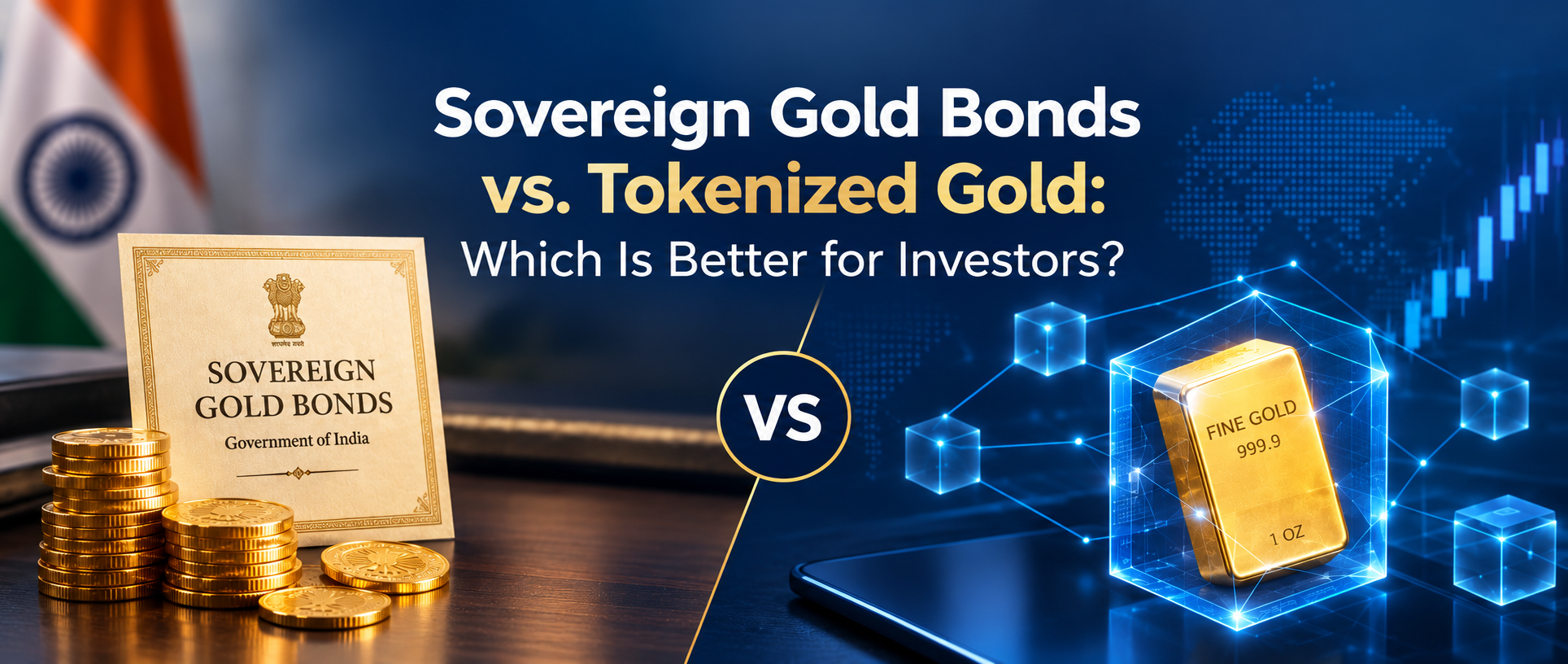
For generations, Indian households bought gold as jewellery, coins and bars, then worried about making charges, purity and locker fees. Today, gold can sit in a demat account, a government bond or even a blockchain wallet. That raises a practical question for anyone weighing Sovereign Gold Bonds vs Tokenized Gold: which one deserves your money?
The two are very different animals. Sovereign Gold Bonds (SGBs) are government securities that track gold and pay interest. Tokenized gold is a blockchain-based token that aims to represent gold, with protections that depend almost entirely on the issuer and the platform. Two developments make the comparison urgent in 2026: the government has not opened a fresh SGB tranche since February 2024, and Budget 2026 narrowed SGB's famous tax exemption.
This guide explains both options, compares them side by side, and shows which investor profiles each may suit. It does not declare a universal winner, because the honest answer is: it depends.
SGBs are government securities denominated in grams of gold. They are issued by the Reserve Bank of India on behalf of the Government of India under the Sovereign Gold Bond Scheme, 2015. You pay in rupees, and at redemption you receive rupees equal to the prevailing gold price, not physical gold.
How they work
Benefits: sovereign credit backing, no storage worries, a contractual interest stream, and no making charges.
Limitations: an eight-year lock-in for primary holders, possible premiums or discounts on the exchange, and a key availability caveat. As of mid-2026 sources we reviewed, <cite>no new SGB tranche has been issued since February 2024, and no issuance calendar has been announced for FY 2026-27</cite>. The Finance Ministry has said fresh issuance is under consideration but not currently appropriate given fiscal and geopolitical conditions. New investors today can generally only buy existing bonds on the secondary market, so always check current RBI and exchange information.
Tokenized gold uses blockchain technology to issue digital tokens that are meant to represent gold. In the best-structured products, each token is a claim on a specific quantity of allocated physical gold, such as bars held in a professional vault, with the issuer publishing reserve information and, ideally, independent audit reports.
Why structures differ. Not all tokens are alike. Key variables include:
Tokenized gold vs ordinary digital gold. Apps that sell digital gold usually record a balance in the platform's books; they do not typically issue tradable blockchain tokens. Tokenized gold lives on a blockchain and may trade around the clock. Neither is automatically safer, and neither is a SEBI-regulated security. In November 2025, SEBI cautioned investors that digital gold and e-gold products are not notified as securities or regulated as commodity derivatives, and that the investor protections applicable to regulated securities do not extend to them. SEBI pointed investors toward Gold ETFs, exchange-traded commodity derivatives and Electronic Gold Receipts as regulated alternatives.
The lesson: legal ownership rights and redemption terms matter more than the word blockchain. Read the issuer's documentation before you buy.
What the differences mean in practice
Both products are driven first by the gold price, so neither can promise outperformance there. What separates net outcomes is everything around it.
SGB return components: gold-price change between purchase and exit, 2.5% annual interest (taxable), the price you paid (including any secondary-market premium or discount), and the exit price or redemption value.
Tokenized gold return components: gold-price change, any token premium or discount to spot, platform fees and spreads on entry and exit, custody fees, redemption charges, and exchange-rate movements.
Assumptions: You invest ₹1,00,000 for three years. Gold rises 30% over that period. For SGB, you buy on the exchange at a 1% premium, interest is 2.5% a year on ₹1,00,000, you sell at the gold value, long-term capital gains tax is 12.5% and interest is taxed at a 30% slab. For tokenized gold, you pay 1% on entry and 1% on exit, 0.25% annual custody cost, and 30% tax on gains (ignoring surcharge, cess and TDS credit mechanics). These figures are invented for illustration; actual costs vary.
The point is not the exact numbers but the mechanism: costs, interest and tax treatment can swing net returns by many percentage points even when gold performs identically. If gold falls, the picture changes: SGB interest cushions the loss, while tokenized gold fees add to it. None of this is a guaranteed return.
Tax rules changed recently, so verify the current position with an official source or professional.
Sovereign Gold Bonds
Tokenized gold
Indian tax law defines a virtual digital asset broadly to include cryptographically generated tokens. Many tax professionals treat gold tokens as VDAs, which would mean a flat 30% tax on gains (plus surcharge and cess), no set-off of VDA losses against other income, and 1% TDS on transfers. However, the treatment of a particular token can depend on its legal structure and the nature of the transaction, and interpretations may evolve. Digital gold purchased through apps also typically attracts 3% GST on purchase, per industry coverage.
Disclaimer: This section is general information. Consult a qualified tax professional for your situation.
For SGBs
For tokenized gold (risks vary widely by product)
Do not assume every tokenized gold product has the same protections. Some are backed by allocated gold with regular attestations; others may be much weaker.
These are conditional pointers, not personal advice.
The core trade-off is protection versus convenience. SGBs offer sovereign backing, contractual interest and a mature legal framework, but they are hard to buy fresh, thinly traded, and now less tax-friendly for secondary-market buyers. Tokenized gold offers flexible access and low entry sizes, but sits in a regulatory gray zone, is likely taxed at 30% with TDS, and its safety depends on product-specific terms that retail investors can struggle to verify.
SGBs may be preferable if you value legal certainty, interest income and a long holding horizon, especially if you already hold original-issue bonds. A well-structured, transparently audited tokenized gold product may suit a technically comfortable investor who understands the risks and costs and sizes the position accordingly. In many cases, SEBI-regulated Gold ETFs deserve a place in the comparison. Let legal protections, total cost, liquidity, horizon and product terms decide, not marketing.
1. Are Sovereign Gold Bonds safer than tokenized gold?
On issuer and legal protections, generally yes: SGBs carry sovereign backing and sit within an established framework. Both are exposed to gold price risk.
2. Do Sovereign Gold Bonds pay interest?
Yes. The scheme pays a fixed 2.5% a year on the issue price, which is taxable at your slab rate.
3. Can tokenized gold be redeemed for physical gold?
Some products allow it, often with minimum quantities, fees and delivery constraints. Many holders simply sell for cash. Check the issuer's terms.
4. Is tokenized gold legal in India?
Holding crypto-type assets is not banned, and gains are taxed under the virtual digital asset regime, but they are not legal tender and there is no dedicated regulatory framework. Rules may change.
5. Which investment has better tax benefits?
Original SGB subscribers who hold to maturity can still receive tax-free capital gains. Secondary-market SGB buyers face capital gains tax, typically 12.5% long-term. Tokenized gold is likely taxed at 30% with 1% TDS. Confirm with a professional.
6. Can investors sell Sovereign Gold Bonds before maturity?
Yes, on the exchange if held in demat form, or through the RBI's premature redemption window after the fifth year. Tax consequences differ.
7. What fees apply to tokenized gold?
Possible costs include platform or trading fees, buy-sell spreads, custody charges, redemption fees, network or gas costs, and GST where applicable. Compare the full schedule.
8. Is tokenized gold backed by actual physical gold?
Some products state that each token is backed by allocated bullion, but structures vary. Verify the reserve disclosures, audits and legal claim before buying.
9. Which option is better for long-term gold investing?
For long horizons, SGBs (especially original-issue bonds held to maturity) have structural advantages, but availability is limited. Compare with Gold ETFs for new investments.
10. What alternatives should investors consider if new SGB issuances are unavailable?
SEBI-regulated options include Gold ETFs, gold mutual funds that invest in ETFs, Electronic Gold Receipts and exchange-traded commodity derivatives. Physical gold is another option.
Choosing between Sovereign Gold Bonds vs Tokenized Gold is less about which asset is better in theory and more about which structure fits your goals, risk tolerance and tax position. Read product documents, model your after-cost, after-tax returns, and size your gold allocation within your wider financial plan, typically as a modest diversifier rather than a core holding. If you are unsure, explore more educational investment guides or speak with a qualified financial adviser.