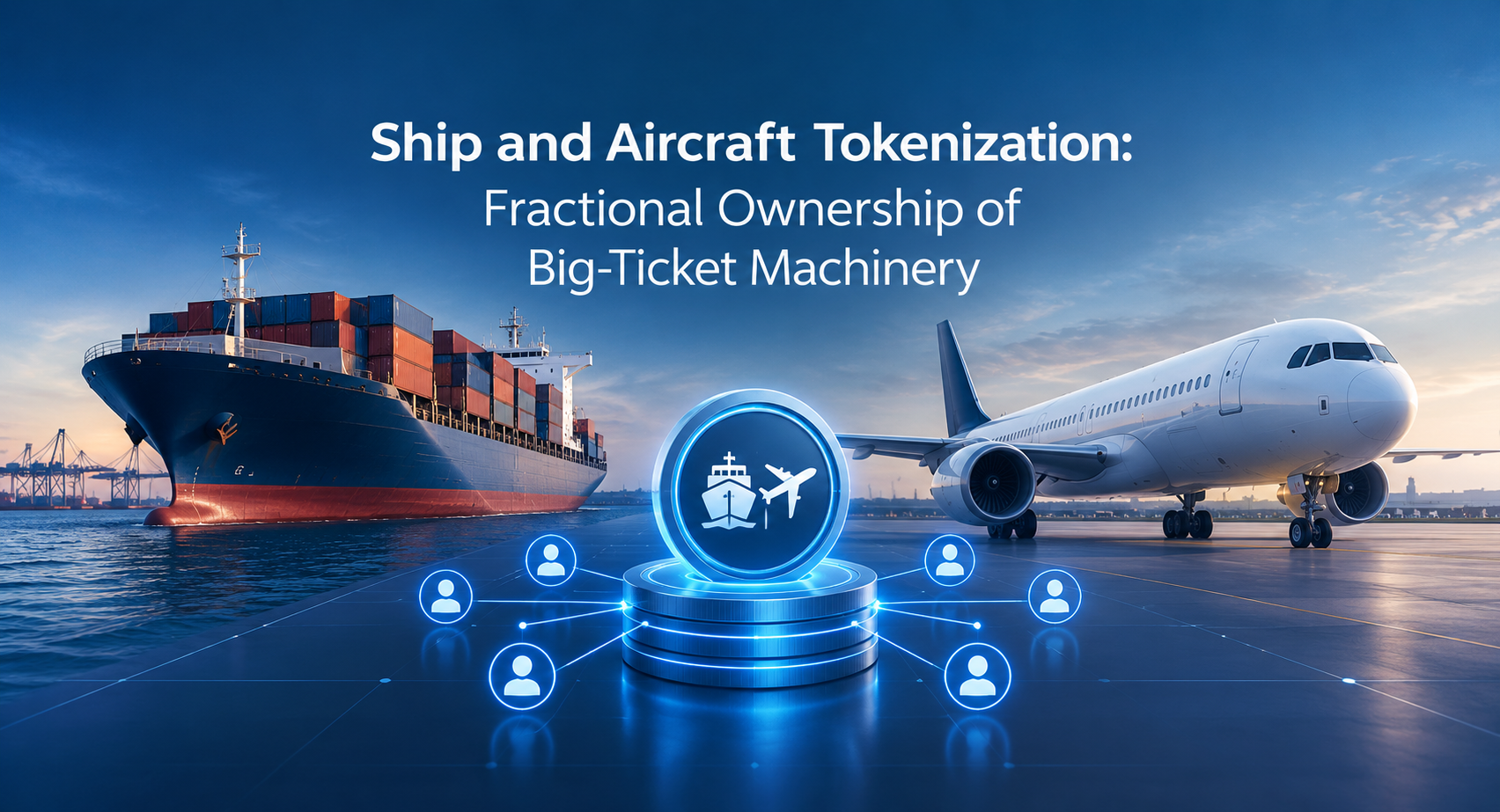
A modern container vessel or wide-body aircraft can cost tens or hundreds of millions of dollars, operate for decades, and generate income through charters or leases. Few investors can fund such assets alone, and the traditional routes to shared ownership, such as syndicated loans, lease funds, and private placements, rely on heavy paperwork and manual administration.
Ship and aircraft tokenization is an emerging approach to this problem. It uses blockchain-based tokens to digitize eligible ownership interests or economic rights in a vessel or aircraft, typically through a legal entity that holds the asset. Done well, this can support fractional participation, more granular record-keeping, and more efficient investor administration.
It is not a shortcut. Tokenization does not automatically create liquidity, open the door to retail investors, or replace legal title. This guide explains how it works for maritime and aviation assets, where it adds value, and what enterprises must get right.
What Is Ship and Aircraft Tokenization?
Real-world asset tokenization represents rights connected to a physical or financial asset as digital tokens on a blockchain. In maritime and aviation, a token can represent:
- Shares or units in an asset-owning company, usually a special purpose vehicle (SPV) that holds title to one vessel or aircraft.
- Beneficial interests, where the governing law and legal structure permit them.
- Contractual rights to eligible cash flows, such as a share of charter or lease income after costs.
Tokenizing the asset versus tokenizing the entity
These are different things. In most practical structures, the ship or aircraft remains registered and owned by a legal entity, and the token represents an interest in that entity or a defined claim on its proceeds. A token does not usually mean an investor "owns a wing" or a cabin of a vessel.
The legal rights matter more than the token
A token is a record and a control mechanism. What investors actually hold is defined by offering documents, SPV constitutional documents, shareholder or trust agreements, and applicable law. If those rights are unclear or unenforceable, the token carries little value regardless of the technology behind it.
How Does Ship Tokenization Work?
Ship tokenization can apply to cargo ships, tankers, container vessels, bulk carriers, and specialized vessels such as offshore support or LNG carriers. A typical workflow includes the following stages.
- Valuation, title, and due diligence. Independent valuation, verification of registry title, review of existing mortgages and liens, class and survey status, and assessment of charter arrangements.
- SPV formation and structuring. A vessel-owning entity is established, often in a recognized maritime jurisdiction, and investor rights are documented in its constitutional and offering documents.
- Investor onboarding. KYC/AML checks and eligibility verification determine who may participate, based on the jurisdiction and offering type.
- Token issuance and ownership records. Tokens representing the defined interests are issued to approved investors, and the platform maintains the digital register.
- Revenue distribution. Eligible charter income or other contractual proceeds, after operating expenses, insurance, financing obligations, and reserves, is allocated to holders under the documented waterfall.
- Ongoing management and exit. Maintenance, dry-docking, insurance renewals, refinancing, and eventual sale or scrapping all affect investor outcomes and must be reflected in governance and reporting.
Hypothetical example (illustrative figures only)
Suppose an SPV owns a mid-sized bulk carrier valued at USD 30 million, with USD 15 million of bank debt and USD 15 million of equity. The equity is divided into 15,000 digital units of USD 1,000 each, offered only to eligible investors in permitted jurisdictions.
An investor subscribing for 100 units would hold a defined interest in the SPV's equity. Distributions would depend on net charter income after crew, fuel (if borne by the owner), maintenance, insurance, management fees, and debt service. Vessel off-hire, a weaker charter market, or a lower resale value could reduce or eliminate distributions. These numbers are hypothetical and do not represent any real transaction or expected return.
How Does Aircraft Tokenization Work?
Aircraft tokenization may cover single commercial aircraft, cargo aircraft, or portfolios of leased aircraft. The structure mirrors ship tokenization in some respects but has distinct features.
- Ownership and leasing structures. Aircraft are commonly held by SPVs and leased to airlines under operating or finance leases. Investor returns usually derive from lease rentals, maintenance reserves where applicable, and eventual residual value.
- Investor rights. Investors typically hold equity or contractual rights in the SPV or leasing vehicle, supported by transfer restrictions and distribution rules coded into the platform.
- Economics. Lease payments, maintenance obligations, insurance, depreciation, and end-of-lease return conditions all shape outcomes.
Three different things
It helps to separate: (1) owning an aircraft directly, (2) owning shares in an aircraft-owning entity, and (3) holding a contractual right to revenue. Each carries different legal protections, tax treatment, and enforcement paths.
Why aviation law adds complexity
Aircraft are mobile assets that cross borders, so registration, title, liens, lessor and creditor rights, and lease enforcement depend on the applicable national laws and international arrangements. Any aviation asset tokenization project requires counsel experienced in aircraft finance in the relevant jurisdictions.
Ship Tokenization vs. Aircraft Tokenization
Neither asset class is inherently more profitable or liquid than the other. Outcomes depend on the specific asset, counterparty, structure, and market conditions.
Business Benefits of Tokenizing Ships and Aircraft
The potential advantages fall into two groups: those that are operational and within an enterprise's control, and those that depend on legal frameworks and market adoption.
Operational benefits (largely technology-driven)
- More granular digital ownership records. A single, shared register reduces reconciliation between spreadsheets, registrars, and administrators.
- Programmable eligibility and transfer controls. Rules such as approved-investor lists, holding periods, and jurisdictional restrictions can be enforced in the workflow.
- Automated distribution of eligible cash flows. Payment calculations and allocation records can be generated consistently from defined rules.
- Improved transparency and auditability. Time-stamped records and role-based access support audits and investor reporting.
- More efficient investor administration. Onboarding, communications, and corporate actions can be handled in one environment.
Benefits that depend on law, counterparties, and markets
- Fractional investment participation. Smaller ticket sizes are possible, but who may invest remains governed by securities and fund regulation.
- Alternative capital-raising structures. Tokenized interests may complement debt, leasing, or fund structures, subject to lender and investor acceptance.
- Secondary-market transferability. Transfers may be technically straightforward, but real liquidity requires permitted venues, willing buyers, and compliant processes.
Real-World Use Cases for Maritime and Aviation Tokenization
The following are hypothetical scenarios, not descriptions of actual deployments.
- Fractional investment in a commercial vessel through an SPV. An owner offers eligible investors units in a vessel-owning entity, with distributions tied to charter income and recorded on a permissioned ledger.
- Tokenized interests in an aircraft leasing vehicle. A lessor raises equity for a leasing SPV, issuing digital units with transfer restrictions that mirror its offering documents.
- Digital participation in a diversified portfolio. A fund holds several vessels or aircraft, and investors hold interests in the fund, spreading exposure across assets and counterparties.
- Tokenization-supported financing for fleet expansion. An operator explores supplementing traditional debt with structured investor participation, subject to lender consent and regulatory review.
- Digitized investor administration for maritime or aviation funds. Existing funds use a tokenization platform mainly to manage registers, reporting, and distributions more efficiently, even where no new investor class is targeted.
Technology Architecture Behind Ship and Aircraft Tokenization
An enterprise blockchain platform typically supports several layers:
- Permissioned participant access. Only authorized issuers, administrators, auditors, and investors can join the network and see relevant data.
- Identity and eligibility. KYC/AML outcomes and investor status are linked to wallet or account permissions.
- Smart contracts and issuance rules. Token supply, subscription terms, and holder rights are encoded and version-controlled.
- Ownership and transaction records. Issuance, transfers, and redemptions are recorded with a tamper-evident audit trail.
- Transfer restrictions and compliance workflows. Transfers can require approval or be blocked when they would breach defined rules.
- Corporate actions and distributions. Dividend or income allocations, notices, and voting events are recorded consistently.
- Integrations. Connections to asset managers, custodians, payment systems, and reporting tools keep on-chain and off-chain data aligned.
What blockchain records do not replace
A blockchain record does not replace an official ship registry, aircraft registry, legal title documents, mortgages, lease agreements, or enforceable contracts. It supports the administration of investor rights; it does not create or override them. Mismatches between on-chain and off-chain records are a real risk and need clear governance rules about which record prevails.
Why permissioned infrastructure can fit
Maritime and aviation transactions involve many authorized parties: owners, managers, lessees, lenders, insurers, administrators, regulators, and investors. A permissioned network such as Hyperledger Fabric allows known participants to share a ledger with controlled visibility, channel-based data separation, and governance over who can validate or view information. That suits commercially sensitive asset and investor data better than fully open environments, although public-chain deployments may be relevant for some designs.
Regulatory and Legal Considerations
Tokenization does not remove existing obligations. Requirements differ by jurisdiction, investor type, and structure, and should be confirmed with qualified counsel against current primary sources. Enterprises should assess:
- Securities and investment-fund rules that may apply to tokens or the underlying SPV interests.
- Investor accreditation, suitability, and KYC/AML obligations.
- Asset ownership and SPV documentation, including constitutional documents and investor agreements.
- Maritime registration, mortgages, and liens, including priority among creditors.
- Aircraft registration, liens, leasing arrangements, and creditor rights under relevant national and international frameworks.
- Cross-border distribution rules and transfer restrictions.
- Taxation, reporting, and disclosure requirements for issuers and investors.
- Custody, enforcement, insolvency, and dispute resolution, including what happens if the issuer, platform, or lessee fails.
No single legal conclusion applies everywhere. A structure that is workable in one jurisdiction may be restricted or require licensing in another.
Key Risks and Challenges
Technology can improve controls and visibility, but it cannot eliminate investment risk.
How Enterprises Can Implement Ship and Aircraft Tokenization
- Select the asset and define the commercial objective. Clarify whether the goal is raising capital, broadening the investor base, or improving administration.
- Conduct legal, financial, and technical due diligence. Review title, encumbrances, cash-flow contracts, valuation, and operational history.
- Establish the ownership and investment structure. Decide on the SPV, rights attached to units, waterfall, governance, and exit mechanics.
- Define investor eligibility and compliance requirements. Map permitted investors, jurisdictions, and KYC/AML processes.
- Choose a suitable enterprise tokenization platform. Evaluate fit against the criteria below.
- Configure issuance, transfer, and distribution workflows. Translate legal terms into platform rules without losing legal accuracy.
- Integrate asset, financial, and reporting systems. Connect administrators, custodians, payment rails, and accounting tools.
- Test controls, auditability, and security. Run scenario tests, security reviews, and reconciliation exercises.
- Launch a controlled pilot and establish ongoing governance. Start with a limited investor group, define oversight, and refine before scaling.
What to assess when selecting a platform
- Scalability for growing numbers of assets, investors, and transactions.
- Permissioning and privacy controls, including role-based access and data segregation.
- Compliance workflows for onboarding, eligibility, and transfer restrictions.
- Interoperability with other networks, standards, and financial infrastructure.
- Integration capabilities with existing enterprise systems.
- Operational support for deployment, monitoring, and change management.
The Role of Spydra in Enterprise Asset Tokenization
Spydra is an enterprise-grade, low-code blockchain platform designed to support real-world asset tokenization on Hyperledger Fabric, with options for private and public blockchain deployments. For organizations exploring maritime or aviation structures, Spydra can be evaluated across several dimensions:
- Configurable token issuance workflows that reflect the terms of an offering rather than a one-size-fits-all template.
- Permissioned networks on Hyperledger Fabric for controlled participation among asset owners, administrators, auditors, and investors.
- Investor onboarding and compliance-related workflows, including eligibility checks and transfer controls aligned to the issuer's legal framework.
- Smart-contract-driven business rules for issuance, distributions, and corporate actions.
- Digital asset lifecycle management from issuance through servicing and redemption.
- Integration with enterprise systems such as asset management, payments, and reporting tools.
- Private or public deployment where the use case and regulatory context support it.
A platform supports the process; it does not itself confer legal ownership, guarantee regulatory approval, ensure liquidity, or automatically connect to every registry or financial institution. Those outcomes depend on the legal structure, counterparties, and integrations the enterprise puts in place.
Exploring tokenization for a vessel or aircraft project? Explore Spydra's asset tokenization capabilities or book a demo to discuss how a configurable, enterprise-grade platform could fit your structure.
The Future of Ship and Aircraft Tokenization
The direction of travel is more likely to be gradual than sudden. Several developments are worth watching:
- Institutional participation. Asset managers and funds may use tokenized structures where legal clarity and operational controls meet their standards.
- Digital asset administration. Even where investor access does not change, digitized registers and automated reporting may become part of fund operations.
- Interoperability with financial infrastructure. Connections to custody, payments, and registries could reduce manual reconciliation over time.
- Evolving legal frameworks. Clearer treatment of tokenized securities and digital registers in different jurisdictions will influence what is practical.
Timelines and adoption levels remain uncertain, and enterprises should plan around present legal and market realities rather than projections.
Conclusion
Ship and aircraft tokenization offers a way to structure fractional investment opportunities and digitize the administration of high-value maritime and aviation assets. Its value lies in better records, programmable controls, and more efficient investor management, not in guaranteed liquidity or returns.
Success depends on four foundations: sound legal structuring, credible asset economics, strong investor protections, and a technology platform that fits regulatory and operational needs. Enterprises that get these right are better positioned to run a disciplined pilot and scale from there.
Ready to evaluate tokenization for maritime or aviation assets? Book a Spydra demo and see how enterprise-grade asset tokenization workflows can be configured for your use case.
Frequently Asked Questions
1. What is ship and aircraft tokenization?
Ship and aircraft tokenization represents eligible ownership interests or economic rights in vessels or aircraft as digital tokens on a blockchain. Usually, tokens relate to shares or units in an SPV or to contractual cash-flow rights. The legal documents, not the token alone, define what holders are entitled to.
2. How does fractional ownership of ships and aircraft work through tokenization?
An asset-owning SPV divides investor interests into digital units issued to approved participants. Each unit reflects a defined share of the entity's equity or proceeds. Eligibility, holding limits, and transfer rules are enforced through platform workflows and the offering documents, rather than granting direct title to the asset.
3. Can investors earn income from tokenized ships and aircraft?
Potentially, if the structure provides for distributions from charter income or lease rentals after costs, debt service, and reserves. Income is not guaranteed. Downtime, counterparty default, operating costs, and asset value changes can reduce or eliminate payments, so investors should review the offering terms carefully.
4. Is ship and aircraft tokenization legal?
It can be, depending on the jurisdiction, investor type, and structure. Tokens may be treated as securities or fund interests, bringing licensing, disclosure, and KYC/AML duties. Tokenization does not remove existing maritime, aviation, or securities rules, so specialist legal advice is essential before launch.
5. How can enterprises choose a blockchain platform for maritime and aviation asset tokenization?
Assess permissioning, privacy, scalability, compliance workflows, interoperability, enterprise integration, and operational support. Confirm how the platform handles transfer restrictions, audit trails, and corporate actions, and verify that it complements, rather than replaces, official registries and legal agreements.