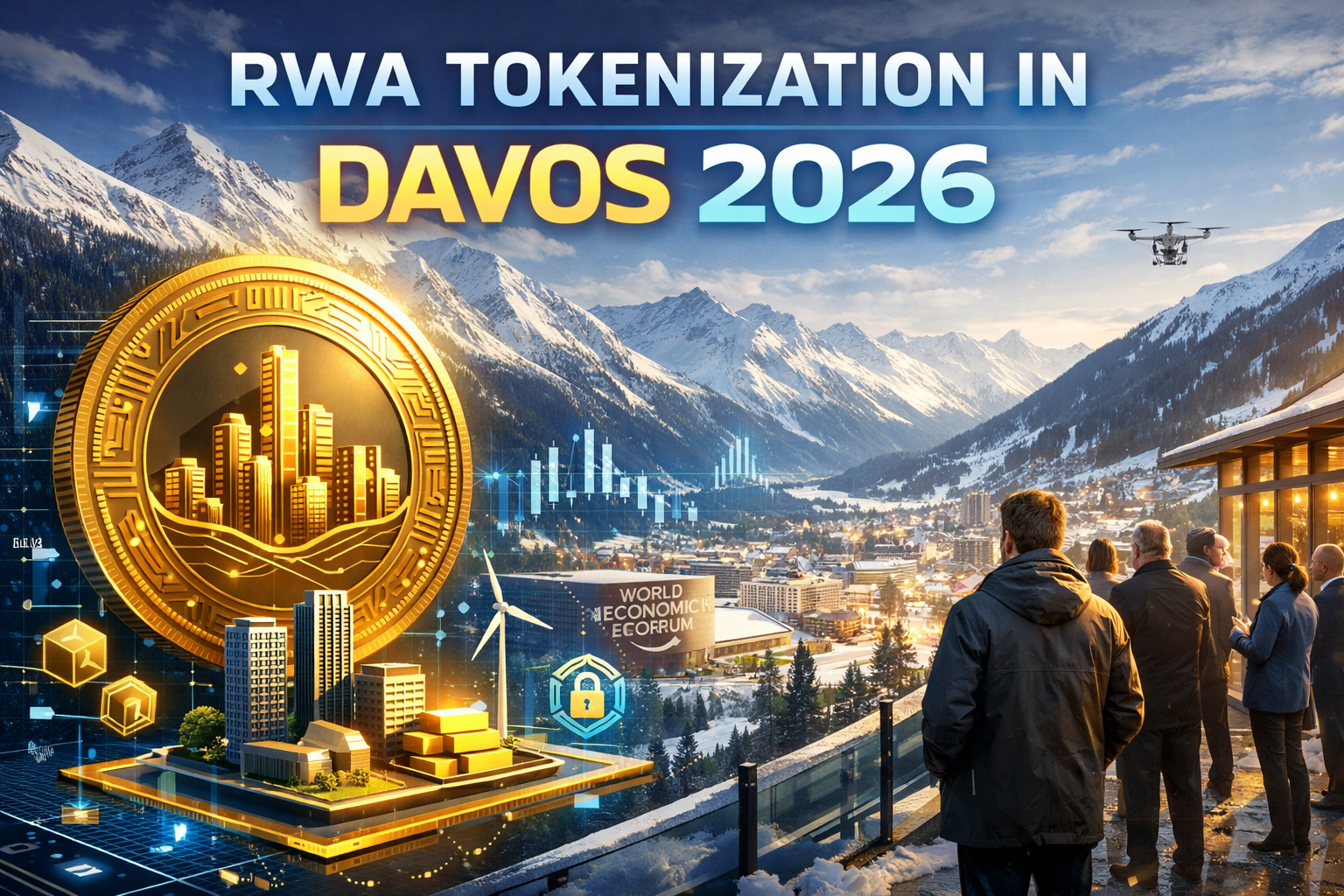
Davos has always been a temperature check for where the global economy is headed. And at Davos 2026, the reading was unmistakable: RWA tokenization is no longer an experiment—it’s a strategic pillar of modern finance.
From policy roundtables to closed-door institutional sessions, conversations around real-world assets on blockchain dominated the agenda. What felt different this year was the tone. Less speculation. More execution. Less “someday,” more “already happening.”
Let’s break down the most important key learnings from Davos 2026 and why RWA tokenization is now taking center stage globally.
Real-world asset tokenization refers to the process of representing physical or traditional financial assets—such as real estate, bonds, commodities, or private credit—as blockchain-based tokens.
While the idea has circulated for years, Davos 2026 marked a clear inflection point. Leaders from global financial institutions, regulators, and technology providers aligned on one message: tokenization solves real market inefficiencies.
Several forces pushed RWA tokenization into the spotlight:
According to discussions referencing World Economic Forum research, tokenization is now viewed as a financial market upgrade, not a disruptive side experiment.
One of the strongest signals from Davos 2026 was how far institutions have already moved. Tokenization is no longer stuck in pilot mode.
Executives from leading global banks and asset managers openly discussed live tokenized products, including:
Institutions emphasized tangible benefits:
In short, RWA tokenization has crossed the credibility gap. It’s now part of institutional roadmaps, not innovation labs.
If regulation once slowed tokenization, Davos 2026 showed it’s now helping shape it.
Rather than debating whether tokenization should exist, regulators focused on how to implement it responsibly. Policymakers discussed frameworks that integrate blockchain-based assets into existing financial systems without compromising investor protection.
Key regulatory themes included:
European regulators referenced progress under MiCA, while representatives from Asia and the Middle East highlighted regulatory sandboxes evolving into full-scale deployment environments. Even traditionally cautious jurisdictions signaled openness to compliant RWA models.
The takeaway? Regulation is becoming an enabler of RWA tokenization, not a barrier.
What truly grounded the Davos 2026 discussions were real, working examples—not theoretical models.
These use cases demonstrated how real-world assets on blockchain can improve efficiency while expanding access. The focus wasn’t on speculation—it was on utility.
Another key theme at Davos 2026 was the evolving relationship between traditional finance and decentralized finance.
Rather than a disruptive takeover, leaders described a controlled convergence. Institutions are selectively adopting proven DeFi mechanics—such as atomic settlement and programmability—within compliant, permissioned environments.
This hybrid approach allows firms to benefit from blockchain innovation while maintaining regulatory guardrails. The consensus?
DeFi isn’t replacing traditional finance—it’s upgrading it.
RWA tokenization wouldn’t be advancing without major progress behind the scenes. Infrastructure maturity was a recurring talking point at Davos.
Technology providers highlighted advances in:
While challenges remain—especially around global standards—the foundation is now strong enough to support real-world scale.
The implications of Davos 2026 extend well beyond the conference halls.
Ignoring RWA tokenization at this stage isn’t cautious—it’s risky.
These aren’t predictions—they’re signals already in motion.
RWA tokenization is the process of representing real-world assets as digital tokens on a blockchain.
It marked a shift from pilots and theory to real-world institutional adoption and regulatory alignment.
Yes, many jurisdictions are implementing frameworks to govern tokenized assets with compliance and investor protection in mind.
Bonds, real estate, private credit, commodities, and environmental assets are leading adoption.
No. Traditional institutions and enterprises are now major participants.
Davos 2026 made one thing clear: RWA tokenization is no longer a trend—it’s a structural shift. The conversation has moved past “if” and landed squarely on “how fast.”
For the global financial system—and for platforms building the future of tokenized assets—this moment marks the beginning of a new era. One where real-world assets, blockchain infrastructure, and institutional trust finally converge.