Tokenization is no longer a theoretical upgrade to financial markets—it is becoming a competitive imperative. By the end of 2025, tokenized real‑world assets surpassed $15 billion in on-chain value, with major banks, asset managers, and market infrastructures actively piloting tokenized bonds, funds, and commodities. Industry estimates suggest that tokenization could unlock $16–$30 trillion in asset value over the next decade as settlement, custody, and issuance move onto digital rails.
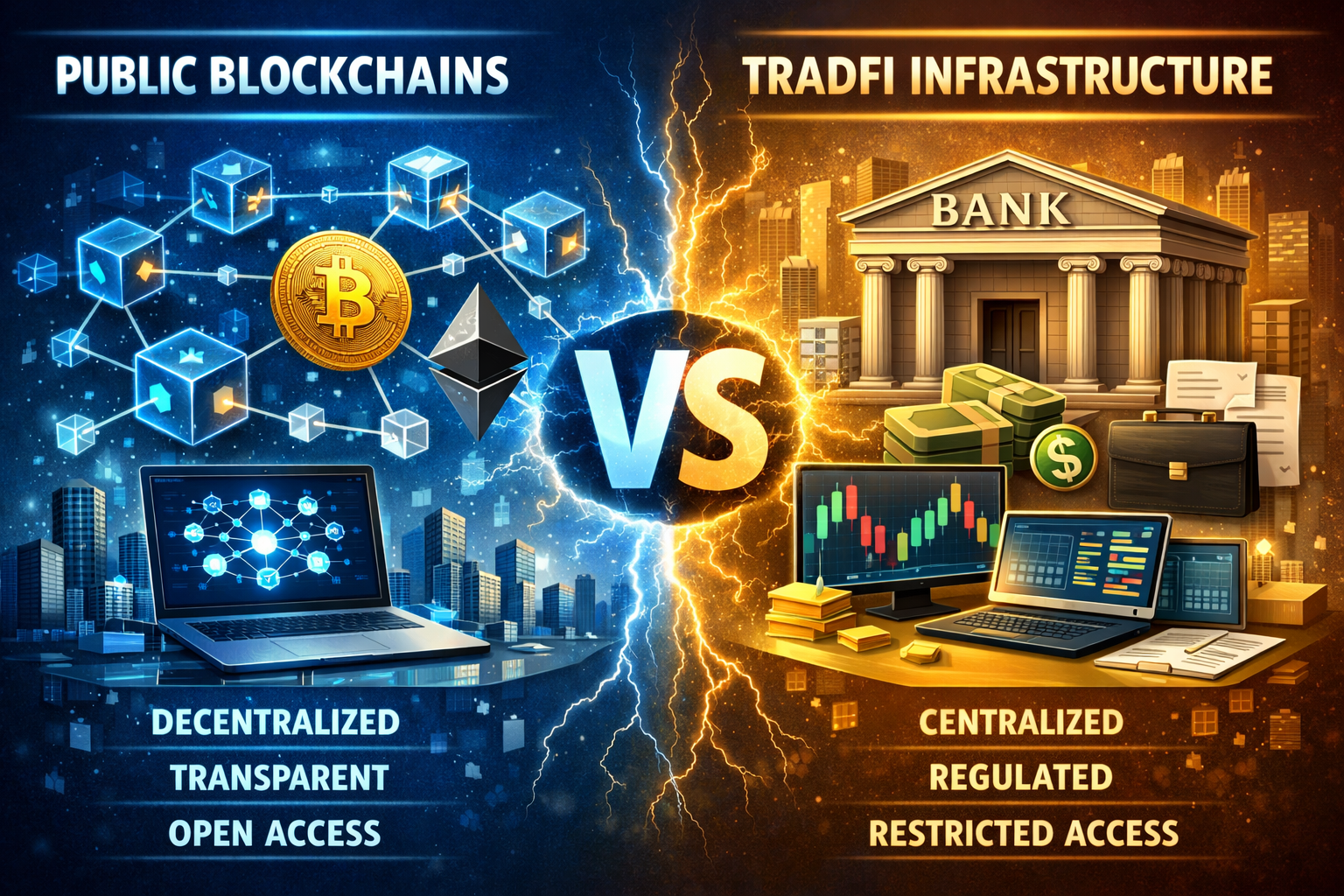
Yet as adoption accelerates, a critical fault line has emerged: should tokenized markets run on public blockchains or remain embedded within traditional financial (TradFi) infrastructure? This question sits at the heart of the broader decentralized finance vs traditional finance debate—pitting open, programmable networks against regulated, intermediary-driven systems that underpin today’s capital markets.
The outcome of this infrastructure battle will determine not only how fast tokenization scales, but also who controls liquidity, standards, and access in the next generation of financial market infrastructure.
Public blockchains are open, permissionless networks where anyone can participate in validating transactions and interacting with applications. These networks operate with transparent ledgers, cryptographic security, and programmable smart contracts. Settlement occurs natively on-chain, often within minutes, without reliance on centralized intermediaries.
Public blockchains emphasize openness, composability, and global accessibility—features that have enabled rapid innovation in decentralized finance and digital asset markets.
Traditional finance relies on layered market infrastructure: custodians safeguard assets, clearing houses manage counterparty risk, and settlement systems finalize transactions, often over multiple days. Access is permissioned, governance is centralized, and trust is derived from regulated intermediaries rather than code.
This infrastructure prioritizes stability, regulatory oversight, and risk containment, reflecting decades of evolution in capital markets.
In decentralized finance, trust is minimized through open-source code and publicly verifiable ledgers. Transactions and asset movements are visible on-chain, reducing reliance on reconciliation across multiple parties.
Traditional finance, by contrast, operates on institutional trust. Transparency is limited to participants and regulators, with records maintained across siloed systems. While robust, this model introduces operational complexity and reconciliation risk.
Public blockchains enable near real-time settlement with cryptographic finality. This compresses settlement cycles and reduces capital locked in margin and collateral.
TradFi systems often rely on T+1 or T+2 settlement, reflecting legacy processes and risk management frameworks. While reliable, slower settlement increases operational cost.
Public blockchains are inherently interoperable. Tokens and smart contracts can interact across applications, enabling composability that accelerates financial innovation.
Traditional financial infrastructure is fragmented across institutions and jurisdictions, limiting interoperability and increasing integration costs.
Automated execution and shared ledgers can reduce back-office costs in decentralized systems. However, volatility and scalability constraints remain concerns.
Traditional systems benefit from scale and predictability but carry significant operational overhead due to manual processes and intermediaries.
Public blockchains have become a natural experimentation ground for blockchain tokenization.
These factors make institutions cautious, despite the efficiency gains.
Many financial institutions are pursuing tokenization within familiar regulatory and operational boundaries.
Tokenization efforts confined to siloed systems risk replicating existing inefficiencies in digital form.
Regardless of infrastructure choice, institutions face common challenges:
These realities explain why adoption has been incremental rather than disruptive.
Rather than a zero-sum battle, the future may lie in convergence. Hybrid models are emerging where assets are issued on permissioned platforms but settled or anchored to public blockchains for transparency and interoperability.
Standards, interoperability layers, and compliance tooling will play a critical role in bridging permissioned vs public blockchains, allowing institutions to balance innovation with regulatory expectations.
Three factors will determine the pace of adoption:
As these elements align, real-world asset tokenization can move from pilots to production.
The debate around decentralized finance vs traditional finance reflects deeper questions about how trust, governance, and efficiency should be structured in modern financial markets. Public blockchains offer transparency, composability, and global reach, while TradFi infrastructure provides regulatory certainty and institutional confidence.
Rather than a single winner, tokenization’s path to adoption is likely to involve pragmatic convergence—combining the strengths of both models. As financial market infrastructure evolves, the institutions that successfully integrate public blockchain capabilities within compliant frameworks will be best positioned to scale tokenization and unlock its full potential.