As digital payments continue to grow across e-commerce, fintech, and online services, protecting payment card data has become a critical priority for businesses. Data breaches involving cardholder information can lead to financial loss, reputational damage, and regulatory penalties. To address these risks, organizations handling payment data must comply with the Payment Card Industry Data Security Standard, a global security framework designed to safeguard cardholder information.
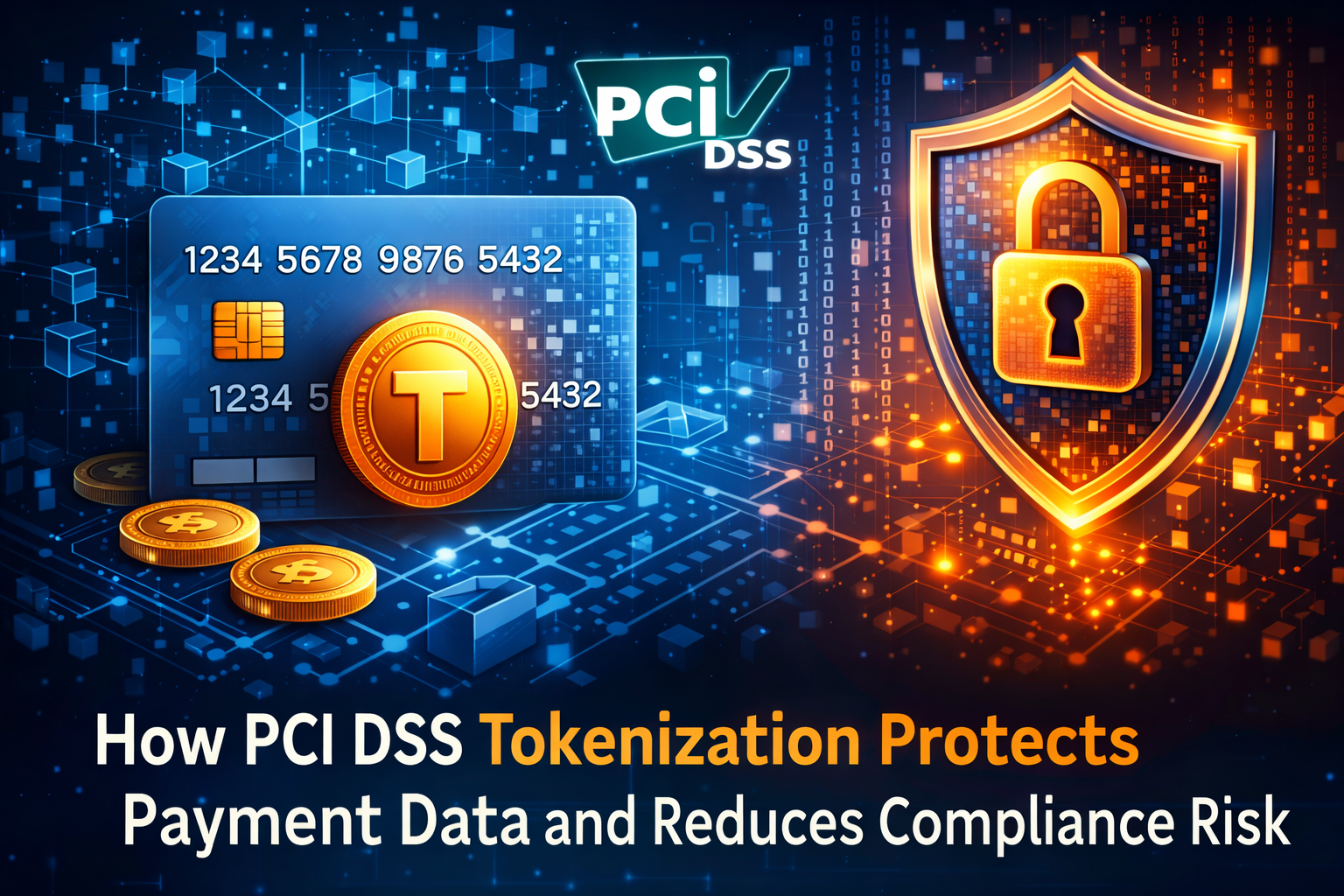
One of the most effective methods for protecting sensitive payment data is PCI DSS tokenization. Tokenization replaces sensitive card information with a unique token that has no exploitable value if intercepted. By removing cardholder data from business systems, tokenization not only improves security but also significantly reduces the scope and complexity of PCI compliance requirements.
PCI DSS tokenization is a data protection technique used to secure payment card information by replacing the Primary Account Number (PAN) with a randomly generated token. This token can be stored and used in place of the actual card number without exposing sensitive payment data.
The security standards governing this process are defined by the Payment Card Industry Security Standards Council, which established PCI DSS to ensure businesses handling card payments implement strong security controls.
With tokenization:
This approach helps businesses maintain payment functionality while dramatically reducing the risk of data exposure.
The tokenization process typically follows a structured workflow designed to isolate sensitive payment data from operational systems.
During an online or in-store purchase, the customer enters their credit or debit card information.
The card information is transmitted securely to a tokenization service that is PCI compliant.
The system replaces the card number with a unique token. This token is randomly generated and cannot be mathematically reversed to reveal the original card number.
The original card data is stored in a highly secure token vault, while the generated token is returned to the merchant’s system.
Future transactions reference the token instead of the original card number, ensuring sensitive data is not exposed.
Example:
Original Card Number
Generated Token
4111 1111 1111 1111
TKX-8F39A21D
Even if the token is intercepted during a transaction, it cannot be used to access the original card data.
Payment data breaches remain one of the most common cybersecurity threats for businesses. Tokenization helps mitigate these risks by minimizing the exposure of sensitive cardholder information.
Because tokens replace card numbers in most systems, attackers cannot retrieve real payment information even if they gain access to the database.
Tokenized payment environments ensure that stolen data cannot be reused for fraudulent transactions.
Tokenization enables secure payment processing across websites, mobile apps, and payment terminals.
Consumers are more likely to trust businesses that implement strong payment security practices.
Together, these benefits make tokenization a powerful component of modern payment security strategies.
Achieving full PCI DSS compliance can be complex and costly because businesses must secure every system that stores or processes cardholder data. Tokenization significantly simplifies this process.
Since tokens replace card numbers in most systems, fewer environments handle sensitive data. This means fewer systems fall within PCI DSS audit requirements.
Organizations can focus security controls primarily on the tokenization system and token vault, rather than across the entire infrastructure.
Reducing the exposure of cardholder data lowers the risk of compliance violations and financial penalties.
Tokenization supports a layered security approach that aligns with PCI DSS best practices.
For businesses managing large volumes of payment transactions, this reduction in compliance scope can translate into significant cost savings and operational efficiency.
Tokenization and encryption are both used to protect payment data, but they operate differently.
Many payment infrastructures use both encryption and tokenization together to provide stronger protection for cardholder data.
Tokenization is widely used across industries that handle payment transactions.
Online retailers use tokenization to store customer payment details securely for future purchases.
Payment processors use tokenization to protect cardholder data during transaction processing.
Streaming platforms and SaaS services rely on tokenization to manage recurring payments securely.
Retailers implement tokenization to secure in-store transactions and reduce compliance scope.
Financial technology companies integrate tokenization to ensure secure digital payment systems.
Leading payment companies such as Visa, Mastercard, and Stripe widely implement tokenization to protect payment transactions worldwide.
Organizations planning to implement tokenization should follow several security best practices.
The token vault storing original cardholder data must have strict security controls and encryption.
Access to sensitive payment data should be restricted to authorized systems and personnel.
Payment data should be encrypted during transmission to prevent interception.
All access and operations involving cardholder data should be logged for monitoring and compliance.
Selecting a trusted provider ensures that the tokenization infrastructure meets regulatory standards.
These best practices help organizations maintain secure payment environments while meeting compliance obligations.
As digital payment ecosystems continue to expand, tokenization is becoming a foundational security technology. New payment innovations—including mobile wallets, digital banking platforms, and contactless payments—rely on tokenization to protect sensitive financial information.
Future payment architectures will likely combine tokenization with other advanced security technologies such as biometric authentication, AI-driven fraud detection, and real-time monitoring systems.
For businesses seeking to strengthen their cybersecurity posture while simplifying compliance, tokenization will remain a critical component of secure payment infrastructure.
Protecting payment card data is essential for businesses operating in today’s digital economy. PCI DSS tokenization provides a powerful solution by replacing sensitive card information with secure tokens, minimizing the exposure of cardholder data across systems.
By implementing tokenization, organizations can improve payment security, reduce the scope of PCI compliance requirements, and build greater trust with customers. As digital transactions continue to increase globally, tokenization will play an increasingly important role in safeguarding payment ecosystems and reducing compliance risk.
1. What is PCI DSS tokenization?
PCI DSS tokenization is a method of protecting payment card data by replacing the card number with a unique token that cannot be used outside the tokenization system.
2. How does tokenization help with PCI compliance?
Tokenization reduces the number of systems storing cardholder data, which decreases the scope of PCI DSS compliance requirements.
3. Is tokenization better than encryption?
Tokenization and encryption serve different purposes. Many organizations use both together to strengthen payment security.
4. What industries use PCI DSS tokenization?
Industries such as e-commerce, fintech, banking, retail, and subscription services commonly use tokenization.
5. Can tokenization prevent payment data breaches?
Tokenization significantly reduces the risk of breaches by ensuring that real cardholder data is not stored in most business systems.