The real estate industry has operated on the same fundamentals for centuries: paper deeds, bank financing, brokers, lawyers, and month-long settlement cycles. For developers, this means slow capital raises, high transaction costs, and investor pools limited by geography and minimum ticket sizes.
In 2026, that model is under direct challenge — not from a new regulation or a market cycle, but from blockchain-based land tokenization. And unlike the speculative crypto hype of earlier years, today's tokenization is institutional, regulated, and enterprise-ready.
The question for every real estate developer is no longer "should I tokenize?" It is "how quickly can I get started before my competitors do?"
Before understanding what tokenization offers, it's important to be honest about the structural problems in traditional real estate that developers and investors have simply accepted as unavoidable.
A traditional property deal ties up large amounts of capital with no ability to partially exit. If a developer needs liquidity, the only option is a full sale — a process that takes months, involves significant transaction costs, and is subject to market timing.
Premium commercial and residential assets routinely require minimum investments of ₹50 lakh to several crores. This limits the investor pool to a handful of HNIs and institutional buyers — leaving a vast untapped pool of mid-market investors completely excluded.
A typical land transaction in India involves registry offices, stamp duty calculations, legal due diligence, mutation, and encumbrance verification. The end-to-end process routinely takes 45 to 90 days — even for straightforward deals.
Despite digitization efforts, land record fraud and title disputes remain endemic. Paper-based ownership records, incomplete digitization, and inconsistent state-level registries create persistent risks that developers pass on to investors through risk premiums.
Developers raising capital for a project are effectively limited to their local network of investors and banking relationships. International capital is practically inaccessible due to legal complexity, currency friction, and investor due diligence requirements.
💡
A survey by EY found that 80% of high-net-worth investors and 67% of institutional investors were already investing or planning to invest in tokenized assets by 2026 — with real estate cited as the second most attractive tokenized asset class overall.
Land tokenization is the process of converting a real estate asset — a plot of land, a commercial building, a residential complex, or a development project — into digital tokens on a blockchain. Each token represents a fractional share of the asset's ownership, value, or revenue stream.
These tokens can be issued, traded, and transferred programmatically via smart contracts — without the need for physical paperwork, intermediary banks, or lengthy legal processes.
1 Asset valuation & legal structuring
The property is valued and held by a Special Purpose Vehicle (SPV) or trust. Legal documentation defines investor rights, revenue sharing, and exit conditions.
2. Smart contract configuration
Smart contracts are programmed to automate ownership distribution, dividend payments, compliance checks, and secondary trading rules.
3. Token minting on permissioned blockchain
Digital tokens representing fractional ownership are minted on an enterprise blockchain like Hyperledger Fabric — giving full control over who can access the network.
4 Investor onboarding & token distribution
Investors complete KYC once and receive tokens directly in their wallets. Minimum investments can be as low as ₹500 per token.
5 Ongoing management via smart contracts
Rental income, dividend payments, governance votes, and compliance reporting all execute automatically — no manual intervention required.
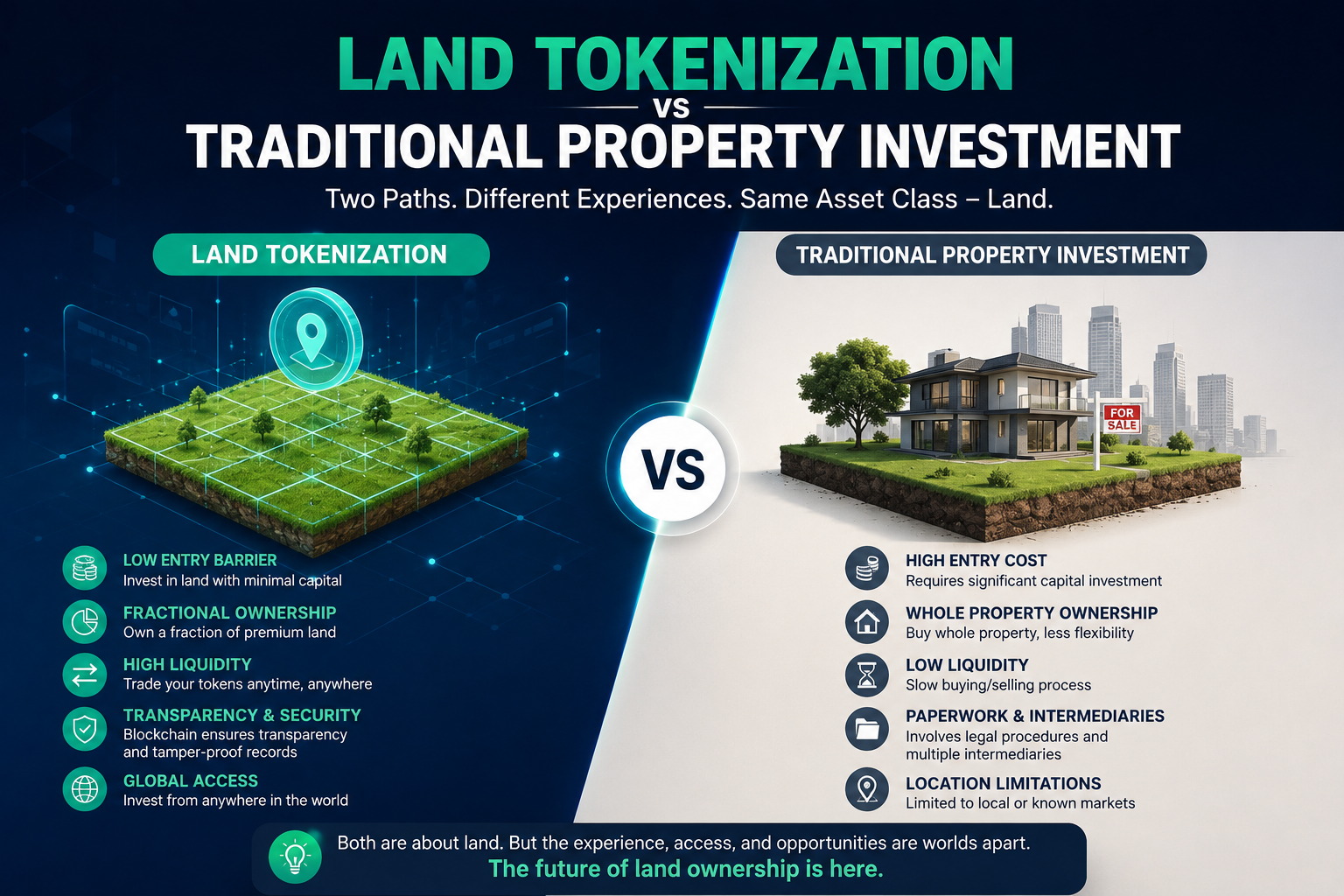
Here is how the two models compare across every dimension that matters to a real estate developer or fund manager:
Land tokenization is no longer a theoretical concept. Major governments and financial institutions have moved from pilot to production in 2026.
🌍
The question is no longer whether governments and institutions will adopt land tokenization — they already are. The question is whether your business will be positioned to benefit from this shift or forced to play catch-up in 2027.
Not all blockchain tokenization is equal. Public chains like Ethereum offer open access but create serious problems for real estate developers:
Spydra is built on Hyperledger Fabric — a permissioned, enterprise-grade blockchain specifically designed for regulated industries. On Spydra's network:
Faster capital raises
Issue tokens to global investors in days rather than running a 6-month fundraising cycle.
Lower cost of capital
Access a broader investor pool competing for your asset—better pricing than bank loans.
Automated compliance
Built-in KYC, AML, and audit trail remove the compliance burden from your team.
No blockchain expertise needed
A low-code platform with pre-built smart contract templates—go live in 2–6 weeks.
Wallet-less investor onboarding
Investors sign up with just email. No crypto wallets, no seed phrases, no drop-off.
ERP integration
Connect Spydra to your existing systems via REST API — no migration, no disruption.
Q: Is land tokenization legal in India?
A: Land tokenization exists in a regulatory grey area in India currently. Land falls under state jurisdiction per the Indian Constitution, and regulations vary by state. States like Andhra Pradesh, Karnataka, and Maharashtra have active blockchain land registry pilots. SEBI and RBI are expected to release comprehensive tokenization guidelines in 2026. Spydra's permissioned Hyperledger Fabric infrastructure is designed to align with compliance requirements as they evolve — giving you a future-proof foundation.
Q: What is the minimum investment in a tokenized land asset?
A: On Spydra's platform, token minimum investments can be configured as low as ₹500 per token. This is entirely configurable by the issuing developer or fund manager depending on the asset and target investor base.
Q: How is tokenized land different from a REIT?
A: REITs are pooled investment vehicles that hold a portfolio of properties and trade on stock exchanges. Tokenized land gives investors direct, fractional ownership of a specific asset — with programmable rights, real-time income distribution, and the ability to trade fractions without going through a stock exchange. Tokenized assets can also be created faster and with lower structuring costs than a listed REIT.
Q: How long does it take to tokenize a property on Spydra?
A: Most Spydra deployments go from initial configuration to live token issuance in 2 to 6 weeks. The platform provides pre-built smart contract templates, compliance modules, and API integrations — so you're not building from scratch.
Q: Can investors trade their tokens on a secondary market?
A: Yes. Spydra's platform supports secondary market functionality, allowing token holders to trade their fractional ownership interests. The developer or fund manager can configure trading rules — including lock-up periods, whitelisted buyers, and compliance checks — at the smart contract level.
Q: What happens if the blockchain platform shuts down?
A: Spydra uses Hyperledger Fabric — an open-source, enterprise-grade protocol. Because the network is permissioned and enterprise-operated, it is not subject to public chain volatility or shutdown risk. All ownership records and transaction history can be ported to any compatible Hyperledger deployment.
Traditional real estate investment is not going away. But the developers and fund managers who build tokenization into their capital-raising strategy in 2026 will have a structural advantage that compounds over time — lower cost of capital, faster fundraising, a global investor base, and automated operations.
The technology is enterprise-ready. The regulatory environment is taking shape. Major governments have moved from pilot to production. The only question is whether your business will be among the early adopters who capture the premium — or the late movers who pay it.
Spydra's permissioned tokenization platform is built specifically for this moment — enterprise-grade compliance, low-code deployment, and zero blockchain expertise required.
Ready to Tokenize Your Land or Real Estate Assets?
Spydra's enterprise-grade tokenization platform is built for real estate developers and property funds who want to move fast — with full compliance and zero blockchain expertise required.
Book a Demo → spydra.app/schedule-a-demo