Real-World Assets (RWA) tokenization involves representing tangible assets like real estate, treasuries, commodities, and private credit as digital tokens on blockchain networks. This enhances liquidity, enables fractional ownership, and bridges traditional finance (TradFi) with decentralized finance (DeFi). As of August 2025, the total RWA TVL stands at approximately $26.3 billion, reflecting a surge driven by institutional adoption, regulatory clarity in jurisdictions like Singapore and the UAE, and innovations in cross-chain interoperability. Key developments include tokenized treasuries exceeding $5.6 billion in market cap (up 545% since 2024) and private credit reaching $558 million in active loans.
Real-World Assets (RWAs) refer to physical or traditional financial assets—such as real estate, government bonds, private credit, commodities, or invoices—that are converted into digital tokens on a blockchain. Tokenizing RWAs makes them programmable, tradable, and accessible across global markets. This shift unlocks liquidity, fractional ownership, automated compliance, and real-time settlement, creating a bridge between traditional finance (TradFi) and the decentralized world. As enterprises and institutions explore efficient ways to manage assets digitally, RWA tokenization has become one of the most impactful blockchain use cases.
Below, I outline major blockchains active in RWA, their 2024-2025 developments and initiatives, and their market impact. Selection is based on TVL, project count, and institutional involvement. Data draws from analytics platforms like RWA.xyz and reports from CoinGecko and Messari.
Not every blockchain is suitable for RWA tokenization. A blockchain must offer the right blend of performance, compliance, and interoperability to handle asset issuance, ownership transfers, legal requirements, and settlement. RWA-ready blockchains typically feature low fees, high throughput, programmable smart contracts, identity and compliance support, and strong security guarantees. Additionally, they must integrate seamlessly with off-chain data providers and custodians to prove asset ownership and maintain real-world trust. These criteria determine how effectively an ecosystem can support large-scale tokenization.
Developments and Initiatives (2024-2025): Base focused on RWA via Coinbase's tokenization of shares and integration with Chainlink oracles. 2025 initiatives: Yield-bearing RWAs like tokenized MMFs and partnerships for private credit. It leveraged Ethereum security for compliant tokenization.
Impact on RWA Market: TVL ~$500 million, growing 260% in H1 2025. Base bridged TradFi with DeFi, tokenizing treasuries and stocks, enhancing accessibility and contributing to the $23 billion market surge.
Developments and Initiatives (2024-2025): Centrifuge pioneered RWA since 2017, surpassing $1 billion TVL in 2025 via tokenized credit and treasuries. Initiatives: Partnerships with MakerDAO and Janus Henderson for $1 billion deployments; integration with Polkadot for interoperability.
Impact on RWA Market: $1 billion TVL (top 3 protocols), tokenizing $661 million+ in assets. It enabled SME financing, growing private credit 85% YoY and contributing to the $15.2 billion RWA market (excluding stablecoins).
Developments and Initiatives (2024-2025): Aptos surged with $700 million RWA TVL via Move language for secure tokenization. 2025 initiatives: Partnerships with BlackRock (BUIDL) and Franklin Templeton (BENJI); Hyperion upgrade for scalability; Wyoming stablecoin pilot.
Impact on RWA Market: Ranked top 3 in RWA TVL ($700 million, +57% in 30 days), tokenizing $420 million in private credit. It outpaced Solana, driving institutional adoption and sector growth to $23 billion.
Developments and Initiatives (2024-2025): Plume, an EVM L1 for RWAs, launched mainnet in June 2025 on Arbitrum Orbit. Initiatives: $226 million TVL from tokenized real estate; partnerships with World Liberty Financial for USD1 stablecoin; 55 million transactions.
Impact on RWA Market: TVL $226 million (+63,765% in May), with $58 billion asset pipeline. It enabled compliant DeFi-RWA integration, attracting 150,000 holders and contributing to policy engagement for regulatory clarity.
Developments and Initiatives (2024-2025): Provenance focused on financial services, adding $415 million TVL in May 2025 via 440,000+ transactions. Initiatives: Tokenization of bonds and IP; partnerships for institutional RWAs.
Impact on RWA Market: $12 billion+ total RWA TVL, leading in scale. It deployed $415 million new capital, tokenizing diverse assets and supporting the sector's 800% growth to $65 billion in Q1 2025.
Scoring and Rating
Parameters (scored 1-10):
Overall rating: Weighted average (higher = stronger RWA ecosystem support)
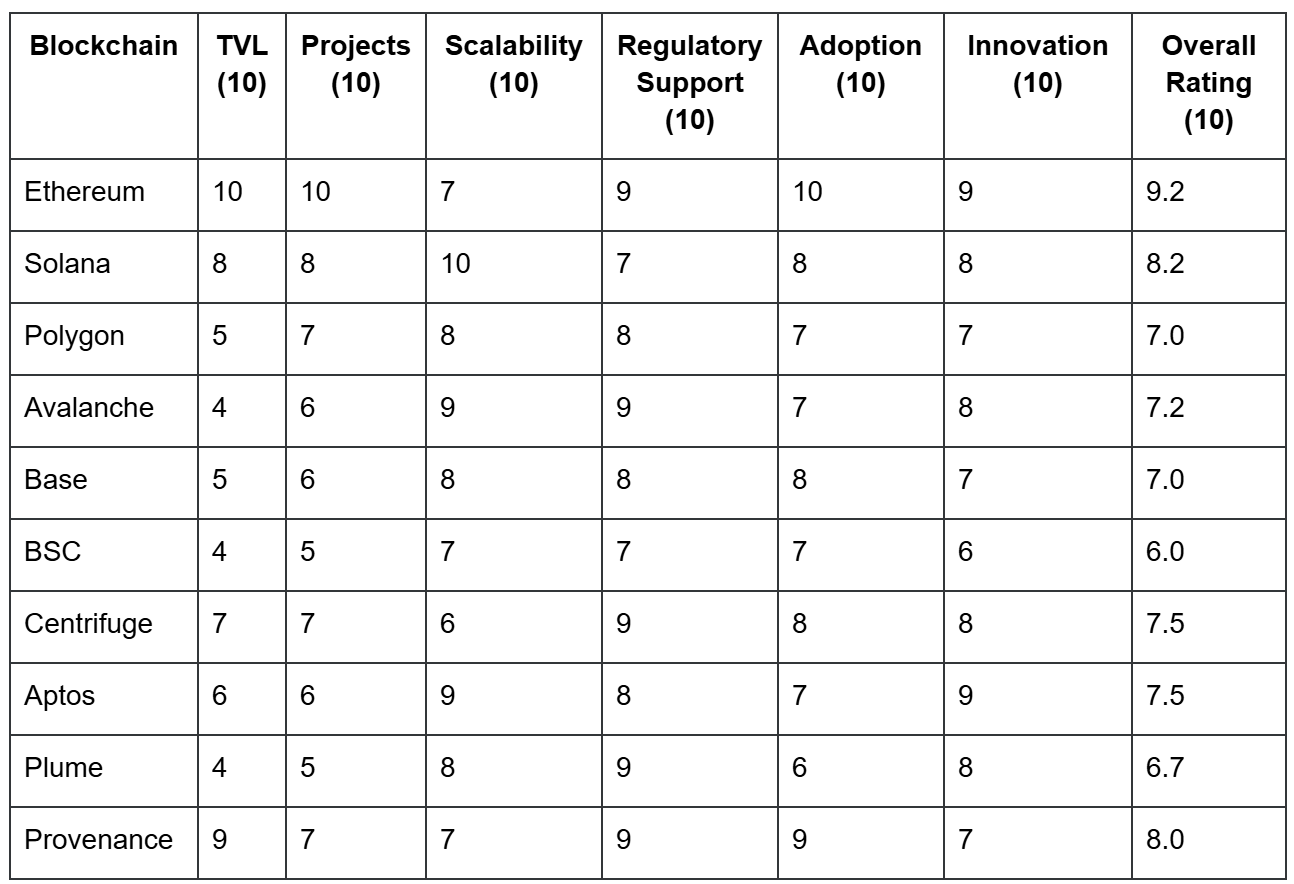
Ethereum leads due to dominance and ecosystem maturity, while Solana and Provenance excel in growth and scale. Emerging chains like Aptos and Centrifuge show strong potential for specialized RWA support.
Across these blockchain ecosystems, RWA tokenization is already being applied to real business use cases. Tokenized Treasury bills are emerging as a preferred on-chain yield product, providing stable returns with institutional-grade transparency. Real estate firms are exploring fractionalized property ownership that allows global investors to buy small portions of high-value assets. Commodity-backed tokens—including gold, metals, and carbon credits—are gaining traction for their auditability and trust. Meanwhile, financial institutions are tokenizing invoices, private credit, and revenue-based financing to reduce settlement delays and unlock liquidity faster than traditional methods.
Despite rapid growth, tokenized RWAs still face several challenges. Liquidity remains limited for many asset classes, partly due to low secondary-market participation. Regulatory uncertainty is another major barrier, as compliance expectations differ across jurisdictions and asset types. Since RWAs represent physical assets, they depend heavily on trust, custody, audits, and real-world data feeds. If off-chain valuations or appraisals are inaccurate, on-chain tokens can be mispriced. Ensuring tamper-proof data through reliable custodians and oracle networks is essential for long-term adoption. These challenges must be addressed for the RWA market to scale sustainably.
Looking ahead, the RWA ecosystem is moving toward cross-chain interoperability, allowing asset tokens to flow seamlessly across networks instead of being siloed. Institutions are expected to increase adoption of tokenized bonds, commercial real estate, and private credit—assets with strong cash flow and predictable valuations. New legal frameworks, on-chain identity systems, and custody regulations will improve trust and compliance. As DeFi protocols begin using RWA tokens as collateral or yield-bearing products, blockchains will increasingly integrate real and digital economies. This evolution positions RWAs as one of the biggest drivers of long-term blockchain adoption.
Real-World Assets (RWAs) are physical or traditional financial assets—such as real estate, commodities, invoices, or bonds—converted into digital tokens on a blockchain. Tokenizing RWAs enables greater transparency, faster settlement, global accessibility, and fractional ownership.
Blockchains provide the infrastructure needed to securely issue, transfer, and track ownership of tokenized assets. They enable programmable smart contracts, auditability, automated compliance, and 24/7 settlement, making RWA markets more efficient than traditional systems.
Ethereum, Polygon, Solana, Avalanche, and Hyperledger FireFly are among the most widely used ecosystems for RWA projects. Each offers different strengths such as low fees, scalability, regulatory support, and strong developer adoption.
Real estate, supply chain, finance, private credit, trade finance, and commodities markets see major advantages. Tokenization reduces manual paperwork, increases liquidity, and introduces global investor participation.
Tokenization allows assets to be fractionalized, meaning they can be divided into small digital units. This makes high-value assets accessible to more investors and increases secondary-market trading, improving overall liquidity.
Yes. Most RWA tokens fall under security or asset-backed instrument regulations depending on the jurisdiction. Compliance often includes KYC/AML checks, custodianship rules, investor eligibility, and transparent asset audits.
Key risks include regulatory uncertainty, custody issues, inaccurate off-chain valuations, data feed manipulation, and low liquidity for certain asset types. Choosing verified auditors, reliable custodians, and compliant blockchain platforms helps mitigate these risks.
Multiple industry reports predict that the tokenized asset market could exceed $10 trillion by 2030, driven by the tokenization of bonds, real estate, private credit, and money-market funds. Institutional adoption is accelerating this growth.
Yes. Many DeFi protocols are now integrating tokenized T-bills, real estate tokens, and private credit instruments as collateral. This bridges the gap between real-world assets and decentralized finance, enabling new yield opportunities.
A blockchain must offer high scalability, low fees, smart contract programmability, enterprise-grade security, privacy controls, and support for compliance/identity frameworks. Interoperability and oracle integrations are also crucial for real-world asset representation.