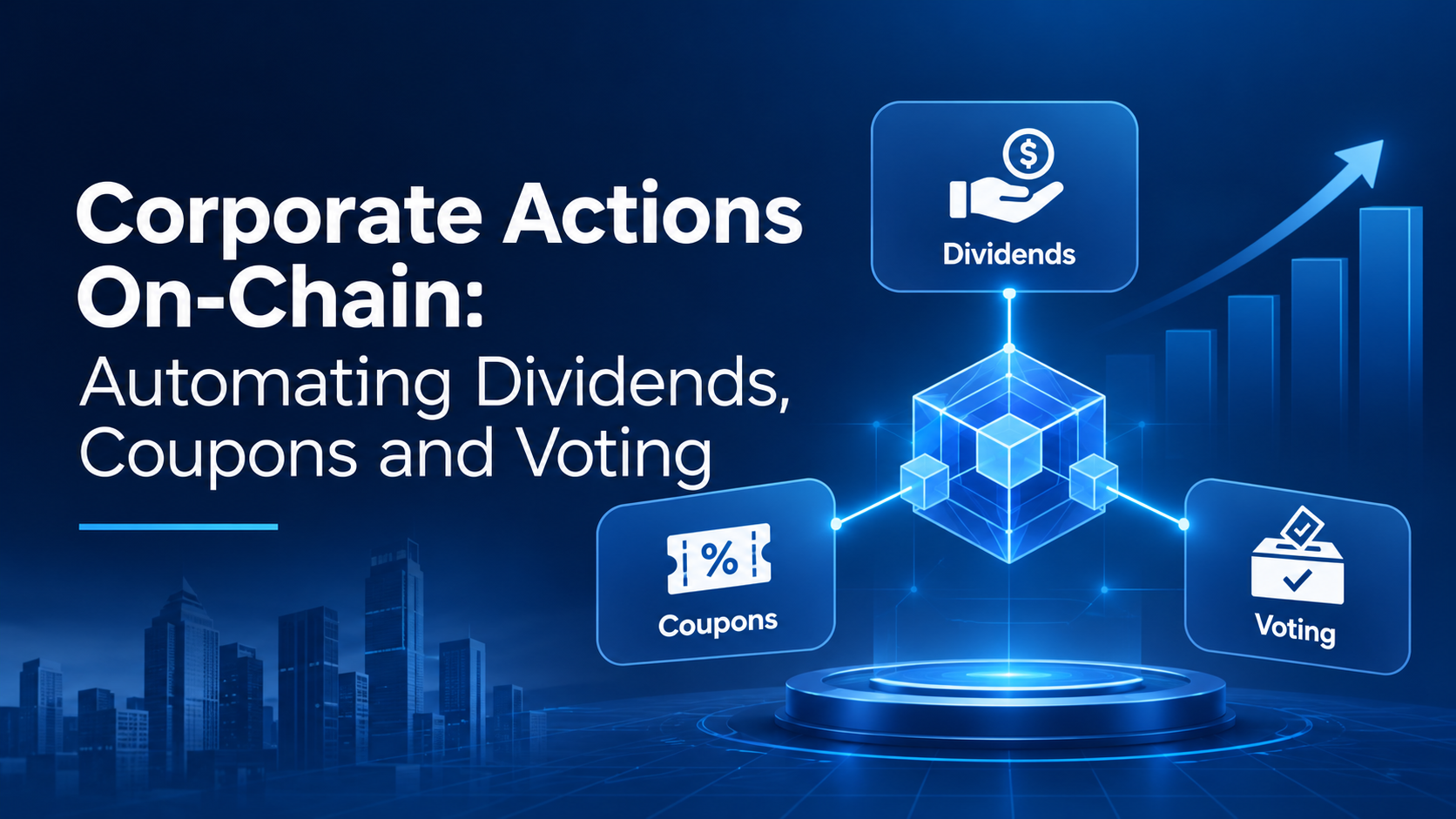
A practical guide for issuers, asset managers, custodians, and market infrastructure teams exploring how smart contracts can modernize securities servicing.
Why Corporate Actions Need Modernization
Buying a security is the visible part of owning it. The less visible part is everything that happens afterward: a dividend is declared, a bond pays a coupon, shareholders are asked to vote, a stock splits, a rights offer opens, a bond reaches maturity. These events are called corporate actions, and they determine what investors actually receive and what rights they can exercise.
In traditional markets, a single event can pass through issuers, paying agents, custodians, sub-custodians, brokers, transfer agents, and investors, each with its own records and systems. Information is passed along in sequence, re-keyed, matched, and reconciled. When it works, nobody notices. When it does not, investors receive the wrong amount, receive it late, or miss a deadline for a decision.
Tokenization offers a different foundation. When a security is represented as a digital token on a shared ledger, ownership records, transfer history, and business rules can live in one place. That makes it possible to automate parts of the corporate action lifecycle with smart contracts. This is the idea behind corporate actions on blockchain: using programmable, auditable infrastructure to calculate entitlements, trigger approved payments, and record shareholder decisions with fewer manual steps.
This guide explains how on-chain corporate actions work, where they add value, what they do not replace, and how enterprises can approach implementation. Where examples are hypothetical, they are labeled as such.
What Are Corporate Actions?
Corporate actions are events initiated by an issuer that affect a security, the rights attached to it, or the entitlements of its holders. The most common categories include:
- Cash dividends: distributions of profit to shareholders in cash.
- Stock dividends: distributions of additional shares instead of cash.
- Bond coupon payments: periodic interest paid to bondholders under the bond's terms.
- Shareholder voting: decisions on matters such as director elections, mergers, or governance changes.
- Stock splits and reverse splits: changes to the number of shares in issue, with a proportional change in price per share.
- Rights issues: offers allowing existing holders to buy additional securities, often at a set price.
- Redemptions and maturity payments: repayment of principal when a bond matures or is called.
- Mergers and acquisitions: events that change or exchange the securities holders own.
Mandatory, voluntary, and mandatory-with-choice
Corporate actions are also classified by whether the holder must act:
This distinction matters for automation. Mandatory events lend themselves to straightforward rule-based execution. Voluntary and mandatory-with-choice events require reliable ways to capture, verify, and deadline-manage investor instructions.
Challenges in Traditional Corporate Action Processing
Conventional workflows were built for a world of paper certificates and layered intermediaries. Several limitations persist:
- Fragmented systems. Issuers, custodians, brokers, and transfer agents each maintain their own records, which must be aligned for every event.
- Manual reconciliation. Teams match positions and entitlements across sources, and discrepancies must be investigated by hand.
- Delayed distributions. Information moves through chains of intermediaries, which can slow the path from announcement to payment.
- Entitlement errors. If holdings data differs between parties on the record date, calculated entitlements can differ too.
- Record-date and ex-date complexity. Determining who is entitled depends on precise cut-offs and settlement timing.
- Cross-border coordination. Payments, tax treatment, and local market practices vary by jurisdiction.
- Limited real-time visibility. Investors and issuers often cannot easily see where an event stands in the processing chain.
- High administrative cost. Manual handling and reconciliation consume operational resources.
- Inefficient shareholder communication. Notices, proxy materials, and voting instructions may pass through several parties before reaching the end holder.
For institutional investors, these frictions mean uncertainty over timing and amounts, and operational risk. For issuers, they mean cost, reputational exposure when errors occur, and reduced visibility into who actually holds their securities.
What Are On-Chain Corporate Actions?
On-chain corporate actions are corporate action events whose key steps are recorded and, where appropriate, executed through blockchain-based infrastructure. They typically rely on four building blocks:
- A shared ownership record. Tokenized securities record who holds what, and the full history of transfers, on a ledger that authorized participants can rely on.
- Smart contracts. Code that encodes the rules of an event, such as eligibility, calculation formulas, deadlines, and approval conditions.
- Verified ownership snapshots. A point-in-time record of holdings at the relevant record date, which becomes the basis for entitlements.
- Trusted data inputs. External information, such as declared dividend amounts, exchange rates, or tax rates, supplied through controlled interfaces or approved oracles.
Issuers and authorized participants can initiate an event, approvers can review it, and stakeholders can monitor status from a common record, rather than relying on sequential messages between separate systems.
What blockchain does not replace
Automation does not remove the need for legal validation, corporate governance, or regulated payment infrastructure. A board still declares a dividend. Legal terms still define bondholder rights. Cash still moves through banking and payment rails, or through regulated digital settlement mechanisms where those exist. Smart contracts execute and record what has been properly authorized; they do not replace the authority behind the instruction.
How Blockchain Automates Dividends, Coupons and Voting
A. Automated Dividend Distribution
A typical automated dividend distribution workflow for tokenized equity follows these steps:
- Capture the record date. The smart contract or its connected application takes a snapshot of token balances at the declared record date.
- Identify eligible holders. Only verified, eligible holders on the snapshot are included; transfer restrictions and identity data help ensure the list is accurate.
- Calculate entitlements. The dividend per token is multiplied by each holder's balance.
- Apply tax and other rules. Withholding tax or other deductions are applied based on holder profiles and applicable rules supplied to the system.
- Initiate approved distribution. After required approvals, the smart contract triggers payment instructions or releases funds through the connected settlement mechanism.
- Record status on-chain. Payment status, amounts, and timestamps are written to the ledger for audit and reconciliation.
Hypothetical example. A company has issued 1,000,000 tokenized shares. Its board declares a dividend of $0.50 per share. An investor holds 20,000 tokens on the record date.
- Gross dividend: 20,000 × $0.50 = $10,000
- Illustrative withholding rate for this investor's profile: 10%, or $1,000
- Net payment: $9,000
The same calculation runs for every holder in the snapshot, the results are recorded, and the issuer can see which payments are completed and which are pending or have failed. The 10% rate here is purely illustrative; actual rates depend on jurisdiction and holder status.
B. Automated Bond Coupon Payments
Tokenized bond coupon payments follow a similar pattern, with the added advantage that coupon terms are known in advance and can be stored with the instrument:
- Represent the bond as tokens. Each token represents a defined portion of the bond's principal.
- Store coupon schedules and terms. Rate, frequency, payment dates, and day-count conventions are held in the instrument's configuration.
- Identify eligible bondholders. A snapshot on the relevant record date determines who is entitled.
- Calculate entitlements. Coupon per token is derived from the terms and applied to each holder's balance.
- Automate payment instructions. Instructions are generated and, after approval, executed.
- Record distributions and obligations. The ledger shows what has been paid, what remains outstanding, and the next scheduled payment.
Hypothetical numerical example. A company issues a tokenized bond with the following terms:
| Parameter |
Value |
| Principal |
$10,000,000 |
| Token denomination |
$1,000 per token (10,000 tokens) |
| Coupon rate |
6% per year |
| Payment frequency |
Semi-annual |
- Annual coupon: $10,000,000 × 6% = $600,000
- Coupon per payment date: $600,000 ÷ 2 = $300,000
- Coupon per token per period: $300,000 ÷ 10,000 = $30
- An investor holding 250 tokens receives 250 × $30 = $7,500 per payment date
Because the schedule and terms are stored with the instrument, the system can calculate every holder's coupon from the record-date snapshot and track which payments have been made, which remain open, and how much principal is still outstanding.
C. On-Chain Shareholder Voting
On-chain shareholder voting applies the same principles to governance:
- Verify eligible identities. Only verified holders can participate, supported by identity and access controls.
- Determine voting rights. Rights are derived from holdings at the voting record date, according to the security's terms, such as one vote per share or class-specific rules.
- Create digital voting records. Each vote is recorded in a tamper-evident form linked to a verified holder.
- Enable secure and auditable voting. Participation and results can be audited without exposing more information than governance rules allow.
- Record outcomes. Final tallies are written to the ledger.
- Support proxy and governance workflows. Where legally permitted, holders can delegate voting rights and instructions can be tracked.
Blockchain can improve transparency and make participation easier, particularly for dispersed holders. But an on-chain vote is not automatically legally binding. Whether it satisfies the requirements for a shareholder meeting or resolution depends on the issuer's governing documents and the applicable law, which must be confirmed with legal counsel.
How Smart Contracts Power Corporate Action Automation
A well-designed workflow moves through a consistent sequence, regardless of the event type:
Components that make it work
- Smart contract logic. Encodes eligibility rules, formulas, deadlines, and state transitions so that the same event is processed consistently.
- Token ownership records. Provide the authoritative holdings data used for snapshots and entitlements.
- Permission management. Defines who can announce, approve, or execute an event, which is essential for segregation of duties.
- Oracle integrations. Bring in external data, such as exchange rates or declared amounts, through controlled and validated channels.
- Identity verification. Links wallet addresses or accounts to verified legal entities, supporting eligibility and compliance checks.
- Audit trails. Every step is time-stamped and attributable, simplifying review.
- Exception handling and manual intervention. Real-world events involve disputes, failed payments, corrections, and legal changes. Workflows need defined paths for pausing, correcting, and escalating, with human approval where appropriate.
On-Chain vs. Traditional Corporate Actions: Key Differences
These differences should be read carefully. On-chain processing can reduce duplication and improve visibility, but it does not automatically remove intermediaries. Custodians, paying agents, transfer agents, and regulators continue to play roles, and many events will still rely on off-chain legal and payment processes.
Benefits of Automating Corporate Actions Through Blockchain
Where tokenized securities and well-governed smart contract workflows are in place, institutions can expect benefits such as:
- Reduced manual processing. Repeatable steps, such as calculating coupons for every holder, are handled by code, freeing teams to focus on exceptions. Use case: a private credit manager servicing hundreds of investor positions each quarter.
- More accurate entitlement calculations. A single ownership record and fixed formulas reduce the chance of mismatched figures. Use case: a dividend run for a company with a dispersed investor base.
- Faster distribution workflows. Fewer hand-offs between announcement and payment instruction can shorten processing time, subject to the speed of the payment rails. Use case: coupon instructions generated immediately after approval.
- Improved ownership transparency. Issuers can see current holders more directly. Use case: a private equity firm tracking its investor register.
- Better auditability. Every event has a recorded sequence of actions and approvers. Use case: internal audit reviewing a bond servicing cycle.
- Reduced reconciliation complexity. Shared records mean fewer discrepancies to resolve. Use case: a custodian matching positions against an issuer's register.
- Improved investor experience. Investors gain clearer visibility into entitlements, status, and voting options. Use case: a real estate investor checking an income distribution.
- Programmable compliance controls. Eligibility and transfer rules can be enforced as part of the workflow. Use case: restricting distributions to verified, eligible holders.
- More efficient lifecycle management. Issuance, servicing, and redemption can be managed within one framework. Use case: a tokenized bond from issuance to maturity.
- Greater operational visibility. Dashboards and shared records show where each event stands. Use case: treasury teams monitoring pending payments.
Regulatory, Security and Operational Considerations
Automation increases the importance of getting the foundations right. Enterprises should address:
- Securities laws and investor protection. Tokenized securities remain securities. Issuance, transfer, disclosure, and servicing obligations continue to apply.
- Shareholder and bondholder rights. Automated workflows must respect the rights set out in the instrument's legal documentation.
- KYC and AML. Participant identity and screening requirements apply to token holders and counterparties.
- Data privacy and confidentiality. Holder data and transaction details must be protected in line with applicable privacy rules and commercial expectations.
- Record-date and entitlement accuracy. Snapshot logic, transfer timing, and cut-off rules must be tested rigorously.
- Smart contract audits. Independent review of contract code is essential before deployment, particularly for logic that moves funds.
- Payment system integration. Cash movements typically rely on banking, payment, or settlement infrastructure that must connect reliably to the workflow.
- Custodian and transfer agent responsibilities. Roles must be clearly defined between on-chain workflows and existing intermediaries.
- Dispute resolution and exception handling. There must be clear procedures for corrections, reversals where permitted, and escalation.
- Legal recognition of digital voting and records. Whether on-chain records and votes are recognized depends on jurisdiction and the issuer's governing documents.
Regulatory obligations vary by jurisdiction, security type, and transaction structure. Organizations should obtain legal and compliance advice for each program rather than assuming that requirements are uniform.
Real-World Enterprise Use Cases
The following scenarios illustrate how on-chain corporate action automation could be applied. Unless stated otherwise, they are hypothetical illustrations of potential applications, not descriptions of specific live deployments.
In each case, the value comes from linking accurate ownership records to rules that are executed consistently and recorded transparently, while retaining human approval and legal oversight where required.
How Enterprises Can Implement On-Chain Corporate Actions
A phased approach helps organizations manage legal, technical, and operational risk:
- Identify corporate action requirements. Determine which events matter most, such as dividends, coupons, voting, or redemptions, and how often they occur.
- Define the legal and ownership structure. Clarify what each token represents, who holds legal title, and how rights are documented.
- Select the blockchain architecture. Choose a permissioned, public, or hybrid model based on privacy, compliance, investor access, and interoperability needs.
- Design digital securities and ownership records. Define token structures, holder data, transfer restrictions, and the data required for snapshots.
- Configure smart contract workflows. Encode event logic, calculation rules, approval stages, and exception paths.
- Integrate identity, compliance, and payment systems. Connect KYC providers, compliance tools, custodians, and payment infrastructure.
- Establish governance and approval mechanisms. Assign roles, approval thresholds, and escalation procedures.
- Test calculations and payment execution. Run simulations covering record-date edge cases, failed payments, and corrections before going live.
- Deploy with monitoring and exception management. Launch with audit logging, alerts, and a clear process for manual intervention.
Why institutional use cases often favor permissioned infrastructure
Institutional programs typically involve regulated participants, confidential investor and deal data, and a need for defined governance. Permissioned blockchain infrastructure provides identity-based access, controlled participation, and configurable governance, which align with those requirements. Public or hybrid connectivity can be added where wider distribution or interoperability is a business goal, but the operational core of a regulated corporate action workflow often benefits from controlled access.
How Spydra Enables Enterprise Tokenization and Automated Asset Workflows
Spydra is an enterprise-grade, low-code RWA tokenization platform built on Hyperledger Fabric. For organizations exploring automated corporate action workflows, it provides infrastructure that addresses several of the foundations described above:
- Digital securities and asset tokenization workflows. Support for representing real-world assets as digital tokens within a managed framework.
- Permissioned network architecture. A controlled-access foundation suited to regulated participants and confidential data.
- Configurable business rules and smart contract workflows. Low-code configuration helps teams define how assets behave and how processes are approved.
- Identity and access management. Verified participants and role-based permissions support eligibility checks and segregation of duties.
- Compliance-oriented transaction processes. Approval steps and audit trails can be built into how assets are issued and transferred.
- Asset lifecycle management. Lifecycle events can be handled within a consistent environment.
- API-based enterprise integrations. Connections to existing custody, accounting, payment, and investor management systems.
- Private and public blockchain ecosystem connectivity. Options to operate in a permissioned environment while connecting to public ecosystems where strategy requires it.
These capabilities can serve as the infrastructure layer for organizations designing automated dividend, coupon, or voting workflows. The specific corporate action logic, such as record-date snapshots, entitlement formulas, and approval flows, is typically defined according to each organization's instruments, legal structure, and jurisdiction. Whether a given workflow is available as a configured template or requires tailored configuration should be confirmed with Spydra directly during requirements discussions.
Explore how Spydra can help modernize enterprise asset tokenization and digital securities workflows. Book a demo to discuss your requirements.
Conclusion: The Future of Corporate Actions Is Programmable
Corporate actions are among the most operationally demanding parts of the securities lifecycle, and also among the most rule-driven, which makes them well suited to automation. Corporate actions on blockchain bring together shared ownership records, programmable rules, and auditable execution, so that dividends, coupons, and votes can be calculated, approved, and tracked with less duplication and greater transparency.
The benefits depend on the surrounding framework. Legal documentation, regulatory compliance, governance, secure payment integration, and sound exception handling remain essential. Blockchain does not replace these; it gives them a more consistent technical foundation.
For institutions modernizing securities lifecycle management, the practical next step is to evaluate enterprise-ready tokenization infrastructure: how it manages identity, permissions, workflows, integrations, and auditability. With that foundation in place, programmable corporate actions become a realistic extension of digital securities rather than an experiment.
Frequently Asked Questions
1. What are corporate actions in blockchain?
Corporate actions in blockchain are events such as dividends, coupon payments, votes, splits, and redemptions that are recorded and, where appropriate, executed using tokenized securities and smart contracts. The blockchain provides the ownership record and an auditable history of each step.
2. How does blockchain automate dividend payments?
A smart contract captures a snapshot of token holders on the record date, calculates each holder's entitlement from their balance, applies configured tax or compliance rules, and triggers approved payment instructions. Results and payment statuses are recorded on the ledger. Payments still rely on connected banking or settlement infrastructure.
3. Can smart contracts automate bond coupon payments?
Yes, in principle. Coupon rate, frequency, and payment dates can be stored with a tokenized bond, and a smart contract can calculate each holder's coupon from a record-date snapshot. For example, a $10,000,000 bond with a 6% semi-annual coupon produces $300,000 per period, or $30 per $1,000 token. Payment execution depends on integrated payment infrastructure and approvals.
4. How does on-chain shareholder voting work?
Eligible, verified holders are identified, voting rights are determined from holdings at the record date, and votes are recorded as tamper-evident entries on the ledger. Results are tallied and stored. Legal recognition of the vote depends on jurisdiction and the issuer's governing documents.
5. What are the benefits of automating corporate actions?
Benefits include reduced manual processing, more accurate entitlement calculations, improved transparency, stronger audit trails, simpler reconciliation, programmable compliance controls, and better visibility for issuers and investors. Exceptions and legal oversight still require human involvement.
6. Are on-chain corporate actions legally recognized?
It depends. Legal treatment varies by jurisdiction, security type, and structure. Some processes may be recognized when supported by appropriate legal documentation and regulatory compliance, while others may still require traditional records or approvals. Organizations should seek legal advice for each program.
7. How does tokenization improve securities lifecycle management?
Tokenization places ownership records, transfer rules, and event logic in one shared, programmable environment. This supports consistent issuance, servicing, corporate actions, and redemption, with better visibility and audit trails across the lifecycle.
8. What role do smart contracts play in corporate action processing?
Smart contracts encode the rules of an event, including eligibility, calculation, approval conditions, and execution steps. They process these rules consistently against on-chain ownership data and record the results. They work alongside, not instead of, legal validation, governance, and regulated payment systems.