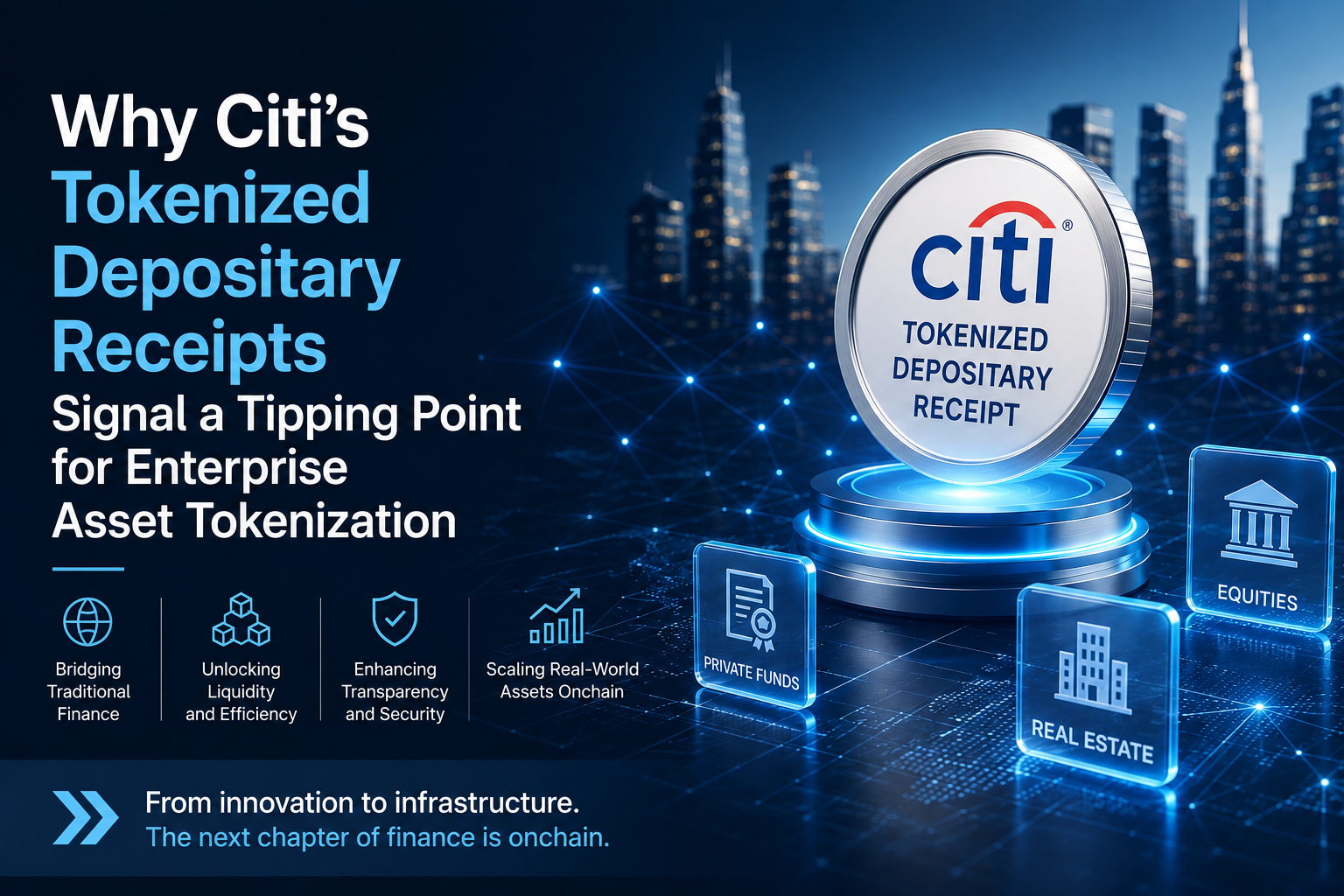
When Citi—one of the world's leading global banks—announces a market-first tokenized product, the industry listens. On June 11, 2026, Citi launched digital depositary receipts on company shares, marking the first time a global financial services company has acted as both issuer and custodian for tokenized depositary receipts.
But this isn’t just a story aboutCiti, or even about depositary receipts. It’s a signal about where enterprise capital markets infrastructure is heading—and why enterprises across sectors need to be thinking about tokenization today, not tomorrow.
Depositary receipts are a decades-old financial instrument—American Depositary Receipts (ADRs) have allowed US investors to hold foreign equities for over a century. What Citi has done is take this trusted, well-understood structure and rebuild it on blockchain infrastructure.
The key innovation: Citi's Digital Depositary Receipts use blockchain infrastructure operated by SIX—one of the world's first fully regulated digital central securities depositories—to tokenize private company shares. Citi acts as both the issuer and custodian of the tokenized receipts, removing the need for third-party SPV structures that have historically added complexity and opacity to private market transactions.
Private company secondaries have long been one of the most inefficient corners of capital markets. As IPO windows extend, employees, early investors, and founders can find themselves holding illiquid positions for extended periods with limited exit options.
Existing workarounds involve navigating SPV structures, multiple intermediaries, inconsistent fee disclosures, and cap table complexity. Citi’s model directly addresses these friction points by providing the following:
• A single, trusted issuer-custodian relationship
• Blockchain-based settlement via a regulated digital CSD
• Direct investor access through familiar DR structures
• Simplified cap tablemanagement for the issuing company
The significance of Citi’s move extends well beyond private market equity. When an institution with Citi's regulatory standing, operational scale, and risk management rigor commits publicly to tokenized infrastructure, it sets a precedent across asset classes.
Skeptics of asset tokenization have long argued that the technology is immature, the regulatory environment unclear, and the use cases speculative. Citi’s launch addresses all three objections simultaneously: it is live, it is regulated, and it is solving a real liquidity problem for real companies.
The logic that makes tokenized DRs compelling for private equity applies equally to other real-world assets: invoices, trade finance instruments, supply chain assets, certificates, carbon credits, and more. The common thread is always the same—assets that are currently illiquid, paper-heavy, or intermediary-dependent become programmable, transferable, and transparent when tokenized.
Here is the critical insight: you do not need to be Citi to benefit from tokenized infrastructure. The capabilities Citi is demonstrating—programmable ownership, smart contract automation, permissioned access control, and transparent settlement—are available to enterprises of all sizes through platforms like Spydra.
Citi uses SIX’s regulated digital CSD as its blockchain layer. Enterprises using Spydra deploy on Hyperledger Fabric—a permissioned, enterprise-grade blockchain purpose-built for regulated, multi-party workflows. Both approaches share the same foundational principle: controlled, auditable, institution-grade tokenization infrastructure.
Spydra is a low-code enterprise asset tokenization platform built on Hyperledger Fabric. Unlike public blockchain platforms, Hyperledger Fabric is a permissioned network—meaning access, transaction visibility, and governance are controlled by the deploying organization, which is exactly what regulated enterprise use cases require. Enterprises can deploy tokenization use cases in under 30 minutes without deep blockchain development expertise.
Spydra has processed over 100 million transactions and supports 50 million+ assets on-chain, with clients including ICICI Bank, Bajaj Finserv, Bosch, and Jio—delivering up to 90% reduction in operational costs for tokenized asset workflows.
Where Citi’s solution is a capital markets product built for institutional investors, Spydra is the infrastructure platform that enterprises use to build their own tokenization solutions. Think of it as the difference between a bank product and the core banking infrastructure—Spydra gives enterprises the latter: a low-code token engine, programmable smart contracts, asset lifecycle automation, and API integration with existing enterprise systems.
Q: What are tokenized depositary receipts?
Tokenized depositary receipts are blockchain-based digital representations of ownership in a company’s shares. They work similarly to traditional depositary receipts (like ADRs) but are issued and settled on a blockchain, enabling faster transfer, greater transparency, and reduced intermediary costs.
Q: Why did Citi launch tokenized depositary receipts for private companies?
As IPO timelines extend, private companies need alternative liquidity pathways. Citi’s solution addresses fragmented secondary markets by providing an institutional-grade, transparent digital instrument that connects private issuers directly with investors—without the complexity of SPV structures.
Q: How does Spydra differ from Citi’s tokenization approach?
Citi's solution is a regulated capital markets product for institutional investors. Spydra provides the permissioned blockchain infrastructure layer—built on Hyperledger Fabric—that enterprises across industries can use to tokenize real-world assets, automate lifecycle management, and integrate with existing systems. existing systems. Spydra is the platform; enterprises build their own tokenization solutions on top of it.
Q: What types of assets can enterprises tokenize on Spydra?
Spydra supports tokenization of a wide range of real-world assets, including financial instruments, supply chain assets, invoices, certificates, loyalty points,carbon credits, and more—all on a permissioned Hyperledger Fabric network designed for enterprise compliance and scalability.
Q: Is asset tokenization only for large financial institutions?
No. While institutions like Citi are demonstrating the model at scale, platforms like Spydra make enterprise-grade tokenization accessible to companies of all sizes. The core infrastructure—permissioned blockchain, smart contract automation, and low-code asset lifecycle management—is available today without needing to be a Tier-1 bank.
Citi’s tokenized depositary receipts are not an experiment—they are a production system solving a real problem for real companies, backed by one of the world’s leading global banks. That matters.
For enterprise leaders, the message is clear: the infrastructure to tokenize real-world assets is no longer speculative. It is proven, permissioned, and production-ready. The question is not whether to build tokenization capabilities—it is how quickly you can move from evaluation to deployment.
Spydra exists to help enterprises answer that question with speed, compliance, and confidence.