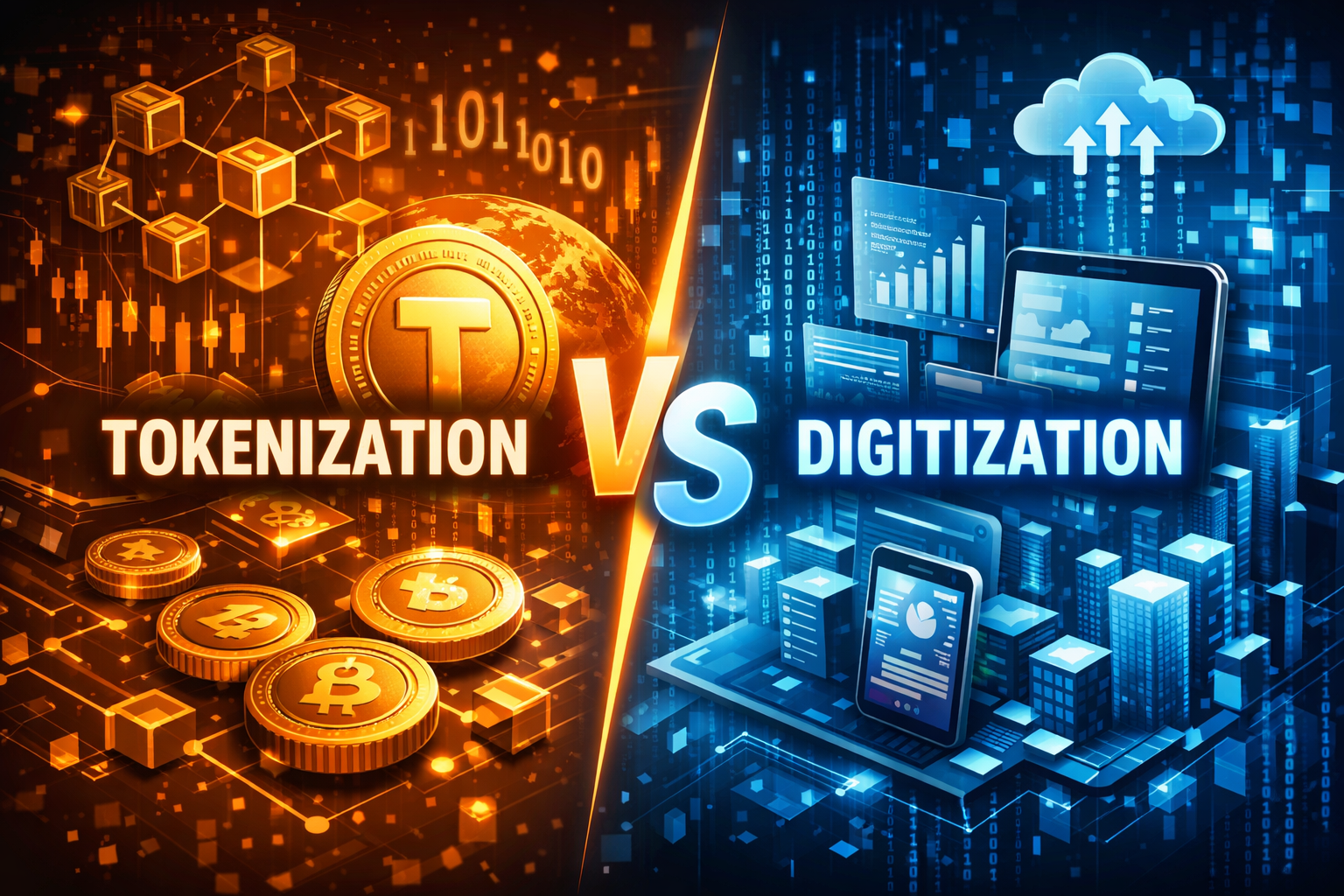
As industries continue to modernize, organizations across finance, real estate, supply chains, and trade are rapidly digitizing their assets and records. Documents that once existed in paper form—contracts, property records, certificates, and invoices—are now stored as digital files. While digitization improves efficiency and accessibility, it does not fundamentally change how assets are owned, traded, or financed.
This is where tokenization introduces a transformative shift. In the debate of tokenization vs digitization, the core difference lies in liquidity and programmability. Digitization simply converts physical information into digital formats, whereas tokenization represents real-world assets as blockchain-based tokens that can be traded, fractionally owned, and automatically settled.
As financial markets increasingly explore real-world asset (RWA) tokenization, the ability to unlock liquidity from traditionally illiquid assets is becoming a major driver of innovation. Platforms like Spydra are helping enterprises move beyond simple digitization toward compliant, scalable tokenization infrastructures.
Digitization refers to the process of converting physical records or analog information into digital formats. This could include scanning paper documents, storing contracts in digital databases, or transforming physical certificates into electronic files.
For example, digitizing property records means that land ownership documents are stored electronically rather than physically. While this improves administrative efficiency, the property itself remains difficult to trade or divide among multiple investors.
In essence, digitization modernizes documentation but does not fundamentally transform the financial infrastructure surrounding the asset.
Tokenization goes a step further by converting real-world assets into blockchain-based digital tokens. These tokens represent ownership or rights to an asset and can be issued, transferred, and managed on a distributed ledger.
Tokenization introduces several capabilities that digitization cannot provide.
For instance, instead of merely digitizing a property deed, tokenization allows the property to be represented by digital tokens that investors can buy, sell, or trade. This creates entirely new opportunities for liquidity and investment.
Tokenization effectively transforms static assets into programmable financial instruments.
Understanding the distinction between tokenization and digitization is critical for organizations evaluating digital asset strategies.
While digitization improves operational efficiency, tokenization fundamentally changes how assets are managed, financed, and traded.
Many valuable assets remain illiquid because they are difficult to divide, transfer, or trade efficiently. Examples include real estate, private equity investments, commodities, and trade finance assets.
Tokenization addresses these challenges by introducing several key mechanisms.
Tokenization allows assets to be divided into smaller units represented by tokens. This enables multiple investors to participate in assets that were previously accessible only to large institutional investors.
For example, a commercial property valued at $10 million could be divided into thousands of tokens, allowing smaller investors to participate in ownership.
Blockchain-based assets can be accessed by investors across geographic boundaries, expanding potential markets and improving capital availability.
Traditional financial systems rely on intermediaries such as clearing houses and custodians. Tokenization enables near-instant settlement through smart contracts.
By automating many transaction processes, tokenization reduces reliance on intermediaries, lowering operational costs and improving efficiency.
Blockchain technology provides transparent and immutable transaction records, enhancing trust and simplifying auditing processes.
These capabilities collectively unlock liquidity for assets that historically have been difficult to trade.
As digital asset markets evolve, regulatory compliance becomes critical for institutional adoption. Tokenized assets must adhere to financial regulations, investor protection standards, and anti-money-laundering requirements.
Regulatory frameworks from authorities such as the Securities and Exchange Commission and the Financial Conduct Authority highlight the importance of compliance in digital asset issuance and trading.
Key components of tokenization compliance include:
By embedding these controls into smart contracts and token infrastructures, organizations can ensure regulatory alignment while maintaining the efficiency benefits of blockchain systems.
Enterprise adoption of tokenization requires robust infrastructure that combines security, scalability, and regulatory readiness.
Spydra provides a low-code platform designed to simplify the creation and management of tokenized assets for enterprises.
Key capabilities include:
Organizations can create and manage digital assets without extensive blockchain development expertise.
Compliance mechanisms such as identity verification, access controls, and regulatory rule enforcement are integrated directly into the tokenization process.
The platform ensures enterprise-grade security through encryption, permissioned networks, and secure asset management.
Spydra enables enterprises to deploy tokenized asset solutions that can scale across industries such as finance, real estate, and trade.
By providing these capabilities, Spydra helps organizations transition from simple asset digitization to fully functional tokenized ecosystems.
Tokenization is rapidly gaining traction across financial markets. Analysts increasingly view tokenization as a foundational technology for the next generation of capital markets.
Several sectors are already exploring tokenized asset models:
As regulatory frameworks mature and enterprise adoption grows, tokenization could unlock trillions of dollars in previously illiquid assets.
Digitization was the first step toward modernizing financial systems, but tokenization represents the next stage in transforming how assets are issued, traded, and financed.
The debate around tokenization vs digitization highlights an important distinction in the evolution of digital finance. While digitization improves efficiency by converting physical records into digital formats, it does not fundamentally change asset liquidity or ownership structures.
Tokenization, on the other hand, enables programmable assets that can be fractionally owned, globally traded, and automatically settled on blockchain networks. By unlocking liquidity and improving transparency, tokenization opens new opportunities for investors and enterprises alike.